

Estimated Reading Time
18 minutes
Key Takeaways
- This end-to-end ai agent development guide shows CTOs how to move from concept to production value with guardrails, observability, and ROI discipline.
- Anchor on a KPI, implement a model gateway, and orchestrate tools with schemas, policies, and audits to control risk and cost.
- Adopt a graph-based agent loop with hybrid RAG, short/long-term memory, and layered safety to minimize hallucinations and drift.
- Voice is special: if how to build an ai voice agent is on your roadmap, design for latency, barge-in, and dialog state from day one.
- Operational success comes from evals-in-CI, canaries and rollbacks, step caps, and dashboards for success rate, p95 latency, and cost/success.
- GTM matters: align docs and pages to search intent so buyers find your capability as it ships—use the research sources and workflows provided.
Introduction: Why This AI Agent Development Guide Matters Now
AI agent development is shifting from labs to line-of-business outcomes. If you plan to ship within 3–9 months, this AI agent development guide compresses the path from architecture to deployment—fast, safe, and cost-effective. And if how to build an ai voice agent is top of mind for support or sales, you’ll find a practical, implementation-first section on telephony, ASR, dialog policy, TTS, and turn-taking with concrete test patterns.
What AI Agents Are (and Why They Matter for Your Roadmap)
In short, an AI agent is a software system that uses an LLM as a policy to perceive context, plan, and execute actions via tools in an iterative loop:
- Observe: Ingest user input and relevant context (history, retrieved knowledge, system constraints).
- Reason: Select goals and next steps; plan with hidden chain-of-thought and explicit tool calls.
- Act: Call tools/APIs, mutate state, or produce structured outputs.
- Reflect: Evaluate progress, critique errors, iterate or terminate.
Assistants vs. tool-using vs. autonomous agents
- Assistants (co-pilots): Draft and respond; low risk, easy to audit.
- Tool-using agents: Invoke constrained tools under least-privilege; controllable via schemas and policies.
- Autonomous agents: Multi-step with minimal oversight; require strict caps, reviews, and incident playbooks.
Business outcomes you can forecast
- Support: L1/L2 deflection, faster time-to-first-response, SLA adherence, lower cost per resolution.
- Back office: Invoice matching, payroll queries, procurement entry, claims triage.
- Sales ops: Lead enrichment, activity summarization, CRM hygiene.
- Engineering/IT: Runbook execution, changelog summaries, incident comms, internal search.
- Outcomes: Reduced handle time, improved compliance, lower opex, faster internal automation.
Case example: Mid-market fintech
Objective: Deflect 35% of L1 support and cut AHT by 25%.
Solution: Tool-using agent integrated with Zendesk, KMS-backed secrets, and a RAG layer over policy docs and product FAQs.
Results (60-day pilot): 38% deflection, p95 E2E latency 2.7s, $0.47 cost/resolved vs $2.10 baseline, SLA breach rate down 19%.
Risk controls: PII redaction, strict function schemas, billing tool kill-switch.
Reference Architecture for Production-Grade AI Agents
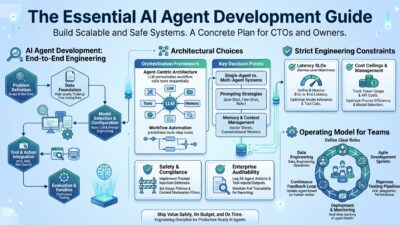
Design for production means separating concerns, constraining failure domains, and instrumenting everything. See the reference in the ai agent development architecture guide.
Textual diagram (layers and responsibilities)
- Edge and API: API Gateway → AuthN/AuthZ → Feature flags
- Orchestration layer: Agent graph (LangGraph/AutoGen) with state store; tracing hooks (OpenTelemetry) around every step
- Policy/model gateway: Model router (OpenAI, Anthropic, Google, Azure OpenAI); token budgeter, safety selector, rate limiter
- Tools/actions: Function-calling adapters with JSON Schemas; isolated workers with egress rules; vendor APIs
- Knowledge/RAG: Ingestion → embeddings → vector DB; hybrid retrieval (BM25 + dense) with freshness and citations
- Memory: Short-term buffer; long-term episodic/semantic memory with decay/eviction
- Safety/compliance: PII scrubbing, jailbreak filters, allow/deny action policy, audit logs
- Observability and evals: LangSmith/LlamaIndex; traces, spans, scenario tests; dashboards for success rate, tool error rate, hallucination rate, p95 latency, cost/task
- Platform: CI/CD, rollbacks, canaries; queues and backpressure; secrets vault and regional data controls
Component notes and decision criteria
- Policy/model: Choose by latency, context window, function-calling reliability, cost/1k tokens, safety profile; define fallbacks and smart routing (cheap-first then escalate-on-fail).
- Orchestration: Prefer graph-based orchestration for multi-step workflows and retries.
- Tools/actions: Enforce JSON Schemas and preconditions; gate side effects with confirmations/dual-control.
- Knowledge/RAG: Hybrid search + reranking; coherent chunking (300–800 tokens, overlap); return citations.
- Memory: Persist long-term only if it improves measured success; otherwise reset to curb drift.
- Safety/compliance: Layered guardrails: PII redaction, toxicity filters, jailbreak mitigation, output normalization, audited tool calls.
- Evaluation/tracing: Unit evals, scenario suites, online metrics; capture spans per reasoning step and tool call.
- Platform: Treat model gateway as a separate service; canaries, blue/green, PromptOps feature flags with instant rollback.
Blueprint: The CTO’s AI Agent Development Guide (From MVP to V1.0)
Use this sequenced playbook (adapted from the ai agent development guide blueprint).
Step 0 — Problem framing and KPIs
- Pick one objective (e.g., reduce support backlog 30% in 90 days).
- Define guardrails (no PII exfiltration; tool kill switches).
- Acceptance: task success ≥85%, cost/success ≤$0.75, p95 ≤3.0 s tool calls.
Step 1 — Data inventory and governance
- Map systems of record; classify PII/PCI/HIPAA/GDPR; retention and consent flows.
Step 2 — Model policy selection (why SLMs matter)
- Scorecard: latency, quality on golden set, function-calling reliability, cost, safety.
- Configure temperature, max tokens, stops per SLA/budget.
- Define fallbacks, circuit breakers, and escalation rules.
Step 3 — Tool design
- Define atomic tools per user story; JSON Schemas with enums/min-max; validate inputs.
- Isolate side effects; ensure idempotency and compensating actions.
Example function schema (payment verification)
{
  "name": "verify_payment_token",
  "description": "Verify a tokenized payment and return non-PCI status only",
  "parameters": {
    "type": "object",
    "properties": {
      "customer_id": {"type": "string", "pattern": "^[A-Z0-9_-]{6,}$"},
      "payment_token": {"type": "string", "minLength": 16, "maxLength": 64},
      "amount_cents": {"type": "integer", "minimum": 1, "maximum": 500000}
    },
    "required": ["customer_id", "payment_token", "amount_cents"],
    "additionalProperties": false
  }
}
Step 4 — Knowledge/RAG
- Ingest authoritative sources with owner/updated_at/visibility metadata.
- Pick embeddings for your domain; test cosine similarity distributions.
- Tune chunking (300–800 tokens, 10–20% overlap); add recency filters and return citations.
Retrieval helper (pseudocode)
def retrieve(query, k=6):
    dense = vector_search(query, k=12)
    bm25 = bm25_search(query, k=12)
    ranked = reciprocal_rank_fusion(dense, bm25)
    reranked = cross_encoder_rerank(query, ranked)
    return dedupe_topk(reranked, k=6)
Step 5 — Prompt/system design
- Write tight role/objectives; include tool instructions and schemas inline.
- Define refusal/escalation; cite sources; hide chain-of-thought.
Step 6 — Agent control loop
- Pick ReAct/MRKL/Reflexion variants; step caps (e.g., max 6 tool calls) and termination conditions.
- Self-critique + targeted retry (fix 4xx once; else escalate).
Step 7 — Offline evaluation
- Golden tasks + adversarial prompts; hallucination traps; calibrate LLM-as-judge to human raters.
Step 8 — Shadow and pilot
- Start in “advisor mode” with HITL; capture interventions and promote stable tasks to autonomy behind flags.
Step 9 — Productionization
- Containerize; queues/backpressure; SLOs and error budgets; health checks, retries with jitter, dead-letter queues.
Step 10 — Post-deploy learning
- Collect explicit feedback; refine prompts/tools/retrieval; fix bad docs; tune recency filters.
How to Build an AI Voice Agent That Handles Real Calls
Voice requires ruthless attention to latency and turn-taking. Start with the full guide: how to build an ai voice agent.
- Telephony and media: PSTN/SIP (e.g., Twilio) for routing + escalation; WebRTC for in-app low-latency calls.
- ASR: Streaming ASR (Deepgram/Azure/Google), VAD, partials; budget 100–150 ms buffering to keep p95 < 300 ms.
- NLU/LLM policy: Feed streaming partial transcripts; support barge-in and repairs; maintain explicit dialog state (slots/intents).
- TTS: Neural TTS with SSML and prosody control; governance for voice cloning (consent, approvals).
- Dialog management (hybrid): State machine for compliance + LLM for natural phrasing; handle silence, no-input, no-match.
- Safety/compliance: Consent capture; PCI/PII redaction; regional data boundaries and DPA terms.
- Tooling examples: Tokenized payment verification, appointment scheduling, CRM/ITSM ticketing with keywords for escalation.
- Test strategy and KPIs: Synthetic call generators, noise/accents, barge-in stress tests; measure containment, task success, AHT, CSAT proxy.
Streaming voice pipeline (pseudocode)
for frame in audio_stream:
    asr_partial = asr.stream(frame)
    if vad.detect_speech(asr_partial):
        policy.update(asr_partial)
        if policy.has_response_chunk():
            tts.stream(policy.response_chunk())
            if user_barged_in():
                tts.stop()
                policy.handle_interrupt()
Case: Healthcare scheduling — setup and results include 62% containment, AHT 2.8 vs 4.1 minutes, p95 turn 240 ms, <8% escalations.
Security, Governance, and Risk Controls
See the roadmap-focused overview in ai agent development risk controls.
- Identity and access: OAuth scopes per tool; short-lived tokens; service identities per env; JIT elevation.
- Sandboxing and policy: Egress allow-lists; filesystem isolation; command allow/deny; prompt-level DLP and watermarks.
- Prompt security and hygiene: Validate and normalize inputs; defend against prompt/indirect injection; output filters for unsafe content or exfiltration.
- Compliance and auditability: Audit every tool call; explainability artifacts; regional data boundaries and subject access workflows.
- Incident response: Tool kill-switches; key rotation; model rollback; trace forensics and user notifications.
Data and Knowledge: Retrieval + Memory That Won’t Drift
- Ingestion: Connectors for docs/ticketing/wikis; scheduled or event-driven; metadata enrichment + masking.
- Indexing: Domain-fit embeddings; consider multi-embedding ensembles; semantic/hierarchical chunking.
- Retrieval: Hybrid (RRF), MMR for diversity; confidence thresholds; top-k/top-p with reranking.
- Memory: Episodic vs semantic; rolling summaries; decay/eviction to avoid prompt bloat.
- Freshness and trust: Invalidate on source updates; corpus versioning; surface citations and URLs.
Evaluation, Benchmarks, and Observability
Deep dive: ai agent development evals and telemetry.
- Metrics that matter: Task success, step efficiency, tool error/hallucination rates, cost/success, p95/p99 latency, safety infractions.
- Offline evals: Golden sets, adversarial prompts, mutation testing; calibrate LLM-as-judge to human raters; CI regression gates.
- Online evals: Shadow mode, A/B, canaries; analyze guardrail hits and false positives; post-incident trace forensics.
- Telemetry patterns: Structured spans per step/tool; correlation IDs E2E; token/cost heatmaps; SLO dashboards + alerts.
- Suggested tooling: OpenTelemetry; LangSmith/LlamaIndex observability; MLflow/W&B for experiment and prompt tracking.
Scalability, Reliability, and Cost Engineering
Reference patterns in ai agent development strategy + deployment.
- Concurrency: Async I/O; queues (SQS/Kafka); backpressure; idempotency keys + dedupe.
- Resilience: Jittered retries; circuit breakers; bulkheads; rate limiters; DLQs with auto-triage.
- Cost controls: Token budgets; caching; adaptive compression; multi-model routing; safe truncation.
- Performance: Stream I/O; parallel independent tool calls; speculative decoding; KV caching.
- Capacity planning: Forecast TPS × tokens/request × timeouts; cross-vendor failover runbooks.
Deployment Patterns and Platform Choices
- Packaging: Slim containers; model gateway as its own service; GPU vs CPU; server-side batching where available.
- Environments: Serverless for bursty; Kubernetes for steady throughput; edge workers for geo/latency-sensitive preprocessing.
- Delivery: IaC (Terraform), blue/green + canary; feature flags for prompts/tools; schema migrations with rollbacks.
- Secrets/config: KMS-backed vault; dynamic config for prompts/thresholds; audited secret reads.
- Multi-cloud/regional: Data residency, vendor diversity, cost arbitrage, clear exit strategy.
Team, Process, and Governance Operating Model
- Roles: Product owner, prompt engineer, agent orchestrator dev, data/retrieval engineer, MLOps, QA/red team, SRE, Security.
- SDLC: Prompt/dataset versioning; eval-in-CI gates; change advisory for prompt/model/tool updates; release notes and rollback templates.
- Governance: AI risk committee; policy library; periodic red teaming; capability reviews; enablement playbooks and office hours.
Build vs. Buy: Frameworks, Platforms, and Decision Criteria
See the comparison guide: ai agent development guide to choosing an agent builder.
- Open frameworks: LangChain/LangGraph, LlamaIndex, AutoGen → flexibility and control, with more integration/on-call ownership.
- Commercial platforms: Agent/voice stacks (e.g., CCaaS with AI) → speed, compliance artifacts; trade flexibility and lock-in risk.
- Decision rubric: Time-to-value, compliance proofs (SOC 2/ISO 27001), integration complexity, lock-in risk, TCO, talent availability.
- Exit plan: Abstraction layers and adapters; contract tests; stable model/tool interfaces.
30–60–90 Day Execution Plan to Ship and Scale
0–30 days (MVP readiness)
- Select 1–2 high-ROI use cases; define KPIs/guardrails; privacy review started.
- Framework spike (LangGraph/AutoGen), first 3–5 tools, RAG MVP; offline eval harness with golden/adversarial sets.
- Baseline security (PII redaction, sandboxing); stakeholder sign-off on SLOs and incident playbooks.
31–60 days (pilot with HITL)
- Launch advisor mode; capture interventions and error classes; optimize prompts/retrieval; add observability dashboards.
- Performance/cost tuning: caching, token budgets, model routing; privacy/compliance reviews (DPIA).
61–90 days (progressive autonomy, GTM live)
- Promote stable paths to autonomy behind flags; canary + rollback; enforce SLOs and error budget policy.
- Procurement/legal done; GTM content live; feedback loops wired into prompt/RAG refactors; quarterly reviews set.
Executive Objections and Risk FAQ (With Talk Tracks)
- Hallucinations and containment: “We constrain knowledge via RAG with citations, run hallucination traps in CI, and cap autonomy with step limits. High-risk actions require confirmations/HITL. We have rollbacks and post-incident playbooks.”
- Compliance and sensitive data: “PII redaction on ingress/egress, least-privilege tools, short-lived tokens, audit logs, SOC 2/ISO 27001 alignment, and enforced data residency.”
- Vendor lock-in: “Model gateway with adapter interfaces and contract tests; multi-model routing and cross-vendor failover; portable prompts/tools.”
- Ongoing ops cost: “Token budgets, aggressive caching, cheap-first routing with escalate-on-fail, and cost/success dashboards—pilots show sub-$0.50 resolution on select tasks.”
- Human escalation and outages: “One-click human handoff; model rollback; key rotation; gateway-based failover when vendors degrade.”
Measurement and Ongoing Optimization After Launch
- KPIs: Task success, containment (voice/assist), cost/success, latency SLO adherence, safety infractions; adoption metrics (DAU/WAU, handled call volume, demo conversions).
- Feedback loops: Post-incident reviews → backlog; quarterly red-team refresh; prompt/RAG refactors for new docs/policies.
Visuals, Artifacts, and Code the Team Should Commission
- Architecture diagram: End-to-end stack with dataflows and failure domains.
- Sequence diagrams: Tool-calling loop; voice barge-in turn-taking.
- Decision matrices: Build vs buy; model selection; KPI benchmarks.
- Code snippets: Function schema; retrieval helper; guardrail wrapper; streaming voice pipeline.
Guardrail wrapper (pseudocode)
def guarded_tool_call(tool, params, context):
    assert validate(schema=tool.schema, data=params)
    if contains_pii(params):
        raise PolicyError("PII in tool params")
    with sandbox(network_allowlist=tool.allowlist):
        result = retry_with_backoff(tool.call, params)
    audit_log(tool.name, params=hash_mask(params), result=truncate(result), ctx=context)
    return sanitize(result)
Summary and Next Steps
Bottom line: Treat agents as production systems: scoped to KPIs, instrumented end-to-end, and governed by strict tool schemas and safety policies. Wire your model gateway + orchestration with evals and tracing, ship in advisor mode, then graduate to autonomy behind flags. Improve retrieval, tune prompts, lock in SLOs—and let search-intent-aligned GTM content drive adoption. If voice is on the roadmap, revisit how to build an ai voice agent and run barge-in/latency playbooks early.
- CTA: Book a technical scoping call; map your top use case to architecture, SLOs, and a 60‑day pilot plan.
- See the reference repo: orchestration graph, function schemas, RAG pipeline, guardrail wrappers.
- Watch the live demo: End-to-end call flow from SIP → ASR → policy → TTS with barge-in.
Real-World Business Case Addendum: B2B SaaS Sales Ops Agent
Context: 120 AEs needed clean accounts and enriched contacts pre-quarter.
Agent: Tool-using with CRM + enrichment APIs and internal product-usage DB; RAG for product playbooks.
Deployment: Two-week shadow in Salesforce advisor mode; then partial autonomy for enrichment.
Results: +28% SDR→opportunity on targeted segments; −17% time-to-first-contact; <$0.12 per enriched contact via cheap-first routing and caching.
Lessons: Strict idempotency on CRM updates; compensating actions on rate limits; “dry-run” tool to log diffs before apply.
FAQ
What’s the fastest safe path from prototype to production for ai agent development?
Start with one KPI-scoped use case, implement a model gateway and graph-based orchestration, enforce JSON Schemas on tools, and run advisor-mode pilots with evals/traces before canarying autonomy behind feature flags.
How do we pick the right model policy and control costs?
Use a scorecard (latency, quality on your golden set, function-calling reliability, cost, safety), route cheap-first with escalate-on-fail, cache aggressively, and cap tokens via your model gateway.
How can we reduce hallucinations and increase trust?
Adopt hybrid retrieval with citations, coherent chunking, semantic reranking, hallucination traps in CI, and self-critique with step caps; expose sources to users where appropriate.
What guardrails are mandatory for tool-using and autonomous agents?
Least-privilege OAuth scopes, PII redaction, sandboxed workers with egress allow-lists, audited tool calls, jailbreak filters, confirmations for risky actions, and incident playbooks with kill-switches.
What makes voice agents different and how to keep p95 latency low?
Design for streaming ASR/TTS, VAD, barge-in, and incremental planning; budget ~100–150 ms ASR buffering and sub-200 ms TTS chunking, and keep dialog state explicit for fast confirmations.
How do we avoid vendor lock-in while maintaining speed?
Introduce a model gateway with adapter interfaces, contract tests, and multi-model routing; keep tool and prompt interfaces versioned and portable across providers.
How should we measure success post-launch?
Track task success, containment (for voice/assist), p95/p99 latency, cost/success, and safety infractions, plus adoption metrics and demo/trial conversions for GTM impact.