

Estimated Reading Time
18 minutes (executive-first, scan-friendly; includes checklists, architecture, latency budgets, and FAQs)
Key Takeaways
- Production-grade agents go beyond chat: planning, tool use, memory, policy constraints, and measurable SLOs you own.
- A reference architecture with clear responsibilities, failure modes, and trade-offs you can hand to Platform/ML Ops.
- A 12‑week implementation plan with evaluation, observability, cost guardrails, and rollback discipline baked in.
- How to design and enforce a real-time voice agent latency budget (<1.2s P95 end-to-end) with barge‑in and streaming.
- Security and compliance controls mapped to enterprise risk; verifiers and allow‑listed tools for high‑risk steps.
- Evaluation and cost governance patterns to keep quality high and spend predictable.
- A build‑vs‑buy framework (TCO, vendor risk, exit strategies) plus ready-to-copy checklists and KPIs.
Executive summary for CTOs and business owners
AI agent development has moved from lab demos to revenue-bearing workloads. This ai agent development guide starts at business outcomes and drills into architecture, evaluation, security, and operations—down to how to build an AI voice agent for real-time CX. The outcome: a blueprint your VP Eng or Head of Platform can execute in 12 weeks with measurable SLOs, cost guardrails, and governance built in.
Bottom line: Treat agents like microservices with tools, memory, and policies—then ship with SLOs, evaluation gates, and rollback buttons.
How to use this guide (and why it’s structured this way)
- Step 1: Share the executive layers with CFO, Security, and CX leads to align on SLOs, cost ceilings, and risk posture.
- Step 2: Hand the reference architecture, evaluation harness, and CI/CD sections to Platform/ML Ops.
- Step 3: Run the 12‑week plan with explicit deliverables and a go/no-go gate.
Why this layout works for CTOs: outcomes first, then deep dives and operational detail—so it’s easy to circulate internally and act. Further reading on executive content strategy: Michael Semer · Authority Exposure · FasterCapital
What CTOs Need to Know Before Funding AI Agent Development
Define the AI agent precisely
An AI agent is an LLM‑driven software component that perceives inputs, reasons over goals and constraints, calls tools/APIs, maintains memory, and acts autonomously within defined policies. In short: perception + planning + tool use + memory + policy, all under SLOs you own.
Business cases with measurable outcomes
- Customer support deflection
KPIs: task success >85%; containment >70% for resolvable intents; first-response <1.5s; cost/ticket <$0.40; CSAT delta ±1pt. - Sales assistance (prospecting, discovery Q&A, proposals)
KPIs: meeting-creation +10–20%; cycle time −7–12%; proposal time −60%; hallucination <1% on pricing/terms. - Internal ops automation
KPIs: median handle time −30–50%; re-open <5%; SLA +15%; per-task cost <$0.10–$0.30. - Field service/diagnostics agents
KPIs: first‑time fix +8–12%; truck rolls −10%; diagnostic time −40%.
Channel SLAs: Chat/web first-token <500ms, P95 <1.5s; Voice round‑trip <1.2s P95, barge‑in >90%; Email/back‑office <10m P95.
Key risks and constraints
- Hallucinations and unsafe actions → typed tools, verifiers, allow‑lists.
- Data leakage via prompt injection or RAG over unvetted corpora.
- Compliance scope (PII, SOC 2, HIPAA/PCI), data residency requirements.
- Reliability of upstream models/ASR/TTS; graceful degradation.
- Observability gaps; vendor lock‑in; model drift; rollback readiness.
Org implications: own SLOs like any microservice: on-call, incident runbooks, change windows, plus skills in prompt/eval engineering, orchestration, RAG/memory, and if voice, ASR/TTS/telephony.
Decision note: If you can’t commit to SLOs, change control, and an evaluation harness, limit scope to sandboxed assistants until you can staff the basics.
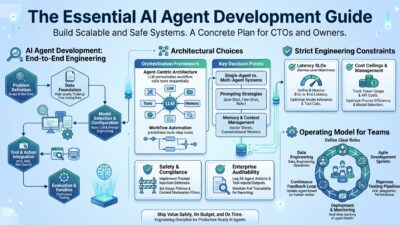
A Reference Architecture for Production-Grade AI Agents
Users/Systems (web/mobile/slack/telephony)
  ▼
[Ingress] ─ AuthN/Z, rate limits, PII redaction, channel adapters
  ▼
[Orchestrator/Planner] ─ Policy/state machine + constrained LLM planning
  ▼
[Tools/Actions]  [Memory]                 [Models]
 CRUD/APIs       Short/Episodic/Long      LLMs, ASR/TTS/Vision, Guardrails
  ▼
[Evaluation Harness] ─ Golden tasks, LLM‑as‑judge, human review
  ▼
[Observability & Cost] ─ Traces, P50/95/99, redaction lineage, budgets
  ▼
[CI/CD for Prompts & Tools] ─ Versioning, canary/blue‑green, rollbacks
Component responsibilities and failure modes
- Ingress: Channel adapters, auth, rate limits, edge PII redaction, schema validation. Failures: bursts, malformed inputs, auth errors, redaction misses.
- Orchestrator/planner: Routing, tool selection, multi‑step plans, policy enforcement. Failures: stalls, loops, violations → timeouts, loop detectors, max‑step caps, allow‑lists.
- Tools/actions: Typed interfaces (OpenAPI/JSON), idempotency, compensations, strict validation. Failures: non‑idempotent side effects, schema drift, rate limits.
- Memory: Short/episodic/long-term with TTL, retention, lineage, per‑tenant scoping. Failures: bloat, stale facts, cross‑tenant leaks.
- Models: Route by task—use smaller/faster where possible; see small vs large language models. Failures: quality regressions, latency spikes → version pinning, canaries, caps.
- Evaluation harness: Golden tasks, LLM‑as‑judge with calibration, human queues. Failures: drift, bias → holdouts, judge rotation, bias checks.
- Observability & cost: Stepwise traces, token/latency/cost histograms, redaction status, budgets/alerts. Failures: PII in logs, missing spans, cost overruns.
- CI/CD for prompts/tools: Versioned prompts/models/tools, canary/blue‑green, signed manifests, automatic rollbacks.
Technology choices and trade-offs
- Frameworks: LangGraph/Semantic Kernel for typed control; OpenAI Assistants for speed (accept vendor risk); multi‑agent libs for protos (debug complexity).
- RAG stack: pgvector vs Pinecone vs Milvus; semantic chunking with overlap, rich metadata, citations; event‑driven re‑embedding for freshness.
- Workflow engines: Temporal for long‑running reliability; in‑process graphs for lowest latency (offload tails to queues).
When not to adopt agents: unstable tools, no eval/observability, or compliance mandates fully deterministic flows—prefer guided flows or expert systems.
Implementation Blueprint: From Prototype to Production in 12 Weeks
Use this 12‑week plan to structure ai agent development with clear deliverables, gates, and risk controls.
- Weeks 1–2: Problem framing and guardrails
Select one use case; set SLOs and per‑task cost caps; red‑team prompt injection and data boundaries; choose initial models and ASR/TTS if voice. - Weeks 3–4: Thin‑slice prototype
Build an orchestrator with 1–2 deterministic tools, schema‑validated tool calls, minimal RAG over approved corpus with citations; ship to a small internal cohort; log P50/P95 and token costs. - Weeks 5–6: Evaluation harness + human review
Create 50–150 golden tasks; calibrate LLM‑as‑judge; track regressions; add redaction and safe‑output filters before egress. - Weeks 7–8: Expand tools + memory
Introduce critical tools, long‑term memory where justified; add rate limits and compensations; guard canary releases with golden‑task gates. - Weeks 9–10: Security, compliance, auditability
RBAC, per‑tenant scoping, audit trails, PII controls, jailbreak defenses, allow‑listed outbound APIs; legal sign‑off. - Weeks 11–12: Hardening and rollout
Autoscaling, circuit breakers, retries, fallbacks and human escalation; SLO monitors and incident runbooks; cost guardrails; A/B across prompts/models; pilot then go/no‑go.
Deliverables checklist: architecture diagram; prompt registry; tool catalog with typed schemas; evaluation suite and dashboards; incident/rollback runbooks; SLA/SLO doc; ROI‑tagged backlog.
Case: “NovaRetail” support deflection
12‑week outcome: 72% containment on eligible intents; 1.2s P95 first response; $0.34 cost per contained ticket; CSAT parity (−0.1pt). Year‑1 net savings ≈ $2.04M; payback <3 months.
How to Build an AI Voice Agent: Real-Time Architecture, Latency, and Telephony
Many CX leaders now evaluate how to build an ai voice agent as a path to 24/7 service. Voice demands a streaming-first architecture and tighter latency budgets than chat.
End‑to‑end pipeline:
SIP/PSTN → CPaaS → media gateway → WebRTC/gRPC streams → ASR (partials <300ms; finals <700ms; VAD; barge‑in) → interruptible LLM planner (function calls) → TTS (neural; <300ms/50 chars; buffer + crossfade) → orchestrator state machine → CRM/order tools → analytics/QA.
- Design practices: barge‑in with TTS flush; incremental decoding to prefetch tools; fallbacks for regulated scripts; warm handoff with transcript and disposition.
- SLOs: end‑to‑end round‑trip <1.2s P95; barge‑in >90%; containment >70%; track WER, drops, and cost/min ceiling (<$0.10–$0.25).
- Compliance/QA: consent notices; pause/resume around PCI/PHI; in‑stream redaction; weekly human QA samples.
- Build vs buy: CPaaS + custom stack for control; turnkey for speed—decide on latency guarantees, data residency, tool flexibility, and failover.
Security, Privacy, and Governance for Enterprise AI Agents
- Threats: prompt injection/jailbreaks, data exfil via tools/RAG, KB poisoning, hallucinated transactions, supply‑chain risks.
- Controls: input/output filters, allow‑listed tools, RBAC and role‑scoped context, deterministic verifiers for high‑risk steps, immutable audit trails with prompt/version/tool lineage.
- Data governance: PII minimization at ingress; encryption; data residency; TTLs/retention; approved corpora with lineage and legal holds.
- Compliance-by-design: map to SOC 2, HIPAA/PCI; model cards and AUPs; HITL for high‑risk actions; vendor DPAs and subprocessor reviews.
- Incident response: rollback buttons for prompts/models; kill‑switches by tenant/feature; postmortems with trace lineage; backlog links for continuous improvement.
Measuring What Matters: Evaluation, Observability, and Cost Control
- Evaluation layers: unit tests for tools; offline golden tasks (success/factuality/safety); calibrated LLM‑as‑judge; human spot checks; online A/B with rollback thresholds set ex‑ante.
- Dataset hygiene: stratified sampling by intent/domain; drift detection; leakage prevention; periodic refresh tied to content changes.
- Observability: stepwise traces (prompts, tool calls, retries, policy decisions), version lineage and semantic diffs, token/latency/cost histograms, redaction indicators, incident hooks to page on SLO/budget breach.
- Cost governance: per‑task budgets; caching (embeddings, common completions); prompt compression/structured prompting; model routing by cost/perf; batch where possible, stream when UX demands; negotiate committed‑use discounts.
- Weekly KPIs: task success, containment, CSAT/QA; P95 latency; escalation/re‑open; cost per task/min; safety incidents per 1k; regression deltas; model spend vs budget.
Build vs Buy: Platform Choices, TCO, and Vendor Risk
Use this decision framework to score latency SLO fit, model flexibility (BYO/routing), governance depth, data residency, observability, integration lift, roadmap control/egress, and unit economics.
1‑year TCO (example): 5–9 FTE across platform/eval/app; variable inference (tokens or GPU OpEx); vector DB and observability ($2–5k/mo each typical); licenses (CPaaS/ASR/TTS); compliance/security (DLP, DPIAs, pen tests). Run sensitivity on volume, model sizes, containment variance, eval cadence.
- Hybrid patterns: managed LLMs + self‑hosted RAG/eval; start turnkey, progressively own memory/tools; abstract interfaces early to ease exit.
- Exit strategies: abstraction layers, prompt portability in a registry, data egress terms, dual‑vendor failover, periodic drills.
Proven Patterns and Anti‑Patterns from Early Adopters
- Patterns: narrow-scope v1 with typed tools; golden‑task gates pre‑release; human review queues for high‑risk steps; opinionated runbooks and rollback buttons; budget‑aware routing and model pinning.
- Anti‑patterns: unbounded tool access; free‑form RAG over uncontrolled corpora; no eval harness; single‑tenant prompts without lineage; relying on emergent control for transactional flows; logging PII in traces.
- Change management: enablement for frontline teams; transparent failure modes; feedback loops into backlog; shadow mode then phased rollout.
Executive Checklists, Templates, and KPIs You Can Copy
Pre‑funding: clear task success criteria; SLO/SLA and per‑task cost ceiling; governance/data boundaries; legal constraints; stakeholder map; success metrics and review cadence.
Build: finalized architecture; tool catalog with JSON/OpenAPI schemas and compensations; prompt registry with lineage; evaluation thresholds and red‑team results; observability plan; incident runbooks and rollbacks.
Go‑live: tested A/B guardrails and kill‑switches; escalation routes and warm handoffs; shadow period with sampling and human QA; rehearsed rollback; capacity plan; support playbooks for CX.
KPI template (baseline → target): task success 70% → 85%+; containment 50% → 70%+; latency P95 2.0s → ≤1.5s (chat), ≤1.2s (voice); cost/task $0.70 → ≤$0.35 (chat), ≤$0.20/min (voice); safety incidents/1k 5 → ≤1; ROI tracked monthly.
FAQ
What is an AI agent in practical, production terms?
An AI agent is a governed, LLM-powered component that plans, calls typed tools/APIs, uses memory, and acts under explicit SLOs and policies—observable, evaluable, and rollback‑ready like any microservice.
How do we prevent hallucinations or unsafe actions?
Use typed tool contracts, deterministic verifiers for high‑risk steps, allow‑listed actions, minimal necessary context, and an evaluation harness with golden tasks plus LLM‑as‑judge and human spot checks.
What are reasonable latency targets for chat and voice agents?
Chat should hit first‑token under 500ms and P95 response under 1.5s; voice must deliver round‑trip under 1.2s P95 with ASR partials under 300ms and chunked TTS for natural cadence.
How do we measure ROI and control cost in ai agent development?
Define task success, containment, and CSAT up front; track token/latency/cost histograms; enforce per‑task budgets in the orchestrator; route to smaller models when near caps; cache embeddings and common completions.
When should we avoid agents and choose guided flows instead?
If tools/APIs are unstable, you lack observability/evaluation capacity, or compliance demands fully deterministic flows, start with guided or expert systems and add constrained LLM support later.
What’s the fastest path to a safe, useful v1?
Thin‑slice one use case, 1–2 deterministic tools, approved corpus RAG with citations, golden‑task eval gates, and clear fallbacks/human escalation—then iterate behind cost and latency budgets.
Summary
In one sentence: Treat agents as governed microservices—planned, observable, evaluated, and budgeted—to turn demos into durable ROI.
This guide gives your team the blueprint: precise definitions, a production reference architecture, a 12‑week execution plan, and a real‑time voice design you can hold to SLOs. Start narrow, ship with evaluation and rollback, then scale responsibly. If voice is on your roadmap, apply the streaming-first patterns from the how to build an ai voice agent section. Ready to move? Anchor on outcomes and run disciplined ai agent development with cost guardrails and governance from day one.