

Estimated Reading Time
17 minutes (executive-friendly with bolded takeaways, mini-cases, and FAQs)
Key Takeaways
- AI agent development is now a board-level priority—treat agents as governed, measurable digital workers, not experiments.
- This CEO-focused ai agent development guide covers business case → architecture → 90‑day rollout → AgentOps.
- Voice matters: learn how to build an ai voice agent that customers prefer by mastering latency, barge‑in, and policy design.
- Design for safety from day one: allow‑listed tools, PII redaction, refusal policies, HITL, and observable SLAs/SLOs.
- Stack patterns that win: orchestrator + RAG + typed tools, with a model gateway and evaluation harness—consider small vs large language models—why SLMs matter.
Standfirst
AI agent development has moved from R&D novelty to board-level priority. This CEO-focused ai agent development guide shows how to go from business case to production deployment, with tooling choices, governance, and a step‑by‑step build plan—including how to build an ai voice agent for sales and support. The winning patterns blend strategy, architecture, and an operational cadence that de-risks the journey while delivering measurable value quickly.
Executive Summary: What CEOs Need To Know Before Funding AI Agent Programs
Before you release budget, align on definitions, value levers, risks, and the operating model that turns agents into reliable, governed, and cost‑effective digital workers.
What is an “AI agent”?
Put simply, an agent is a governed system—not a prompt. See: What is an AI agent?
- Definition: Autonomous/semi‑autonomous system (often LLM‑powered) that perceives inputs, plans, calls tools via function APIs, retains memory, follows policy, and escalates to humans.
- Inputs/channels: Web chat, email, SMS, mobile, voice (PSTN/SIP/WebRTC), APIs.
- Capabilities: Reasoning/planning, RAG, typed tool use (CRM, ticketing, ERP, payments), policy adherence, and observability.
Expected value levers for AI agent development
- Labor productivity and FCR lift
- 24/7 coverage with controlled escalation
- Faster cycle times across scheduling/triage/data entry
- Improved conversion for SDR qualification and inbound sales
- Lower handling cost via higher containment
- Reduced wait times and faster time‑to‑first‑token/audio
Top risks to govern up front
- Hallucinations and tool misuse; prompt injection and data exfiltration
- Privacy leakage and cross‑tenant contamination
- Brand risk from tone/content; security and regulatory exposure
- Uncontrolled cost from token/minute overuse
Operating model to scale safely
- Productized internal platform: Orchestration with AgentOps + MLOps baked in
- Cross‑functional squad: Product, SWE, AI/ML, data, security, compliance, CX ops
- Controlled rollout: HITL, canary/blue‑green, observable SLAs/SLOs
Choose High‑ROI Use Cases: A CEO’s Framework For Prioritizing Agent Investments
Start with work that is frequent, rule‑heavy, and measurable—then pressure‑test data readiness, risk, and integration complexity.
Prioritization criteria (score 1–5)
- Frequency and time‑on‑task
- Error cost and tolerance for partial automation
- Data availability and system context
- Compliance tolerance and auditability
- Addressable impact (cost or revenue)
- Integration complexity and side effects
- Latency requirements (chat vs voice)
- Change management burden
High‑impact patterns that go first
- Customer support triage and self‑service (see the customer service AI playbook)
- Sales SDR qualification and meeting setting
- IT helpdesk (password resets, access requests)
- AP/AR workflows (invoice intake, vendor onboarding)
- Order status/self‑service portals
- Knowledge retrieval (RAG) copilots
- Voice scheduling/concierge
Quick business case math
- Cost savings: TAM of tasks × minutes saved × fully loaded rate
- Revenue: Conversion delta × eligible volume × AOV
- Platform costs: tokens/minutes + speech + vector DB + orchestration
- Risk contingency: 10–20% holdback early on
Stage‑gate from discovery to pilot
- 3–4 week POC with synthetic + real traffic
- Exit criteria by intent: accuracy, containment, CSAT, AHT, conversion lift
- Kill, pivot, or graduate—avoid “zombie” POCs
Real Business Case: Mid‑Market E‑commerce Support + Sales Voice Agent
Context
- $180M revenue DTC retailer; 220 FTE; seasonal spikes
- Pain: 35% “where is my order,” 12% returns/exchanges, 10% product fit; 12+ min peak phone waits; SDRs miss 30% of inbound
Approach
- Channels: Web chat + IVR/SIP voice + SMS
- Scope: Order status, returns eligibility, sizing guide, store hours, promo policy; SDR handoff + scheduling
- Stack: LLM + RAG (catalog, policy docs), CRM/ticketing tools, payment provider (read‑only), scheduler; streaming ASR, low‑latency TTS, full‑duplex barge‑in
- Guardrails: Allow‑listed functions, PII redaction, refusals for payments changes, policy cards
Assumptions and results after 60 days (illustrative)
- Volume: 60k contacts/month; 40% eligible for automation (assumption)
- Containment: 62% of eligible contained (measured)
- AHT reduction: −28% on assisted calls via prefilled context (measured)
- CSAT: −0.1 on automated vs assisted; +0.3 post‑handoff due to shorter queues (measured)
- Unit costs: ASR $0.045/min; TTS $0.030/min; LLM $3.00/1M tokens; vector DB $0.20/1k ops (illustrative)
- Savings: 24k contained × 4.5 min × $1.00/min = $108k/month
- Revenue uplift: SDR answer +12%, qualification +8% (assumption) → +$180k/month bookings at 25% close (assumption)
- Net: $108k + $180k − $52k platform/telecom = $236k/month; payback < 45 days
Deployment patterns applied (returning to the case)
After the 60‑day pilot, voice expanded from 20% → 60% of inbound via canary + blue/green. Availability 99.95%, P95 first audio 620 ms; two automated rollbacks triggered by upstream CRM rate limits; postmortems trimmed tool timeouts by 40% the following sprint.
Reference Architecture: The Production‑Grade AI Agent Stack CEOs Can Trust
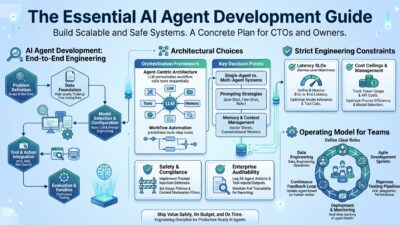
A production agent is a system, not a prompt. Design for reliability, latency, safety, and cost from day one. See the full ai agent development guide.
- Channels: Web chat, mobile in‑app, email, voice (PSTN/SIP/WebRTC)
- Orchestrator: Planning, tool selection, policy enforcement; deterministic branches for compliance‑critical flows
- Model gateway: Router with guardrails, fallback/retry; consider small vs large language models (SLMs vs LLMs)
- Knowledge (RAG): Vector store, loaders, chunking (500–1,000 tokens), embeddings, relevance feedback
- Tools/integrations: Typed, schema‑validated functions; strict argument validation and timeouts
- State/memory: Per‑session working memory; optional long‑term factual store with PII redaction
- Safety/policies: Content filters, jailbreak detection, provenance checks, allow‑listed tools, output validators/refusals
- Observability (AgentOps): Tracing across prompts/tools, token/minute cost accounting, quality scores, red‑flag events
- Deployment: Containers or serverless; secrets management; VPC isolation; autoscaling; blue/green + canary
Latency design targets
- Text: P50 < 1.5s to first token; stream early; P95 ≤ 2.5s
- Voice: End‑to‑first‑audio ≤ 300–700 ms; partial ASR in 200–300 ms; enable barge‑in/duplex
Security and privacy
- Data minimization and PII redaction at ingestion
- Encryption in transit/at rest; scoped tokens; RBAC/ABAC on admin panels
Implementation Playbook: From POC To Scaled Rollout In 90 Days
Day 0–15: Discovery + Design
- Define KPIs: accuracy, containment, CSAT, AHT, FCR, conversion, $/interaction
- Draft system prompt + policy cards (brand, refusals, escalation)
- Enumerate tools with exact JSON schemas; idempotency keys; sandboxes
- Data readiness: gold answers, canonical sources, access controls, PII plan
- Test plan: golden sets, scenario matrix, adversarial prompts
Day 16–45: Build + Pilot
- Implement RAG (chunking 500–1,000 tokens, hybrid search)
- Function calling with strict validation; retries/backoff; circuit breakers; audit logs
- Safety: I/O filters; prompt‑injection mitigations; provenance enforcement
- Evaluation: offline scoring; scenario tests; red‑team; cost/latency profiling; shadow traffic
Day 46–90: Hardening + Launch
- AgentOps: tracing, replay, feedback loops; guardrail tuning; HITL workflows
- Traffic ramp 1% → 5% → 25% gated by SLOs; blue/green/canary with auto‑rollback
- Governance: model change control; versioned prompts; approvals; audit trails
How To Build An AI Voice Agent That Customers Actually Prefer
Voice is unforgiving; latency and barge‑in support make or break UX. Learn how to build an ai voice agent end‑to‑end (see also the AI agent development roadmap).
End‑to‑end voice pipeline
- Telephony/WebRTC with consent prompts
- VAD with tuned end‑of‑speech thresholds
- Streaming ASR (partials + finals, timestamps, confidence)
- Agent policy/planning with turn‑taking and slot capture
- Function calls (CRM lookup, tickets, scheduling, order status; PCI‑scoped payments)
- TTS: low start‑time neural; cache common snippets
- Barge‑in: full duplex; recover gracefully from partials
- Transcripts + analytics (latency, containment, handoffs, MOS)
Conversation design
- Persona: friendly, concise, brand‑consistent; “teach‑back” confirmations for critical steps
- Slot‑filling state machine with confirmations/re‑prompts
- Interruptions: acknowledge barge‑ins; handle low‑confidence ASR
Reliability and quality
- Latency budgets: first audio ≤ 700 ms; pre‑cache; stream synthesis
- Fallbacks: short prompts or pre‑recorded snippets under stress
- Compliance: consent, PII redaction, region pinning, masked playback
Testing
- Synthetic call generation (accents, noise, rapid speech)
- Edge‑case library (no order ID, interrupted confirmation, policy exceptions)
- Human evaluation: MOS panels, post‑call CSAT/NPS, mystery shopping
Governance, Risk, And Compliance: The CEO’s Non‑Negotiables
- Data governance: minimize data; PII/PHI tagging; DLP and retention; encryption; RBAC/ABAC; secrets management
- Model governance: approved model list per domain/data class; promotion gates; change control
- Safety policies: refusal triggers; brand tone guardrails; allow‑listed tools with rate limits
- Regulatory: sector‑specific controls and consent/logging; see AI for healthcare overview
- Vendors: DPAs, subprocessor reviews, pen tests, SOC 2/ISO alignment
Evaluation, Guardrails, And AgentOps: Proving Fitness To Launch
Quality definition and test types
- Task success and factuality (golden‑set; citation/provenance for RAG)
- Tool correctness (arguments, success codes, idempotency)
- Policy adherence (tone, refusal rules, prohibited actions)
- Empathy/tone for CX‑sensitive flows
Test coverage and metrics dashboard
- Offline: golden sets, scenario suites, adversarial red‑team
- Shadow mode: live traffic with human finalization
- Post‑deploy: drift detection, hallucination flags, policy violations
- Exec metrics: containment, AHT, escalations, cost/turn, P50/P95 latency, CSAT/NPS, conversion and revenue impact
Build Vs Buy, Team, And Operating Model
Choose the control surface you need—see how to choose an AI agent builder.
- Turnkey platforms: faster TTV; constrained customization
- Framework builds: maximum customization; deeper engineering lift
- Decision factors: TTV vs differentiation, regulatory constraints, customization and TCO
- Core roles: PM, AI engineer, backend integrator, data/ML, QA/SDET, CX ops, compliance, security
- Vendor management: SLAs/SLOs, residency, rate limits, egress, IP/indemnities—see the AI agency buyer’s guide
Deployment Patterns And SLOs: From Staging To Global Scale
- Environments: dev → staging (shadow) → prod (canary/blue‑green); feature flags and traffic splits
- Infra: containers with autoscaling (steady); serverless (bursty); edge CDN for static KB; regional endpoints for latency/compliance
- SLOs: availability ≥ 99.9%; text P95 ≤ 2.5s; voice first‑audio ≤ 700 ms; target containment per domain
- Incident response: runbooks by failure mode; comms templates; blameless postmortems; guardrail updates
Change Management And Adoption: Orchestrating People, Process, And CX
- Stakeholders: exec sponsor, Legal/Compliance, CX leaders, IT/Security, frontline managers
- Training: what the agent can/can’t do; escalation etiquette; KPI alignment; incentives
- Comms: set expectations, publish limits, feedback channels, quick wins
- Phased rollout: dogfooding → limited segment → broader release; internal case studies
Budgeting, Pricing, And ROI: Setting Executive Expectations
- Cost model: LLM tokens, ASR/TTS minutes, vector DB, orchestration, observability, headcount, contingency
- Unit economics: cost/interaction vs human; voice typically 2–4× text but often higher conversion
- Board framing: savings + revenue uplift − total cost; risk‑adjusted value; payback and 12–24‑month NPV
Executive Dashboard: Metrics That Predict Agent Success
- Leading indicators: tool success rate, knowledge hit‑rate, hallucination flags/100 turns, P95 latency, abandonment
- Outcomes: CSAT/NPS, FCR, AHT reduction, conversion lift, revenue/contact, cost/interaction, containment
- Governance: policy violations, data leakage incidents, escalation SLA adherence, audit completeness
- Cadence: weekly ops; monthly steering; quarterly strategy re‑baseline
The 90‑Day AI Agent Development Guide: Timeline, Checklists, And Exit Criteria
Weeks 1–2: Foundations
- Artifacts: business case, KPIs, risk register, initial architecture, model list, policy cards
- Exit: data sources identified; security/compliance POC sign‑off; baselined success metrics
Weeks 3–4: Data + Prototyping
- RAG ingestion; chunking + hybrid search; golden‑set labeling; prompt stacks; tool schema drafts
- Exit: ≥80% golden‑set coverage; tool schemas validated; sandbox credentials issued
Weeks 5–6: Orchestrator + Tools
- Function calling; retries/timeouts; idempotency; deterministic branches; PII redaction pipeline
- Exit: end‑to‑end staging path; P50 text <1.5s; voice first‑audio <700 ms (lab)
Weeks 7–8: Safety + Evals
- Filters; jailbreak/prompt‑injection tests; allow‑lists; HITL; shadow 5–10% traffic
- Exit: ≥85% golden‑set accuracy on top intents; zero critical policy violations in 500‑turn red team; cost/turn in band
Weeks 9–12: Pilot → Hardening → Launch
- Canary 1–5%; replay + trace reviews; guardrail tuning; cost/latency optimization
- Blue/green to 25–50%; runbooks; on‑call; incident drills; exec dashboard live
- Exit for “go”: ≥X% containment at ≤Y cost/interaction; P95 latency under SLO; ≤Z policy violations/week; rollback plan documented
Deliverables checklist
- Business case deck; architecture diagram; policy/prompt repo; eval suite; post‑incident runbooks; executive dashboard
Appendix: Practical Checklists To Copy Into Your Plan
Security and compliance quick check
- PII/PHI redaction at ingestion; RBAC/ABAC logging
- Allow‑listed functions with schema validation and timeouts
- Version‑controlled refusal/escalation criteria with audits
- Model change control with rollback + audit trails
Latency and reliability quick check
- Text P50 <1.5s; P95 <2.5s; stream tokens
- Voice first audio ≤700 ms; tuned VAD; duplex barge‑in
- Retries/circuit breakers; cache common snippets
- Canary deploys with error budgets and auto‑rollback
Evaluation and AgentOps quick check
- Golden set covers 80–90% intents; adversarial suite maintained
- Dashboard: containment, AHT, escalations, cost/turn, latency, CSAT
- Human review with easy replay/labeling; weekly quality council
Notes for your design team
- Visuals: reference architecture; latency swimlane; KPI dashboard; 90‑day Gantt
- Accessibility: short, scannable paragraphs; subheads map to executive questions; on‑page FAQs
Assumptions and disclaimers
- Vendor names omitted; unit costs/ROI are illustrative—validate against your contracts and volumes
- SLO targets reflect common expectations—tune to your sector/geo/CX bar
Conclusion: Your Next Three Moves To De‑Risk And Accelerate
- Fund a tightly scoped POC with measurable exit criteria on 1–2 intents
- Stand up AgentOps from day one for tracing, replay, quality, and cost control
- If voice is in scope, plan a phased rollout with strict latency budgets, barge‑in, and consent/compliance
Call to action: Book an executive working session to map use cases, risks, and ROI—or kick off a 2‑week discovery sprint for architecture, policy cards, an eval suite, and a pilot plan. See /case-studies for outcomes, /pricing for a calculator, and /security for controls.
FAQ
What should a CEO align on before funding an AI agent program?
Agree on definitions, value levers, risks, KPIs, and an operating model with AgentOps, governance, and staged rollouts so the program is both safe and ROI‑positive.
How is an AI agent different from a traditional chatbot?
An agent plans, calls typed tools/APIs, uses memory, follows policies, and escalates to humans—going beyond Q&A to complete multi‑step tasks reliably.
Where do most failures happen in early agent pilots?
Weak data readiness, untyped tool calls, missing guardrails, and no eval harness; fix with RAG quality gates, schema‑validated functions, refusal policies, and golden‑set tests.
How do we control LLM and speech costs at scale?
Cap tokens/turn, cache snippets, route to task‑fit models, compress prompts, and monitor cost/turn in AgentOps with alerts tied to feature flags.
What latency targets should we hold vendors to for voice?
End‑to‑first‑audio within 300–700 ms with full‑duplex barge‑in, plus partial ASR hypotheses in 200–300 ms to keep conversations natural.
What compliance guardrails are non‑negotiable?
PII redaction at ingestion, allow‑listed tools with schema validation, model change control with audit trails, consent logging, and region pinning when required.
Summary
Bottom line: With the right sequence—strategy, reference architecture, a 90‑day playbook, rigorous AgentOps, and change management—you can turn ai agent development from a risky experiment into a governed, compounding capability that lifts margins and CX quarter after quarter.
Next steps
– Skim the full ai agent development guide and pick 1–2 intents for a POC.
– If phones matter, prioritize ai voice agent latency and barge‑in from day one.
– Stand up exec dashboards for containment, AHT, P95 latency, and cost/interaction; iterate weekly.
See also: Case studies · Pricing calculator · Security controls