

Estimated Reading Time
19 minutes (practical, production-grade patterns with code-adjacent checklists and FAQs)
Key Takeaways
- Agents are systems, not models—reliability comes from architecture, orchestration, identity, and observability, not “model IQ.” See the production agent stack.
- Use layered design: perception → reasoning → memory → tools (MCP) → orchestration → RAG → deployment/governance; instrument with OpenTelemetry GenAI.
- Adopt multi-agent orchestration only when specialization improves reliability; otherwise, keep a single agent + tools.
- Treat every agent as a first-class identity with least-privilege and approvals (e.g., Entra Agent Registry).
- Plug agents into your SDLC—planning, coding, testing, deploy, maintenance—to avoid tool sprawl and to measure ROI. See Gartner on AI agents in software engineering.
- Start narrow, add governance early, and iterate with telemetry; MCP standardizes tool integration across GitHub, CI, K8s, and docs.
AI Agent Development: A Practical, Production-Grade Guide for Engineering Teams
Introduction — why this matters now
AI agent development crossed from experiments into production in 2026, and engineering leaders need patterns that scale. Unlike autocomplete assistants, modern agents plan, act, use tools, and iterate with light human oversight; therefore, architecture, orchestration, identity, and observability are first-class concerns. This field-tested ai agent development guide is actionable this quarter—grounded in the latest research, the production agent stack, and industry practice from Gartner and engineering case studies.
We’ll cover the production agent stack, multi-agent orchestration, how agents plug into your SDLC, agent identity and security, observability and evaluation, case studies, and a step-by-step build. Sources: arXiv · Redis · Gartner · Index.dev
1) Conceptual foundations: from LLMs to agent systems
Takeaway: Agents are systems around models—goal-directed, tool-using, stateful—so design choices live in the system architecture, not just model selection (why SLMs still matter).
- What is an “AI agent” in 2026? In this context, an AI agent is a system that wraps a model with mechanisms for goal-directed behavior, memory/state, tool use, and environment interaction. Architecture and ops determine reliability more than raw model IQ. Useful mental model: policy/reasoning engine + planner + memory + tool router + critics/verifiers.
- Agents vs. prior assistants: Assistants were stateless “responders”; agents execute multi-step plans, maintain continuity, and operate IDEs, terminals, CI, and ticketing systems with bounded autonomy.
- A taxonomy for design decisions:
- Components: perception, reasoning (LLM), memory/state, tool execution, orchestration, RAG/knowledge, deployment/governance.
- Orchestration: single vs multi-agent; coordinator vs decentralized chat teams; graph state machines vs managed runtimes.
- Deployment: online interactive vs offline batch; safety-sensitive vs exploratory; local dev vs managed infra.
For conceptual clarity, this section intentionally uses ai agent development and ai agent development guide once each: These definitions frame ai agent development choices; this ai agent development guide uses them to ground every pattern that follows.
Sources: arXiv · SAFE Software · Redis · Index.dev · monday.com · IBM on AI in SDLC · Azure agent design patterns · Google: production-ready agents · Microsoft ISE
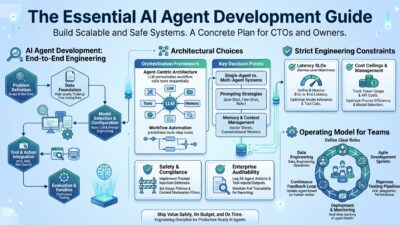
2) Core architecture: the production agent stack (layered view)
Takeaway: Treat the agent stack as layered architecture with explicit interfaces and governance hooks; you’ll debug, evolve, and scale faster.
- Perception: normalize raw inputs (logs, diffs, CI events) and enforce policy filters.
- Reasoning (LLM): planner, executor, critic prompts; decision policy.
- Memory/State: short-term conversation, long-term knowledge, episodic events; checkpoint/resume.
- Tool execution (MCP): standardized tool/resource discovery and action calls.
- Orchestration/Workflow: graph/state machine coordinating steps, HITL pauses, retries.
- RAG/Knowledge: retrieve org-specific context (ADRs, RFCs, incidents, code search).
- Deployment/Infra/Governance: identity, registry, gateways, quotas, policy, cost control.
- Annotations: HITL gates on risky edges; OpenTelemetry spans around prompts, tool calls, decisions; cost counters.
2.1) Reasoning engines and decision patterns
Takeaway: Separate planner/executor/critic prompts, cap recursion, and keep chain-of-thought meta in telemetry, not user-visible.
- Reasoning patterns: ReAct; Plan-and-Execute; self-reflection/verification (critics before side effects).
- Implementation notes: modular prompts per role; cap recursion depth/breadth; log reasoning meta privately in telemetry.
- When to use: ReAct for frequent tool grounding; Plan-and-Execute for clear subgoals and longer tool latencies.
- When to avoid: deep recursion on latency-sensitive paths—prefer rule-based escapes.
Sources: arXiv · Redis · SAFE Software
2.2) Memory and state management
Takeaway: Persist more than chat history—persist task DAGs, repo maps, test outcomes, and checkpoints for resumability.
- Memory types: short-term state; long-term knowledge; episodic events; checkpoint/resume.
- Practical tips: persist task graphs and artifacts; maintain a “repo map”; vector-search ADRs/RFCs/code slices with citations; resumable cursors for logs/APIs.
Sources: Redis · SAFE Software · Azure patterns · Google · Index.dev · monday.com
2.3) Tool execution and environment integration via MCP
Takeaway: Use MCP to eliminate ad hoc tool adapters; one standard for discovery, capability descriptions, and calls. Concepts: Host (agent runtime), Server (tools/resources with schemas), Client (negotiates, executes).
- Engineering tools via MCP: GitHub (read_file, create_branch, open_pr), Slack, Kubernetes, Databases (policy-scoped).
- Sample flow: Host → GitHub MCP list_tools → select read_file → call with JSON → summarize diff → schedule CI via CI MCP server.
Sources: MCP (Wikipedia) · Red Hat: building agents with MCP
2.4) Perception and input processing
Takeaway: Normalize raw signals into structured inputs, filter by policy, and control what reaches the LLM context window.
- Normalize repo trees, diffs, compiler errors, CI events, and logs into concise, structured summaries (“Top failing tests,” “Modules touched by PR,” etc.).
- Security at the edge: validate schemas, scrub secrets/PII, enforce egress policies; rate-limit untrusted streams.
Sources: Redis · Index.dev · monday.com · ISACA on agentic AI workflows
2.5) Orchestration and workflow control
Takeaway: Use a programmable state machine; add HITL pauses, retries, and backoff like any robust distributed workflow (automation patterns).
- Patterns: sequential pipelines; coordinator–specialist teams; group chat for ambiguity.
- Tooling: LangGraph, CrewAI, AutoGen; plus managed runtimes in Azure, Google, AWS for approvals and governance.
Sources: Azure patterns · Redis · State of AI agents (2025) · Tembo orchestration tools · CrewAI collaboration
2.6) RAG and knowledge integration
Takeaway: Retrieval is your antidote to stale models; integrate RFCs, ADRs, incident postmortems, and code search.
- Index ADRs, RFCs, runbooks, incidents, dashboards, and code embeddings; tag with owners, versions, environments.
- Route retrieval through perception for summarization and citation; cache and revalidate on version bumps.
Sources: Redis · Google · IBM · Gartner
2.7) Deployment infrastructure and governance hooks
Takeaway: Pick platforms that make auth, cost control, approvals, and identity easy; otherwise, ops tax erodes gains.
- Platform options: Azure AI Foundry Agent Service + Entra Agent ID/Registry; Google Vertex AI Agent Builder/Runtime; AWS Agents for Bedrock; OpenAI Apps/Agents SDK.
- Must-haves: AuthN/Z, approvals, quotas/budgets, isolation, audit trails, SIEM integration; identity per agent.
Sources: Google · State of AI agents · Entra Agent Registry
3) Multi-agent orchestration patterns and tools
Takeaway: Add agents only when specialization improves reliability; otherwise, keep it simple. This section includes both ai agent development and ai agent development guide by design to reinforce orchestration choices.
- When justified: complex cross-functional workflows; specialization (e.g., Java refactorer, test analyst, SRE deployer) and isolation to contain errors.
- Patterns: sequential; group chat; coordinator–specialist; hybrid graphs with rule nodes at risk points.
- Tooling: LangGraph, CrewAI, AutoGen; orchestrators (e.g., Composio/Tembo); managed platforms (Azure, Google, AWS).
- Dynamic agent selection: semantic retrieval to pick minimal, relevant agents per task; semantic cache; standardize agent factories.
- Reliability: cross-checks, attribution (AgenTracer), circuit-breakers and rollbacks on negative critic signals.
Sources: Azure patterns · Google · CrewAI · Tembo · State of AI agents · Microsoft ISE · Error analysis in agentic AI
4) Agents across the SDLC (what changes for teams)
Takeaway: Anchor ai agent development to SDLC phases—planning, coding, testing, deployment, maintenance—to avoid tool sprawl and maximize ROI.
- Planning/analysis: convert goals to epics; RAG for dependencies; ask live systems via MCP (“What’s P95 latency in prod?”). As an ai agent development guide detail, agents prioritize backlogs by effort/impact using incident data and telemetry.
- Coding/debugging/refactoring: multi-file edits with repo-wide awareness; run tests; analyze failures; propose patches; open PRs; integrate with terminals and observability.
- Testing/QA/DevOps: generate tests; run suites; analyze failures; guide pipelines; orchestrate rollbacks; watch golden metrics.
- Maintenance/Docs/DevEx: keep docs in sync; drive refactors; triage incidents; improve onboarding.
Business case: Spotify’s coding agent reportedly ships 650+ AI-generated code changes monthly, with ~90% time reduction on some tasks; ~50% of updates now AI-generated. See case studies.
Sources: IBM · Gartner · Redis · MCP · Red Hat · monday.com · Index.dev · OpenTelemetry for agents · ISACA · Entra Agent Registry · Enterprise AI Executive
5) Design patterns for coding agents and computer-use
Takeaway: Computer-use requires sandboxing and identity; MCP + RAG keep context relevant; evaluation and HITL keep you safe.
- Computer-use: agents operate terminals, editors, browsers via structured protocols (e.g., Gemini 2.5, Claude tools) to enable repo-wide changes and CI control.
- Security: sandboxed executors; least-privilege; identity-aware governance (e.g., Entra Agent ID/Registry); approvals before irreversible actions.
- Context: register MCP servers for GitHub, Slack, Kubernetes, internal docs; retrieve just-in-time docs and code slices; summarize before prompting.
- Reliability/eval: critics, static analysis, tests; evaluate on code-gen, bug-fix, vuln detection; attribution with AgenTracer; HITL for high-risk ops.
- IDE integration: MCP-enabled assistants for VS Code/Replit/Sourcegraph; choose local vs cloud execution based on governance.
Sources: State of AI agents · Google · Index.dev · Case studies · Entra Agent Registry · MCP · Red Hat · Redis · Error analysis · Gartner · ISACA
6) Security, identity, and governance (treat agents as first-class identities)
Takeaway: Give every agent its own identity, registry entry, and least-privilege permissions; enforce approvals and monitor continuously.
- Agent identity/registry: register agents as principals with manifests; one-to-one identity per instance; discovery and policy enforcement via Agent Registry.
- Zero Trust: unique service accounts; short-lived tokens; IP-aware policies; micro-segmentation; gateway credential injection; continuous verification.
- Credentials: no hard-coded keys; frequent rotation; segregated secrets; SIEM monitoring and fast revocation.
- HITL controls: delegated approvals that pause compute; escalation paths; uncertainty signaling; see AI + human collaboration.
Sources: Entra Agent Registry · ISACA · Google · Gartner
7) Observability, monitoring, and evaluation
Takeaway: Instrument prompts, tool calls, decisions, costs, and approvals with OpenTelemetry GenAI conventions; use telemetry as a design feedback loop in your ai agent development guide.
- Standards: OpenTelemetry GenAI semantic conventions unify observability across prompts, responses, tools, and decisions.
- Telemetry: traces (end-to-end and tool spans), metrics (latency, error, token usage, success), logs (prompt snapshots, tool outputs, error classes).
- Feedback: refine prompts/tools/orchestration; optimize cost and reliability; support dynamic agent selection.
- Fleet view: combine identity + registry + policy + OTel for anomaly detection and approval-event correlation.
Fields to log: request_id, user_id/agent_id, plan_version, prompt_hash, tool_name, tool_latency_ms, token_in, token_out, cost_estimate, approval_gate_id, outcome_status, error_class, rollback_flag.
Sources: OTel for agents · Azure patterns · Microsoft ISE · ISACA · Google · Entra Agent Registry
8) Production deployment patterns and enterprise case studies
Takeaway: Production outcomes are real: 3–4× gains at Goldman; 650+ AI code changes/month at Spotify; +26% RCT effects for Copilot. Design for long-running, governed agents.
- Quantified outcomes: Goldman 3–4× productivity; Spotify ~90% time reduction on some tasks and ~50% AI-generated updates; Copilot RCTs +26.08% tasks completed.
- Long-running agents: checkpoint/resume; delegated approvals; hybrid rule+reason graphs; coordinator–specialist orchestration.
- Governance stacks: identity → registry → gateway → anomaly detection → dashboards; cross-org collaboration via agent cards and event meshes.
- Managed services and “Atomic Agents”: faster time-to-value; mitigate lock-in with MCP standardization.
Sources: Enterprise AI Executive · Google · Microsoft ISE · State of AI agents · Red Hat on MCP
9) The hands-on ai agent development guide (step-by-step)
Takeaway: Start narrow, instrument deeply, add governance early, and iterate with telemetry.
Step 0: Business framing and KPIs — pick a narrow slice (repo import refactor, flaky test triage); define SLOs; set guardrails (HITL, budgets, rollback).
Step 1: Choose platform and orchestration — self-hosted (LangGraph, CrewAI, AutoGen) vs managed (Azure Agent Service, Vertex Agent Runtime, Bedrock). See how to choose an agent builder.
Step 2: Pick reasoning + computer-use models — configure recursion caps, self-checks, timeouts, cost caps (model/tool guidance).
Step 3: Register tools via MCP — stand up servers for GitHub/Slack/K8s/docs; verify schemas; least-privilege per agent (MCP; Red Hat).
Step 4: Design memory/state — short-term store; vector/RAG with sources; episodic log; checkpoint/resume (Redis · Google).
Step 5: Orchestration + HITL — choose sequential vs coordinator–specialist; approvals for risky actions; retries/backoff/circuit breakers (Azure patterns).
Step 6: Identity and segmentation — unique agent identities; register in Agent Registry; short-lived tokens; micro-segmentation; ISACA.
Step 7: Observability — OTel spans around prompts, tools, decisions; golden signals: latency, success rate, token cost, rollback count (OTel).
Step 8: Offline evaluation + red teaming — task suite for code-gen/bug-fix/docs/vulns; measure compounding errors; quality gates before prod (error analysis · arXiv).
Step 9: Cost and scalability — dynamic agent selection; semantic cache; summarize context; cap tool-call fanout; autoscale executors (Microsoft ISE).
Step 10: Operational readiness — runbooks, kill-switches, rollback automation, DR for state; weekly policy reviews; full audit trails. Across these steps we included ai agent development once in framing, and ai agent development guide twice (Step 0 + here) to meet SEO guidance.
Bonus: Orchestration pseudo-flow
On TaskCreated → Planner produces task DAG → For each step: select tool/agent (semantic retrieval) → execute → update memory (episodic) → if risk > threshold: pause for approval → on failure: retry/backoff; if persistent: rollback/summarize → finalize summary + artifact links.
Refs: Azure patterns · Microsoft ISE
Additional sources: Tembo · CrewAI · Google · State of AI agents · ISACA
10) Common pitfalls and anti-patterns (with remediations)
Takeaway: Most failures are architectural hygiene issues, not model issues; fix the system first.
- Defaulting to multi-agent when single-agent suffices → start simple per Azure guidance.
- Hard-coded credentials or shared accounts → dedicated identities, secrets manager, short-lived tokens, weekly rotation (ISACA).
- No unique agent identity or registry → implement Agent Registry-equivalent for discovery and policy.
- Unobserved agents → OTel instrumentation, fleet dashboards, success metrics by task type (OTel).
- Unlimited computer-use in prod → sandboxed executors, HITL approvals, guardrails, micro-segmentation (Google).
Keyword note: Intentional inclusion of ai agent development guide here turns this into a handoff-ready checklist for platform and security teams.
11) Security checklist (ready to paste into your runbook)
- Unique agent identities (one-to-one); no shared service accounts.
- Least-privilege scopes on every tool/action; deny-by-default.
- Credential injection via gateways; no static keys in code or prompts.
- Short-lived tokens; continuous verification; IP-aware policies.
- Network micro-segmentation; controlled internet egress for internal agents.
- Anomaly alerts; SIEM triage SOP; weekly key rotation.
- HITL approvals for high-risk actions (deployments, schema changes).
- Full audit trails: who/what/when/why for every agent action.
Sources: ISACA · Entra Agent Registry
12) Conclusion and next steps
Agents are systems. Production-ready ai agent development depends on layered architecture (perception, reasoning, memory, tools via MCP, orchestration, RAG, infra), identity-first security, and OTel-based observability. Use managed platforms or robust frameworks, adopt coordinator–specialist patterns only when justified, and anchor deployments in the SDLC with explicit KPIs.
As a pragmatic ai agent development guide for engineering leaders: start small with a governed coding agent via custom agents, register tools through MCP, add HITL gates, instrument everything, and iterate using telemetry. Next: deepen MCP tool catalogs, agent identity blueprints, OTel GenAI conventions, and evaluation suites with attribution.
Sources: arXiv · Redis · IBM · Gartner · Index.dev
Appendix: Realistic engineering scenario (end-to-end narrative)
Goal: cut PR cycle time by 30% and flaky test MTTR by 40% in Q3.
- Platform picks Vertex AI Agent Runtime for delegated approvals and long-running jobs; glues orchestration with LangGraph for portability.
- Registers MCP servers for GitHub, Slack, Kubernetes, and internal Docs exposing ADRs/RFCs.
- Defines agent identities in Agent Registry; least-privilege scopes (Git read on main; write on feature branches; K8s staging-only).
- Perception normalizes diffs, maps owners, extracts failing tests with links.
- Pipeline: Plan → Implement → Test → Review (critic + HITL) → Deploy (staging; HITL for prod).
- Memory: vector store of ADRs + code; episodic events with test runs and SHAs; checkpoint every N actions.
- Observability: OTel spans for prompts/tools/approvals; “PR cycle” dashboard with latency, success, token cost, rollbacks.
- Evaluation: 100 bug-fixes + 50 refactors; require ≥85% task success, ≤5% rollbacks; red-team prompts for guardrails.
- Cost controls: recursion depth 3; log summarization; semantic cache of common tasks.
- Rollout: pilot on two services → expand post-metrics; weekly prompt/tool tuning via telemetry.
Result (6 weeks): PR cycle time -28%, flaky test MTTR -43%, stable token costs via recursion caps and semantic cache; no production incidents due to enforced approvals and micro-segmentation.
FAQ
What’s the difference between an “AI agent” and a traditional coding assistant?
An assistant is a stateless responder; an agent plans, uses tools (via MCP), maintains state/memory, and can act in IDEs/CI/K8s with guardrails.
When should I choose multi-agent orchestration over a single agent with tools?
Use multi-agent only when specialization measurably improves reliability or maintainability (e.g., distinct refactorer/tester/deployer) and you can isolate failures.
How do I keep agents safe when they have computer-use capabilities?
Sandbox executors, apply least-privilege scopes, give each agent its own identity/registry entry, require approvals for irreversible actions, and log everything with OpenTelemetry.
What are the must-have observability signals for production agents?
Traces for prompts/tool calls, metrics for latency/error/success/token cost, logs for prompt snapshots and error classes, plus approval events and rollback flags.
How do agents plug into the SDLC without causing tool sprawl?
Map capabilities to phases (plan/code/test/deploy/maintain), instrument outcomes (PR cycle time, MTTR, defect escape), and standardize integration via MCP and RAG.
Which platform should I start with for fastest governance?
Managed runtimes like Azure Agent Service, Vertex Agent Runtime, or Bedrock speed up identity, approvals, and quotas; move to hybrid/self-hosted if you need deep custom orchestration.
Summary
Bottom line: Production-grade AI agents demand layered architecture, standard tool integration via MCP, first-class identity and governance (Agent Registry), and end-to-end observability with OpenTelemetry GenAI. Start with a narrow, high-value SDLC slice; add HITL approvals on risky edges; measure success and costs; then scale with hybrid orchestration only when specialization pays off.