
Estimated Reading Time
17 minutes (skim-friendly with bolded takeaways, bullets, and a strict-format FAQ)
Key Takeaways
- Agents are beyond demos: With the right guardrails, orchestration, and evaluation, they drive measurable ROI—not prototypes.
- Start with intent mapping and an ai agent development guide so your scope, SLAs, and KPIs are explicit before code.
- Architect like any service: model gateway, tools, retrieval, policy, and observability—then iterate behind feature flags.
- Control risk/cost via small models for routing, tool-first execution, streaming, and caching.
- Ship to production with blue/green, canary, auto-rollback, and a quantified latency budget—especially for voice.
- Governance matters: treat “intent universe” like a product taxonomy to avoid overlap and enable reliable reporting.
Executive summary: From concept to durable outcomes
AI agent development has moved from tinkering to P&L-impacting initiatives. This ai agent development guide shows CTOs how to go from a validated use case to production-grade deployment: intent mapping, reference architecture, tooling, evaluation, security/compliance, cost control, and rollout. Result: you quantify trade-offs, design for SLAs, and ship agents that deliver measurable ROI.
Hook: From validated use case to a production-grade AI agent—the technical, step-by-step path spanning intent, architecture, tooling, evaluation, security, cost, and rollout that lets CTOs ship reliably.
What CTOs need to know about agents right now
What is an “AI agent”? An autonomous or semi-autonomous system that perceives context, plans/reasons (LLM + possible planners), acts via tools/APIs, and improves through feedback. Unlike a chatbot, an agent executes tasks end-to-end with tool use, memory, and policy constraints.
- Common types (B2B SaaS)
Task agents; workflow/orchestration agents; conversational/voice agents; embedded feature agents (in-app copilots). - Core components
LLM runtime; guardrails; tool adapters; retrieval/memory; orchestrator/state machine; observability/evaluation. - Executive design criteria
Business criticality, data sensitivity, latency/SLA, explainability/regulatory fit, change management.
Reference architecture for production-grade agents
Architect your agent like any cloud-native service—with explicit boundaries, contracts, and telemetry. See the ai agent development blueprint.
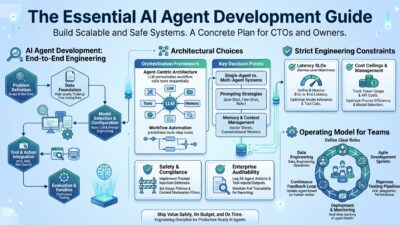
- Modular layers
Channel; realtime I/O (ASR/VAD, TTS); orchestrator/FSM; LLM runtime (gateway, prompts, functions); tools; retrieval/memory; policy/guardrails; observability/analytics; job queue/event bus. - Cloud-native notes
Containers; autoscaling; feature flags; blue/green + canary; regionalization and KMS; tenant isolation.
How to build an AI voice agent end-to-end
Build a first-call-resolution voice assistant that verifies identity, retrieves account info, resolves top intents, and escalates when needed. Full walkthrough: how to build an AI voice agent and voice architecture examples.
- Ingestion/telephony (Twilio/SignalWire/WebRTC); tune jitter buffers; silence timeouts; DTMF fallback.
- ASR/TTS (low-latency streaming); SSML; VAD + barge-in to reduce perceived latency.
- Realtime LLM with function calling + streaming; low temperature; intent-aware decoding.
- Tool functions (schema-first) with idempotency, strict timeouts, retries, circuit breakers, audit fields.
- Retrieval (RAG) hybrid search, chunking 200–400 tokens, re-ranking, policy filters.
- Safety/compliance PII redaction, consent logging, output validation on amounts/dates.
- Evaluation harness synthetic dialogs, offline grading (disclosures/KB grounding), online QA.
- Deploy/operate canary + rollback on guardrail triggers; shadow mode; on-call runbooks.
Latency budget (targets)
ASR partials 300–500 ms; LLM first token 300–700 ms; first audible response < 1.5 s; stream everything and prefetch likely tools.
Mini-case (FinServe B2B)
Before: AHT 6:40, 62% containment, CSAT 3.8/5, $1.95 cost/call.
After (90 days): 78% containment (top-5 intents), AHT 3:20, CSAT 4.3/5, $1.10 cost/call; ~$102k/month net savings; payback ~10 weeks.
Tool use, planning, and memory
- Planning: ReAct for flexible chains; Toolformer-style selection; deterministic task graphs/FSMs for high-stakes flows. Tip: favor FSM + targeted LLM reasoning for revenue-impacting tasks.
- Memory: short-term scratchpads (redact before logs), rolling conversation summaries, long-term semantic memory tied to entities with provenance/time.
- Schema-first design: strict JSON with enums/ranges; partial-delta retries; human approvals for high-risk actions with rationale and signatures.
Data pipelines and RAG
- Ingestion: connectors, OCR, HTML→Markdown, de-dupe (URL+hash), early PII scrubbing, versioning.
- Indexing: semantic chunking, hybrid BM25+dense, timestamps, re-rankers.
- Retrieval: multi-vector per doc; freshness boosts; guard negatives.
- Continuous improvement: click-vs-answer comparison, labeled “gold” passages, regression tests on re-embedding.
Reliability engineering: evaluation, guardrails, observability
- Test strategy: offline intent success, tool-call accuracy, KB grounding, policy adherence; online A/B/canary with shadow mode.
- Guardrails: input sanitation, allowlists, schema validators, mandatory-disclosure regex, abuse controls, circuit breakers.
- Observability: traces/spans; prompt IDs and model versions; token/cost; tool latency/error codes; retrieval sources; PII redaction, encryption, immutable audits.
Security, privacy, and compliance by design
- Data boundaries: redact PII pre-LLM; encrypt in transit/at rest with KMS; tenant isolation; RBAC/ABAC; immutable logs.
- Model choices vs compliance: vendor APIs for speed; self-/private-host for sensitive workloads; region pinning; retention windows; BYOK.
- Threats/mitigations: injection/exfiltration defenses; server-side prompts; approvals and staged rollouts for destructive tools.
Cost, performance, and scalability
- Cost levers: small models for routing, caches with TTL, tool-first execution, batch embeddings, response truncation.
- Performance: stream everywhere, speculative decoding, dynamic contexts, retrieval gating, quantized local models for sub-tasks.
- Scale plan: concurrency limits, autoscale on queue depth, backpressure, premium priority lanes, geo-failover.
- Exec dashboard: cost per resolved task, margin impact, SLA compliance, error budgets, policy breach rates.
Deployment options and MLOps for agents
Ship like a platform team. See the comprehensive guide.
- Packaging/IaC: microservices (channel, orchestrator, LLM gateway, tools, RAG, evaluator); Terraform; Helm.
- CI/CD: version prompts and tool schemas; eval gates pre-release; feature flags; signed artifacts.
- Model/Prompt registry: lineage, datasets, approvals, rollback recipes, drift notes.
- Post-deploy: nightly eval suites; anomaly alerts; RAG refresh cadence.
Naming, taxonomy, and documentation
- Canonical primaries (e.g., “Pay invoice” vs “Explain fee” as separate primaries); “switch payment method” as a subflow under “Pay invoice.”
- Docs mirror topic clusters: overview/policy pillar; spokes for flows, tool specs, KB mappings, test datasets, SLAs. Cross-link tightly. References: AccordContent · Digitelia.
Production launch readiness checklist
- Use case validated; P0/P1 intents finalized; KPIs defined.
- Architecture deployed: orchestrator, LLM gateway, tools, RAG, observability, guardrails, rollback.
- ASR/TTS/LLM/tool contracts tested; error budgets set; latency budgets codified.
- Security reviews passed; PII redaction verified; audit logging on; DPIA (where required).
- Offline+online evals pass; on-call runbook; human escalation live.
- Cost dashboard live; alerts configured; canary plan approved.
Roadmap: from pilot to scale
Plan for controlled growth—see the ai agent development roadmap.
- v1 Pilot: top-3 intents; constrained tools (read-only if possible); HITL approvals; weekly eval refresh.
- v2 Expansion: more intents; proactive suggestions; planner upgrades; caching/routing; RAG freshness.
- v3 Scale: multi-lingual/tenant; larger tool ecosystem; self-serve analytics; governed continuous learning.
Next steps
- Download: “AI Agent Development Guide” (requirements template + launch checklist).
- Book a 30-minute technical architecture review: we’ll assess intents, latency budgets, tool contracts, guardrails, and outline a pilot. Schedule here.
- Explore voice agent call flows and diagrams; governance playbooks; evaluation dashboards.
Image alt text suggestions
– ai agent development architecture
– voice agent call flow
– retrieval-augmented generation pipeline
– agent guardrails and observability dashboard
FAQ
What is AI agent development and how is it different from a chatbot?
Agent development combines planning, tool use, memory, and guardrails so software can complete tasks end-to-end; a chatbot typically just answers questions. For definitions and patterns, see what are AI agents.
How do I choose between building and buying an agent platform?
Build when you need deep integrations, strict data boundaries, and differentiated UX; buy when the use case is standard and SLAs/compliance fit. A practical decision checklist: how to choose an AI agent builder.
What architecture should I start with to reach production reliably?
Use a modular blueprint: channel + realtime I/O, orchestrator/FSM, LLM gateway with function calling, tools, RAG, guardrails, and observability—see the ai agent development blueprint.
How can we control inference cost without hurting quality?
Route simple tasks to smaller models, cache prompt/RAG results, prefer tool-first execution, and stream responses; details in small vs large language models.
How long does it take to go from pilot to production?
With a narrow scope and ready data, MVPs land in 4–8 weeks and production rollout in 8–16 weeks, then scale via the agent development roadmap.
Which metrics prove ROI for executive stakeholders?
Task success rate, AHT, containment %, CSAT/NPS, cost per resolved task, and margin impact—tracked pre/post with canary rollouts as advised in the ai agent development guide.
Summary
Bottom line: Treat agents like cloud-native products: intent-first design, modular architecture, disciplined evaluation, and compliance by design. Use the ai agent development guide to scope, then ship with canaries, guardrails, and dashboards so value compounds instead of stalling in demos. Next: pick one P0 intent, define SLAs and tool contracts, and book a technical architecture review.