

Estimated Reading Time
19 minutes (executive-ready with actionable blueprints, examples, and FAQs)
Key Takeaways
- This ai agent development guide gives CTOs an architecture-first path from POC to production with governance, observability, and ROI.
- Choose between single- and multi-agent designs, codify output/tool contracts, and enforce guardrails before scale.
- Operational success hinges on traces, metrics, cost/latency budgets, and a 7-iteration rollout—measured weekly.
- Security and compliance are system features: DLP at tool boundaries, domain allowlists, approval flows, and audit trails.
- For voice, sub-300ms perceived response demands low-latency ASR/TTS pipelines and interruption-aware orchestration.
Who This Guide Is For and How to Use It (Executive Summary for CTOs/Owners)
This is a pragmatic ai agent development guide for CTOs, VPs of Engineering, and owners who must take an AI agent from proof of concept to production—backed by explicit trade-offs, example configs, KPIs, and cost/performance levers. Because ai agent development spans architecture, security, SRE, legal, and operations, we lead with architecture and walk from requirements to deployment.
- What you’ll get: reference architectures, build-vs-buy and TCO, security/privacy controls, a 7-iteration plan, deployment blueprints, and an observability/IR playbook.
- How to use it: pick a baseline architecture; set guardrails in “Requirements to Roadmap”; follow the 7-iteration blueprint; use the checklist and templates to ship in 90 days.
What AI Agents Are (and Are Not): Components, Capabilities, and Boundaries
Precisely, an AI agent is a system that uses an LLM-backed policy to perceive inputs, plan, invoke tools, retain/retrieve memory, and act toward goals within constraints.
- Not a static chatbot: agents plan multi-step actions; chatbots answer in-session text.
- Not a brittle rules engine: agents are probabilistic planners with tools; rules engines are deterministic.
Core components for ai agent development
- Policy/brain: LLM with JSON Schema tool-calling; deterministic parsing.
- Planning: ReAct, plan-and-execute, graph planners; pin when templated, adapt when open-ended.
- Tools: APIs/DBs/RPA/retrieval; standards: idempotency keys, timeouts, circuit breakers, backoff, obs hooks.
- Memory: short-term scratchpad + long-term vector/RDB; TTL/decay; auditable writes.
- State: FSM/DAG/Actor; persisted for resumability and at-least-once semantics.
- Safety: allow/deny tool policies, content/URL allowlists, data filters, DLP and SSRF guards, approvals.
- Observability: traces/logs/metrics; token/latency/cost attribution; success/failure taxonomy.
Real business example: See the Customer Service AI playbook for a SaaS support agent achieving 38% deflection and AHT -27% via single-agent RAG, strong tool contracts, and explicit allow/deny policies.
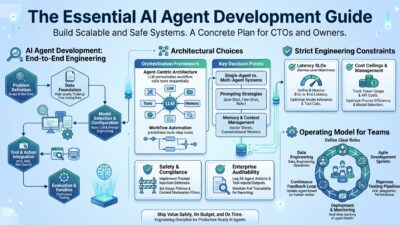
Choosing an AI Agent Architecture: Single-Agent, Multi-Agent, and Agentic Workflows
- Single-agent
Pros: simpler SLOs; fewer coordination bugs. Cons: mixed skills, less parallelism. Best for FAQ, IT runbooks, and back-office automation. - Multi-agent (role-specialized workers + overseer/critic)
Pros: specialization, parallelism, modular prompts. Cons: coordination overhead, failure modes. Use for pricing approvals, data QA, complex IT workflows.
Orchestration patterns to consider: ReAct, self-critique, graph planners; LangGraph-style state; AutoGen-like role collaboration; intent routers. See orchestration patterns.
Failure/Contention: deadlock caps and watchdogs; idempotent retries with backoff; actor mailboxes and optimistic concurrency.
Technology Stack Decisions That Stick: Models, Frameworks, Memory, and Tooling
Use an LLM selection matrix balancing quality, latency, cost, and privacy. Consider hosted frontier models vs open weights; ensure regional processing and DPAs where required.
- Retrieval: hybrid sparse+dense, semantic chunking, reranking; vector stores (Pinecone/Weaviate/pgvector/ES kNN).
- Orchestration: LangChain/LangGraph, AutoGen, Semantic Kernel; prefer JSON-schema tool calling; typed I/O tool specs.
- Tooling standards: idempotency, timeouts/circuit breakers, jittered backoff, bulkheads, scoped creds, audit logs.
Requirements to Roadmap: Defining Outcomes, Constraints, and Guardrails Upfront
Translate goals to agent objectives and KPIs; lock NFRs early; define acceptance and governance. This is the essence of a disciplined ai agent development guide.
- KPIs: CSAT, AHT, NRR impact, FCR, deflection, SLA adherence, containment.
- NFRs: per-step latency budgets; PII/PCI handling and residency; trace coverage and DR/BCP.
- Governance: prototyping and production “definitions of done”; RACI across Product/Eng/Sec/SRE/QA/RevOps.
Implementation Blueprint: From Prototype to Production in 7 Iterations
Work through a 0→6 iteration plan to reduce flakiness and build reliability by design. Reference the detailed ai agent development blueprint.
- Iteration 0 — Baseline and Eval Harness: sandbox tasks, gold sets, graders; set latency/cost targets and budget alerts.
- Iteration 1 — Prompts and Output Contracts: role prompts + examples; enforce JSON Schemas for tool use.
{
  "type": "object",
  "properties": {
    "action": { "type": "string", "enum": ["create_ticket","lookup_order","respond"] },
    "params": { "type": "object" },
    "confidence": { "type": "number", "minimum": 0, "maximum": 1 }
  },
  "required": ["action","params","confidence"],
  "additionalProperties": false
}
- Iteration 2 — RAG with Citations: curate corpora; source governance; freshness TTL; show citations; log queries.
- Iteration 3 — Tool Integrations (Least Privilege): token-scoped accounts; audit trails; simulate failure paths.
- Iteration 4 — Planning and Multi-Step Workflows: add critic/reflection only if ROI-positive; pin deterministic mini-plans.
- Iteration 5 — Safety Hardening: allow/deny policy engine; prompt-injection defenses; DLP at tool boundaries.
- Iteration 6 — Scale, Chaos, and Cost: load/chaos tests; caching and streaming; canary with rollback levers.
Prompting, Planning, and Control: Patterns That Reduce Flakiness
- Prompting: ReAct with hidden scratchpads; validate outputs against schemas; repair on failure.
- Planning: plan-and-execute for short flows; graph planners for branching DAGs with retries/compensations.
- Determinism: pin repetitive tasks; allow adaptive planning for discovery/research.
- Verification: single-pass critic when it improves task success; unit checks for structured fields; deterministic fallbacks/HITL.
Memory, Knowledge, and Retrieval: Building Reliable Context Windows
- Short-term: scratchpads; aggressive summarization; token budgets per role.
- Long-term: vector for facts; relational for state; TTL/decay; privilege-aware reads/writes; poisoning prevention.
- Retrieval quality: semantic/Markdown/code-aware chunking; hybrid retrieval + rerankers; evidence display and citations.
Tooling and Action Safety: Letting Agents Touch Real Systems Without Causing Incidents
- Tool specs: typed I/O; preconditions/postconditions; dry-run flags; idempotency semantics.
Example: “refund” requires order.status in [delivered] and amount ≤ refundable_amount. - Authorization/policy: user- and task-scoped permissions; explainable denials; break-glass approvals.
- Execution sandbox: egress policies; secrets isolation; data masking; obs hooks with correlation IDs.
- CISO/SRE: DLP and shadow-data checks; immutable audits; token rotation; circuit breakers, rate limits, backpressure, DLQs.
How to Build an AI Voice Agent That Works in Production (Telephony/WebRTC Edition)
To answer how to build an ai voice agent in production, meet sub-300ms perceived response with robust ASR/TTS and interruption-aware orchestration—plus contact-center compliance.
- Low-latency stack: SIP/PSTN or WebRTC ingress; VAD + barge-in; streaming ASR with partials; turn-level context; safe tool use; chunked neural TTS with prosody and time-aligned playback.
- Operations: PCI redaction, consent prompts, warm transfers, QA scorecards, E911/local compliance, regional failover, jitter buffers.
- KPIs/experiments: AHT, Containment, CSAT, FCR; A/B with CUPED; track handoff accuracy and latency distributions.
Caller speaks → VAD → streaming partials → interruption-aware LLM drafts → TTS begins → barge-in cancels playback → loop.
Evaluation and Red Teaming: Proving Usefulness, Safety, and ROI
Start with an offline eval harness; graduate to online A/B with clear gates. See the extended guidance in offline eval harness.
- Offline: golden prompts and expected JSON; semantic + rule graders; CI gates.
- Online: intercept experiments; user/session metrics; guardrail-trigger and escalation rates.
- Adversarial: prompt/jailbreak and exfiltration suites; domain-allowlist coverage tests; regression gates.
- HITL: sampling protocols, rater calibration, QA dashboards; close the loop on prompts/tools.
Observability and Incident Response for Agent Systems
- Tracing: per-turn spans for LLM, retrieval, tools, external APIs; attribute tokens/latency/cost; propagate correlation IDs.
- Metrics: success/failure taxonomy, hallucination flags, handoff rates, tool error codes, model routing ratios.
- Tooling: LangSmith/Langfuse; OpenTelemetry; Honeycomb/Datadog/Grafana; privacy-aware logs.
- Runbooks: circuit-breaker thresholds, feature-flag playbooks, rollback and comms templates.
Security, Privacy, and Compliance: Building Trust with CISOs and Regulators
Threat model indirect prompt injection, SSRF, data exfiltration, and action escalation. Align controls with your regulatory regime; see the compliance overview in the ultimate guide.
- Controls: data minimization; PII redaction at ingress; regional processing; RBAC/ABAC; scoped secrets; model isolation.
- Compliance: SOC 2/ISO 27001, DPIAs, vendor DDQs, immutable audit trails, retention and right-to-be-forgotten flows.
- Third-party risk: SLAs/DPAs, breach notice clauses, shadow-IT scanning, policy enforcement.
- Legal review: clarify purposes, retention, lawful basis/consent (esp. voice), cross-border transfers.
Deploying and Scaling AI Agents: Environments, Releases, and Efficiency
- Packaging/infra: containers vs serverless; GPU vs CPU by model size/latency; model routing by task difficulty; layered caching.
- Release engineering: canary by cohort; feature flags for prompts/tools/policies; rollback via config-as-code; see release engineering.
- Cost/perf levers: smaller models + rerankers; early exits/classifier gates; speculative decoding; cache-hit goals >60%.
- Multi-tenant/fairness: quotas, budgets, rate limits; noisy-neighbor controls; SLIs/SLOs with error budgets.
Build vs Buy: Decision Matrix and Total Cost of Ownership for CTOs
Use a structured assessment; see the criteria in how to choose AI agent builder. Often the hybrid path wins: buy orchestration/evals; build domain tools/knowledge/policies.
- Decision factors: differentiation, compliance/data control, time-to-value and talent, vendor lock-in/roadmap risk.
- 12-month TCO: inference/infra, orchestration, Eng/ML/SRE/QA, compliance/security tooling, vendors, sensitivity to token prices/volume.
Operating Model and Teaming: Who Owns What from Day 0 to Day 365
- Ownership: Product (KPIs), Eng/ML (architecture/prompts/tools), Sec/Compliance (controls), SRE (SLOs/on-call), QA/Labeling (evals), RevOps/Support (workflows).
- Cadence: weekly quality reviews; prompt/config change control; postmortems; tool onboarding and deprecation policies.
- Change mgmt: frontline training, stakeholder comms, exec dashboards for ROI and risk trends.
The Production-Readiness Checklist (Print and Use)
Preflight
- KPIs defined/baselined; budget alarms configured; eval harness green; red-team gates passed; rollback rehearsed.
- Guardrails configured: allow/deny, DLP, URL/domain allowlists; PII/consent checks complete.
Technical
- End-to-end tracing with correlation IDs; latency/cost budgets enforced; circuit breakers/backoff tested.
- Canary cohorts/feature flags ready; audit logs wired and retained.
Business
- Legal/security/compliance sign-off; vendor DPAs; support escalation runbooks; monitoring SLAs; QA scorecards; exec comms templates.
Case Study Templates You Can Replicate
Use this scaffold to communicate impact clearly; for regulated care, see the ai agents for healthcare guide.
- Template: problem, baseline, architecture (agents/tools/memory/policy/obs), iterations 0–6, issues, fixes, KPI impact, costs vs savings.
- Verticals: SaaS support triage; Fintech KYC ops; healthcare intake/eligibility; logistics dispatch; internal IT runbooks.
Example (Fintech KYC Ops): multi-agent extractor/validator/escalation with policy engine → 71% same-day approvals; false-accept <0.2%; cost/verification -42%; audit trails + DPIA + regional processing + break-glass.
Conclusion and Next Steps: From Pilot to Program
Production-grade ai agent development is architecture + governance + continuous evaluation—not a prompt stunt. Pick a minimal, high-ROI use case with clear KPIs; run the 7-iteration loop; formalize SRE, security, and legal processes so the system survives incidents and audits.
90-day pilot plan
Days 1–15: requirements, gold datasets, baseline evals, Iteration 1 (prompts + JSON schemas).
Days 16–35: RAG with citations, policy scaffolding, Iterations 2–3 with least-privilege tools.
Days 36–60: planning layers + critic (ROI-gated); Iteration 4–5 safety hardening.
Days 61–90: load/chaos/cost tests; canary; checklist; go/no-go and board update.
CTAs: architecture review for two candidate use cases; PoC workshop (Iterations 0–2 in two weeks); security readiness assessment.
Appendix: Reference Architecture Sketches (Textual)
Single-agent with tool gateway
Client → Ingress/API → Agent (LLM policy) → Planner → Tools Gateway (RBAC, circuit breakers, audit) → Systems (CRM/DB/etc.)
Memory: short-term scratchpad; long-term vector + relational. Observability: tracing around LLM + Tools + Retrieval.
Multi-agent with overseer/critic
Router → Planner → (Retriever | Executor | Verifier) → Tools → Systems; Overseer coordinates; Critic verifies; Policy enforces tool authorization.
Appendix: Example Build-vs-Buy Matrix (Condensed)
- Build if: highly sensitive data/controls; behavior encodes differentiation; you have MLE/SRE bandwidth.
- Buy if: time-to-value dominates; orchestration/evals are commodity; you can export data/policies.
- Hybrid: buy orchestration/evals; build tools/knowledge/policies.
FAQ
What’s the fastest reliable path to production for ai agent development?
Adopt the 7-iteration blueprint: baseline and eval harness → schema-guarded prompting → RAG with citations → least-privilege tools → planning only if ROI-positive → safety hardening → scale/chaos/cost, with canary releases and rollback.
Should we start with a single-agent or multi-agent architecture?
Start single-agent for simpler SLOs and fewer coordination bugs; move to multi-agent when specialization or parallelism materially improves success rate, cost, or latency and you have observability to manage failure modes.
How do we prevent tool misuse or data leaks?
Enforce an allow/deny policy engine, domain allowlists, DLP at tool boundaries, SSRF guards, scoped credentials, and human approvals for privileged actions—plus immutable audit logs and correlation IDs.
Which models should we use and how do we control cost?
Use a model routing matrix: smaller, faster models for routine tasks with rerankers, and premium models for hard intents; add caching (prompt/result/embedding), early exits, classifier gates, and speculative decoding to keep spend predictable.
How do we measure success beyond accuracy?
Track business KPIs (CSAT, AHT, deflection, FCR, NRR impact), quality metrics (task completion, hallucination fallback rate), and operational metrics (latency/cost per span, tool error codes), with A/B tests and CUPED for lower variance.
What’s different about building a voice agent?
Voice demands sub-300ms perceived response, streaming ASR with partial hypotheses, interruption-aware LLM planning, and ultra-low-latency TTS—plus PCI redaction, consent prompts, and resilient telephony/WebRTC networking.
When does build-vs-buy tip toward buying?
Buy when time-to-value dominates and orchestration/evaluation is commodity, provided you can export prompts, traces, and memory; build domain-specific tools, knowledge, and policies for differentiation and control.
Summary
Bottom line: Treat ai agent development as a disciplined engineering program—architecture-first, contract-driven, and governed. Pick a focused use case with clear KPIs, follow the 7-iteration path, harden security/compliance, and instrument relentlessly. For deeper dives, see the ai agent development guide, the implementation blueprint, and voice-specific guidance on how to build an ai voice agent.