

Estimated Reading Time
18 minutes (executive-friendly: scannable sections, bolded levers, and action checklists)
Key Takeaways
- Why now: AI agent development is graduating from experiments to board-level programs; CEOs need a practical, risk-aware path from strategy to deployed results.
- Definition: An AI agent is an autonomous or semi‑autonomous system that perceives, reasons, and acts via tools/APIs—within policy—with continuous evaluation.
- Roadmap: 0–60 days pilot → 60–180 limited production → 6–18 months platformized scale (multi‑agent, shared tooling, governance).
- Guardrails first: Security/compliance, brand safety, HITL, auditability, and ROI instrumentation from day one.
- Architecture: Shared runtime, RAG knowledge, tool schemas, policy layer, and observability—so each new agent is configuration, not a custom build.
- ROI: Well-scoped pilots often show positive unit economics in 60–90 days; tie outcomes to baseline KPIs and stage gates.
- Voice matters: For telephony, tight latency budgets (300–500 ms turns) and streaming pipelines are non‑negotiable.
- Operate transparently: Evaluation harnesses, gold/adversarial tests, lineage, and change control build C‑suite and regulator trust.
Introduction: Why this AI agent development guide now
AI agent development is moving from lab demos to board‑sanctioned programs. Executives need a single playbook linking architecture, data readiness, risk, ROI, and operating model—so autonomous or semi‑autonomous copilots deliver measurable outcomes (not just novelty). This AI agent development guide is for CEOs and platform leaders who must travel from strategy to a safe, supportable deployment—quickly and credibly.
Executive summary: the CEO brief
- What matters now: Agents compress cycles across revenue, cost, and risk. With tight scope and instrumentation, pilots show positive unit economics in 60–90 days. But security, brand safety, and governance must be in place on day one.
- Definition — AI agent: autonomous/semi‑autonomous software using LLMs or similar models to perceive inputs, reason over goals, and act via tools/APIs—within policy—with continuous evaluation.
Three‑horizon roadmap
- 0–60 days: Pilot a thin‑slice use case with real data, guardrails, and gold tests.
- 60–180 days: Limited production for one function; add RAG, observability, and HITL.
- 6–18 months: Platformize at scale—multi‑agent routing, shared tooling, governance.
Ownership
- Executive sponsor (CEO/COO): outcomes, risk posture, roadblock removal.
- Product owner (business): use cases, SLAs, ROI targets.
- Platform/ML lead: architecture, model strategy, latency/cost envelopes.
- Security/legal: policies, audits, DPIAs, residency.
- QA/eval: gold sets, release gates, drift alerts.
Guardrails to insist on
- Security/compliance by design; no PII leakage; audit trails.
- Brand safety: refusal patterns, prompt/policy hardening.
- Human‑in‑the‑loop (HITL) for edge cases and approvals.
- Measurable ROI tied to baseline KPIs.
Why this format: Executives prefer utility-first, scannable content and visual summaries. Research: Agility PR; Metia
Call to action
- Primary: Schedule a 30‑minute executive working session to scope your first AI agent pilot — book here.
- Secondary: Download the CEO 90‑Day AI Agent Development Guide checklist.
Why AI agent development belongs on the CEO agenda: revenue, cost, risk
Map use cases to board outcomes
- Revenue
Lead qualification agents; ABM sequence drafting; sales enablement copilots; proactive churn‑save agents. - Cost
Tier‑1/2 support deflection via chat/voice; collections assistants; AP/AR workflow agents; IT helpdesk copilots. - Risk
Policy compliance monitors; SOC triage copilots; DLP assistants validating outbound content.
Build the business case
- Baseline AHT, deflection %, CSAT, sales cycle, win rate, SLA breaches.
- Targets e.g., Tier‑1 AHT 7.5 → 5.0 min (±0.5), deflection +15pp, CSAT +0.3.
- Stage outcomes Discovery → Prototype → Pilot → Scale with reuse of platform components.
Real business case (anonymized)
- Context: $120M ARR SaaS; lead quality gaps, Tier‑1 backlog, SMB churn 10%.
- Approach: Three agents (lead triage, Tier‑1 support, churn outreach) on shared runtime + RAG.
- 90‑day results: MQL quality +18pp; SDR time/lead −32%; meetings +14%. Support deflection 28%; AHT −21%; CSAT +0.2. Retention saves +9%; net churn −1.1pp.
- Economics: $0.24–$0.68 per successful task vs. $1.50–$4.20 labor.
Executive formats matter: One‑page dashboards tying KPIs to stage outcomes accelerate decisions. Research: Pedowitz; Build a Trusted Brand; Metia; Agility PR
An enterprise reference architecture for AI agent development
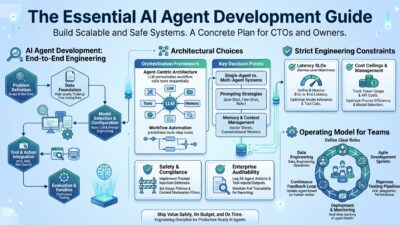
Enterprise reference architecture for AI agent development objective: build once, scale to many agents. Standardize channels, knowledge, tools, guardrails, and observability so each new agent is configuration, not a custom build.
- Channels: web/app chat, email, SMS, voice, internal tools.
- Ingress: event gateway; message bus; SaaS webhooks.
- Orchestrator: agent runtime (state machine/planner); multi‑agent router; policy layer (allow/deny, ceilings, approvals, rate limits).
- Reasoning core: LLMs with function calling; small models for routing.
- Memory/knowledge: conversation state; vector store; RAG; structured KB/CRM/ERP; cache.
- Tools/actions: microservices + SaaS APIs with schemas and RBAC.
- Guardrails: filters, PII redaction, prompt hardening, jailbreak resistance.
- Observability: telemetry, traces, lineage, cost/latency dashboards, feedback capture.
- Governance: eval harness, CI/CD for prompts/policies/models; feature flags; shadow modes.
Diagram: Enterprise Agent Reference Architecture
Alt text: “Enterprise ai agent development reference architecture showing channels, orchestrator, LLM reasoning, RAG knowledge, tools, guardrails, and observability.”
Technology choices and trade‑offs
- LLM abstraction: balance latency/price/quality; add a model router to switch families without rewrites.
- Vector DB: FAISS/pgvector vs. Weaviate/Pinecone; hybrid search (BM25 + vector); domain‑aligned embeddings.
- Orchestration: LangChain/Semantic Kernel/LlamaIndex for POCs; consider custom finite state machines and event‑driven patterns for auditability and resilience.
- Non‑functionals as SLOs: chat P95 <1.5s; voice turn <500ms; 99.9% uptime; cost ceilings; full lineage.
Operate with authority and transparency: Document authorship, decisions, evidence; align with E‑E‑A expectations. Research: Orbit Media; LinkedIn
Data readiness and knowledge integration: make agents know your business
- Inventory product docs, policies, pricebooks, contracts/MSAs, CRM notes, tickets, release notes. Rank by criticality, freshness, access.
- RAG — done right
Pre‑processing: semantic chunking, headers kept, metadata; dedupe; scrub PII; normalize.
Indexing: embedder per type; hybrid search.
Query: filtered retrieval, re‑ranking, context shaping, citations, tool‑grounding (e.g., pricing API).
Freshness: streaming updates, invalidations, TTLs/cadence. - Governance: role/tenant entitlements; masking; consent; redaction pre‑LLM; encryption; access logs.
- Dashboards: accuracy on gold sets; hallucination rate; context hit rate; grounding coverage; freshness lag.
Diagram: RAG Pipeline for Enterprise Knowledge
“RAG pipeline converting enterprise knowledge into retrievable context for ai agent development, including preprocessing, indexing, hybrid search, re‑ranking, and grounding.”
Guardrails, safety, risk, and compliance by design
- Policies: usage bounds; tool scopes; approvals for high‑risk actions; rate limits; cost ceilings; content domain restrictions.
- Safety layers: input/output moderation; PII/PCI/PHI filtering; jailbreak resistance; refusal/escalation patterns; prompt hardening.
- Compliance: immutable audit logs; residency/retention; consent capture; DPIAs; SOC2/ISO mappings; DSR automation; eDiscovery.
- HITL: confidence‑based review; supervised queues for money‑movement/legal; red teaming and drills.
Evaluation and QA: know when your agent is production‑ready
- Test artifacts: gold datasets (100–500 tasks); adversarial sets (prompt‑injection, gray areas, long‑context, multilingual, ASR errors).
- Metrics: task success; exact/semantic match; groundedness (citations valid); tool‑call precision/recall; hallucination rate; escalation appropriateness; CSAT proxy; latency P50/P95/P99; cost/task; containment rate.
- Modes: offline regression + online A/B/interleaving; drift alerts; rollback triggers.
- Release management: version prompts/policies/models/tools; shadow and canary; feature flags; changelogs.
Implementation roadmap: a CEO’s 90‑day AI agent development guide
0–30 days: Discovery + Prototype
- Select 1–2 high‑leverage, low‑risk use cases; define stage outcomes and ROI hypotheses.
- Form tiger team (product owner, platform/ML, security, data, QA).
- Secure data; index top knowledge; build thin‑slice prototype with RAG + 1–2 tools; stand up observability.
31–60 days: Hardening + Eval
- Add moderation, PII redaction, policy layer; set latency/cost budgets.
- Create gold/adversarial tests; integrate 2–3 core tools (CRM/ticketing/billing).
- Instrument evaluation pipelines; prepare shadow mode.
61–90 days: Pilot
- Shadow on real traffic; measure success/deflection/CSAT proxy/cost.
- Iterate prompts/policies/tooling; train frontline; finalize escalation playbooks.
- Set go/no‑go scale criteria with thresholds and risk sign‑offs.
RACI and governance
- Responsible: product owner, platform/ML lead. Accountable: executive sponsor.
- Consulted: security/legal, data governance, frontline managers.
- Informed: Finance, Procurement, Communications, HR.
Call to action
Primary: Schedule a 30‑minute executive working session — scope your first AI agent pilot.
Secondary: Download the CEO 90‑Day AI Agent Development Guide checklist.
Build vs buy: selecting platforms and partners without lock‑in
Build vs buy: how to choose an AI agent builder
- Evaluation criteria: model flexibility/BYOK; data control/residency; observability depth/eval harness; guardrail maturity; RBAC/approvals; audit/export; cost transparency; latency SLOs; roadmap fit.
- RFP checklist (copy/paste): latency SLOs by channel; audit trails; VPC/private networking; SOC2/ISO docs; BYOK; data retention controls; “no training on customer data”; prompt/policy/model versioning; fine‑tuning; eval harness; pricing tiers; usage caps/kill‑switches; exit and portability.
- Vendor landscape: LLMs, orchestration frameworks, vector DBs, ASR/TTS, telephony providers.
How to build an AI voice agent that meets enterprise SLAs
How to build an AI voice agent starts with channel‑specific architecture and a hard latency budget—or CX degrades and containment collapses.
- Channel architecture: SIP/PSTN via Twilio/Vonage; IVR; WebRTC. Real‑time stack: streaming ASR (Deepgram/Google/Whisper RT), TTS (ElevenLabs/Polly/Azure Neural), VAD, barge‑in, echo cancellation. Dialogue manager: barge‑in aware; partials; repairs; privacy announcements; consent capture; escalation.
- Latency budget (per turn 300–500 ms): ASR 100–200 ms; LLM 100–250 ms (streaming + constrained prompts/tools); TTS 80–150 ms (pre‑warm, cache phrases).
- Safety/compliance: recording policies; redaction/PCI suppression; opt‑in retention; jurisdiction routing.
- Voice KPIs: containment, FCR, CSAT, transfer quality, silence time, barge‑in success.
Diagram: Voice Latency Budget and Flow
Alt text: “Enterprise voice agent latency budget showing ASR, LLM, and TTS targets within ai agent development platform.”
Costing, ROI modeling, and procurement guardrails
- Cost drivers: model tokens; RAG retrieval ops; ASR/TTS minutes; tool/API calls; hosting; observability; evaluation runs.
- Unit economics: cost per successful task vs. baseline human cost; scenario analysis for volume, accuracy, model mix, knowledge freshness.
- Budget posture: variable vs fixed; reserved capacity; pilot caps and kill‑switches; abstraction to reduce lock‑in.
- Investment case: break‑even, sensitivity, risk‑adjusted returns; track authority/impact beyond traffic (internal “citations,” adoption, share‑of‑voice).
Security, privacy, and legal: what GCs and CISOs will ask
- Expect: data residency/processing; subprocessors/DPAs; encryption/key mgmt; BYOK; “no training on your data”; IP ownership; indemnities; audit logs/retention/eDiscovery; incident SLAs; DPIAs.
- Pre‑negotiation checklist: red lines on data use; BYOK/residency clauses; SOC2/ISO evidence; provider attestations; shadow‑mode safety plan.
Operating model, talent, and change management for scaled agents
- Org design: “LangOps/AgentOps” platform team (product, ML/LLM, platform eng, safety/ethics, eval/QA, analytics/telemetry); embedded business owners; frontline champions.
- Core processes: intake/triage; prioritization; sprint cadence; eval cycles; incident reviews; model/prompt change control with approvals.
- Training & comms: playbooks, quick‑reference guides, office hours; executive email briefs and visuals for alignment.
Case study blueprint: document wins that unlock budget
- Template: Problem → Approach (architecture, RAG, guardrails, policies, operating model) → Metrics (before/after) → Risks/mitigations → Lessons → Next horizon.
- Evidence standards: reproducible results; links to gold/adversarial tests; runbooks; audited logs; dashboards.
- Packaging: one‑pager + infographic + 90‑second video.
Decision sequence
Pick one valuable, low‑risk task → secure data → thin‑slice prototype → instrument → shadow → harden → pilot → platformize and scale.
10‑item launch checklist
- Executive sponsor/product owner/AgentOps leads named and calendared.
- Business case with baseline KPIs and ROI hypothesis approved.
- Priority intents and knowledge sources inventoried; RAG indexing started.
- Architecture and model abstraction chosen; latency/cost SLOs set.
- Guardrails/policies defined; DPIA plan and audit logging in place.
- Gold/adversarial test suites drafted; success taxonomy agreed.
- Prototype with 1–2 tools and observability shipped to dev/stage.
- Shadow mode enabled; dashboards wired to KPIs.
- Frontline training and escalation playbooks ready.
- Go/no‑go scale criteria and rollback plan documented.
Executive email template
Subject: Launching our 90‑day AI Agent Pilot—focused, safe, and measurableTeam,
We are launching a 90‑day AI agent pilot to improve [use case]. The scope is intentionally narrow with clear safety policies, audit trails, and human‑in‑the‑loop controls.
Goals: [2–3 KPIs]. Guardrails: [2–3 policies]. Timeline: [0–30, 31–60, 61–90 milestones].
We will share a weekly dashboard and brief. Questions → [product owner], [platform lead].
—[Executive sponsor]
Call to action
Primary: Schedule your 30‑minute executive working session to scope the first pilot.
Secondary: Download the CEO 90‑Day AI Agent Development Guide checklist.
Visual assets to produce with this article
- Diagrams: enterprise agent reference architecture; RAG pipeline; voice latency budget.
- Tables/checklists: RFP checklist; evaluation metrics; 90‑day milestones; risk controls matrix.
- One‑pager PDF: CEO pilot plan and success criteria.
- Short video (60–90s): animated architecture overview for executive briefings.
Author
About the author: [Name], Head of Platform Engineering, has led multi‑year AI platform programs across SaaS, fintech, and telecom. They specialize in enterprise agent orchestration, safety engineering, and measurable ROI, emphasizing transparent methods and rigorous evaluation aligned with E‑E‑A expectations. Research:
FAQ
What is an AI agent and how is it different from a chatbot?
An AI agent can perceive, reason, and take actions via tools/APIs to achieve goals within policy, while chatbots typically answer questions; see the definition in this overview.
How fast can we expect ROI from a first pilot?
With a tightly scoped use case, real data, and proper instrumentation, many teams see positive unit economics within 60–90 days, especially in support deflection and sales ops.
How do we prevent hallucinations and brand‑unsafe outputs?
Use RAG with citations, strict policies and refusal patterns, tool‑call constraints, adversarial testing, and HITL at low confidence thresholds.
How do we avoid vendor lock‑in to one LLM provider?
Adopt model abstraction with a router, maintain compatibility tests, and negotiate portability and exit clauses; see LLM abstraction guidance.
What security and privacy assurances will legal and security require?
BYOK, no training on your data, VPC/private networking, RBAC, immutable audit logs, DPIAs, data residency controls, and SOC2/ISO evidence are common requirements.
When should we move from pilot to scaled deployment?
After meeting thresholds for task success, ROI, latency/cost SLOs, and risk sign‑offs—validated via shadow and canary releases with documented runbooks and changelogs.
Summary
Bottom line: Treat AI agents as a platform play, not a project. Start with a narrow, valuable use case; stand up RAG, guardrails, and observability; evaluate rigorously; then scale by configuration across functions. Executives should demand scannable dashboards, transparent methods, and stage‑gated ROI—so value compounds safely.
Next steps
– Pick one thin‑slice task and baseline KPIs.
– Stand up the shared runtime, policy layer, and evaluation harness.
– Shadow, harden, pilot—then platformize to add the second use case.
– Book your executive working session: scope your first AI agent pilot.