

Estimated Reading Time
16 minutes (executive-focused; skim-friendly with bolded metrics, bullets, and mini-cases)
Key Takeaways
- AI agent development is a board-level lever—start with 1–2 measurable use cases, instrument KPIs, and govern from day one.
- Use a modular architecture with RAG, tool allowlists, reversible writes, and full observability to control risk and cost.
- A 90‑day blueprint takes you from discovery to limited production with KPI gates and safety drills before scale.
- Build what differentiates; buy commodity plumbing. Maintain optionality with export paths and “no train on my data.”
- Voice success depends on latency, accuracy, and clean handoffs—see the tutorial on how to build an AI voice agent.
AI Agent Development: A CEO’s end-to-end playbook
As a CEO, you don’t need hype—you need decisions you can fund, govern, and scale. This ai agent development guide gives you crisp architecture choices, a 90‑day execution plan, and a practical voice tutorial. In one sentence, an AI agent is a software system that uses an LLM or policy engine to perceive inputs, plan, call tools and APIs, maintain memory, and act autonomously within human‑approved guardrails.
Why CEOs should care right now
- Because value is real: deflect support contacts, automate internal knowledge work, accelerate sales support, reduce IT ops toil, and streamline back‑office processes.
- Because ROI levers compound: labor augmentation, cycle‑time reduction, 24/7 availability, improved containment, higher NPS/CSAT, and lower cost/interaction.
- Because risks are manageable if designed for: data leakage, hallucinations, brand safety, model drift, and compliance exposure.
What you will get
- A 90‑day blueprint with gates, budget ranges, core roles, and a vendor landscape to de‑risk decisions.
- A practical tutorial on how to build an AI voice agent with latency, CX, and compliance standards.
- A board‑ready KPI stack and RFP checklist to select partners without sacrificing optionality.
Real business case example (anonymized, enterprise B2C)
- Situation: A mid‑market insurer with 1,200 support FTEs launched an LLM‑powered voice agent for policy inquiries and ID card requests across telephony and SMS.
- Actions: Implemented ASR tuned for Spanish/English, RAG over policy documents, reversible CRM writes, strict PII redaction; rolled out with human‑in‑the‑loop (HITL).
- Results after 12 weeks: 32% call containment on targeted intents, AHT down 22%, CSAT 4.3/5 parity with human baseline, and cost/interaction of $0.24 vs $3.20 human. Payback: 5.5 months.
What CEOs Need to Decide Before Funding AI Agent Development
Before you approve budget, lock the strategy—or you risk demo‑ware that never scales.
- Business case and success criteria
Pick 1–2 high‑impact, low‑regret use cases with measurable value. Define KPIs upfront (e.g., CSAT ≥ 4.3/5, AHT −25%, FCR +15%, cost/interaction <$0.30, policy violations <0.5%). Tie each KPI to dollars. - Risk posture and red lines
Prefer “graceful deflection” to confidently wrong. Explicit no‑go areas (PII exposure, legal/medical advice, trading, irreversible transactions). Require reversibility and auditability for all writes. - Governance model and accountability
Executive sponsor with P&L. DPO/CISO sign‑off for data flows; model risk committee for releases and incidents. Define HITL escalation paths and on‑call. - Build vs buy appetite and constraints
Clarify vendor lock‑in tolerance and IP strategy. Note regulatory contexts (GDPR/CCPA/HIPAA/PCI), residency, and infra constraints. Demand exportability and retrainability. - Time‑to‑value scope and decision gate
Commit to a 6–12 week pilot and a 90‑day decision gate with pre‑agreed KPIs and a cost envelope. Freeze scope creep.
CEO tip: Tie funding tranches to KPI milestones and safety audit results—velocity with prudence.
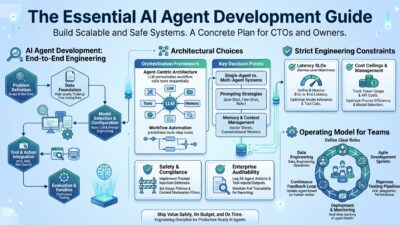
AI Agent Architecture at a Glance: Components and Technical Choices
You don’t need to code it—but you must sanction the architecture. Architecture choices determine cost, latency, risk, and future optionality.
- Foundation model layer
Hosted (OpenAI/Azure OpenAI, Anthropic, Google) for speed/quality; self‑hosted (Llama, Mistral) for data control/cost. Decide by domain performance, latency SLOs, cost/token, and data‑use terms. - Orchestration/runtime
Tool/function calling, multi‑turn planning, parallel tools, retries, error handling. LangChain, LlamaIndex, or custom policy engine. Orchestration maturity drives time‑to‑market and debuggability. - Tooling layer
Read‑only first (CRM, ERP, ticketing, calendars, KBs); then writes with least‑privilege, dry‑run previews, and auditable logs. - Retrieval augmentation (RAG)
Trusted, versioned sources via embeddings + vector store + re‑ranking. Index cleansed, PII‑redacted content with provenance. - Memory
Short‑term dialogue state; long‑term user/entity memory with consent, TTLs, and deletion workflows. - Guardrails and safety
Input filters (toxicity, PII, jailbreak), policy classifiers, allow/deny tool lists, output moderation and fact‑checks. Full compliance logs. - Observability
Turn‑level tracing; dashboards for tokens/cost/latency; prompt + version control; automated eval harness with human review.
Voice‑specific addendum
- STT/ASR: Whisper, Google, Azure, Deepgram; tune vocabulary; target WER < 10%.
- Turn‑taking: VAD + barge‑in; per‑turn latency ≤ 800 ms (ASR 200–300, LLM 300–400, TTS 100–200 ms).
- TTS: Neural voices with SSML; target MOS ≥ 4.2; brand voice consistency.
- Telephony: SIP/RTC or CPaaS; consent prompts; call control APIs.
Example policy snippet (allowlist + reversible writes)
{
  "tools": {
    "crm.lookup": { "access": "allow", "scope": ["read:customer","read:case"] },
    "crm.create_case": { "access": "allow", "scope": ["write:case"], "reversible": true, "dry_run_required": true },
    "billing.refund": { "access": "deny" }
  },
  "pii": { "redact_before_index": ["cc_number","ssn","dob"] },
  "escalation": { "confidence_threshold": 0.72, "route_to_human": true }
}
Require your team to present this policy file for approval before go‑live—small documents prevent large incidents.
Build vs Buy: A Decision Framework That Protects ROI and Optionality
Make modular choices now to avoid expensive rewrites later—see how to choose an AI agent builder.
- Differentiation lens: Build unique IP or regulated logic; buy commodity layers (telephony, generic orchestration, off‑the‑shelf classifiers).
- TCO model (12–24 months): Include LLM fees/inference hosting, vector DB, observability, security reviews, compliance audits, human QA, prompt/knowledge upkeep, retraining, HITL staffing, retries/failures, lifecycle mgmt, and incident response.
- Data residency and compliance: If strict residency, self‑host models/vector stores; otherwise confirm SOC 2, ISO 27001, HIPAA/PCI, and region pinning.
- Vendor maturity: SDKs, webhooks, tool catalogs, streaming, latency SLOs, support SLAs, export/migration paths; “no train on my data.”
- Quick heuristic: Prototype with managed LLM + off‑the‑shelf orchestration; migrate components to owned infra as scale and constraints demand.
Implementation Blueprint: From Pilot to Production in 90 Days
Speed without shortcuts—velocity wins only if safety and KPIs keep up. See strategy-to-deployment details in this execution guide: AI agent development strategy → deployment.
- Week 0–2: Discovery and guardrails
Map processes/KPIs; assemble knowledge; define red lines + HITL triggers; security review and audit logging; deliver success metrics, incident runbooks, policy file, and golden tests. - Week 3–5: Prototype
Stand up RAG, baseline prompts, 5–10 golden tests per task; integrate 1–2 read‑only tools; enable tracing and cost tracking; run shadow mode and collect confusion matrices. - Week 6–8: Hardening
Add reversible writes; enforce safety filters and allowlists; internal beta + human ratings; optimize latency with streaming, truncation, caching. - Week 9–12: Limited production
Expand integrations/intents; tune latency p95 and cache hits; set cost controls; define SLA/on‑call/rollback; A/B vs human baseline; decision gate on KPIs + incident drills.
Budget guardrail: $75k–$250k for constrained voice/chat; $250k–$600k for multi‑system + compliance. Fund in tranches tied to gates.
How to Build an AI Voice Agent That Customers Trust
Trust is won in milliseconds. Design for low latency, high accuracy, clean handoffs, and compliance—start with this how to build an AI voice agent primer.
- Telephony: SIP/CPaaS (Twilio/Vonage); webhook call control; consent notices; DTMF fallback; correlation IDs.
- STT/ASR: Whisper/Google/Azure/Deepgram; domain/accent tuning; custom vocabulary; WER < 10% with biasing for key terms.
- NLU/Turn‑taking: VAD + barge‑in; interruptions handled politely; per‑turn ≤ 800 ms; stream partials to cut perceived delay.
- Dialogue management: System prompt for role/tone/compliance; track state; confirm key facts; repeat sensitive details.
- TTS: Neural voices (SSML control); MOS ≥ 4.2; brand voice consistency; test with panels.
- LLM + tools: RAG for policies/product data; secure CRM/ticketing/scheduling; reversible writes.
- Compliance: Consent; PII redaction; PCI/PHI segmentation; retention policy; encryption at rest/in transit.
Customer safeguards: Confidence‑based human handoff with warm transfer + transcript; abuse handling; three “I didn’t catch that” thresholds; post‑call SMS/email recap for critical transactions.
Voice agent metrics on your dashboard
- Business: Containment, CSAT, AHT vs human, transfer, abandonment, cost/call.
- Technical: ASR WER, latency p95, policy violations, tool errors, TTS glitches per 1k calls.
Data, Security, and Governance for Enterprise‑Grade Agents
- Data controls: Tenant isolation, encryption, secrets in KMS/HSM, column‑level PII redaction pre‑index, DLP on egress; contract “no training on my data” with deletion SLAs.
- Residency: Region pinning for LLMs and vector stores; on‑prem for sensitive workloads; DR tested quarterly.
- Access/least privilege: Per‑tool scopes, short‑lived tokens, JIT access, auditable action logs mapped to users/sessions.
- Compliance overlays: GDPR DPIA and DSR workflows; CCPA opt‑outs; SOC 2; HIPAA/PCI segmentation; explicit consent for recording/transcripts.
- Change management: Prompt/policy versioning; rollout rings; kill switch; post‑incident reviews within 72 hours.
Board question: “Who accessed what, when, and why—and how can we reverse it?” Your logs and policies should answer in minutes.
Safety, Guardrails, and Evaluation
Trustworthiness is engineered via layered controls and measurable evals—see this deeper ai agent development guide on safety.
- Layers: Pre‑LLM input scanning (PII/toxicity/jailbreak), policy‑grounded prompts, tool permission policies, output moderation, retrieval overlap checks.
- Evaluation harness: Golden test sets (≥100 per use case, refreshed quarterly); auto‑graders for structure/factuality/refusals; human rubrics for accuracy/tone/compliance with severity tags.
- Continuous validation: Shadow mode, canary traffic, weekly eval runs; regression thresholds gate releases; auto rollback on spikes.
- Executive signal pack: Hallucination rate, violation rate, tool error rate, groundedness, refusal appropriateness, cost/interaction trend.
Integration Patterns: Connect Agents to CRM, ERP, and Knowledge Safely
- Patterns: Start read‑only; then constrained writes with dry‑run previews and approvals; event‑driven webhooks; idempotent calls; retries with backoff; circuit breakers.
- Knowledge ingestion: ETL for PDFs/HTML/SharePoint/Confluence; chunk 300–800 tokens; hybrid dense + BM25 with re‑ranking; cite sources in every answer.
- Observability: Trace each tool call with input/output and user/session; correlate technical metrics to business KPIs; tag data lineage (doc + embedding + index versions).
Operating Model and Team: Who Runs Your Agents After Go‑Live
Treat agents like a product with P&L—and run them accordingly.
- Core roles: Product owner (P&L), solutions architect, LLM/ML engineer, data engineer, prompt/policy engineer, Sec/Compliance lead, QA/CX analyst, SRE/AIOps.
- Processes: Weekly error review; prompt library governance; dataset curation; rollbacks; incident mgmt; cost stewardship with budgets per intent.
- Documentation: Runbooks, escalation matrices, audit packs, HITL RACI.
- Resourcing tip: Co‑source early (internal + partner) with a 6–12 month transition to in‑house ownership of prompts, knowledge, and observability.
KPIs, Cost Model, and Board‑Ready Economics
- KPI stack (intent‑level): Experience (CSAT/NPS, FCR, containment, AHT delta); Quality (accuracy/groundedness, refusals, policy violations, hallucination rate); Performance (latency p50/p95, throughput, time‑to‑resolution); Financial (cost/interaction, opex delta, payback, NPV/IRR).
Sample unit economics
- Pilot (chat): 50k monthly interactions → LLM ~$0.0054/interaction; vector/infra/obs ~$0.010; QA (5% samples) ~$0.020; total ≈ $0.036 vs $3–$6 human; breakeven at ~0.6% deflection.
- Voice (inbound support): 100k monthly calls on 3 intents → ASR/TTS+LLM ~$0.14/call, CPaaS+storage ~$0.03, QA/HITL ~$0.05; total ≈ $0.22/call vs $3–$4 human; payback with 10–15% containment on targeted intents.
Cost levers: Prompt compression; truncation; caching; small‑model routing; batch embeddings; vector tiering; channel deflection (voice → SMS).
Common Failure Modes (and How to Avoid Them)
- Launching without guardrails/HITL → Add policy engine, denial lists, confidence‑graded handoff.
- “Demo‑ware” dies in production → Invest in eval harnesses, tracing, golden tests; gate on regressions.
- Unbounded tool access → Allowlists, reversible actions, dry‑runs, approvals.
- Knowledge drift → Scheduled re‑indexing, stale‑content detection, content owner SLAs.
- Sticker shock → Caching, small‑model routing, ROI gates per intent, vendor pricing on usage.
- Compliance surprises → DPIA pre‑pilot, data‑use clauses, access reviews, tested kill switches.
- Latency‑driven CX failure (voice) → Strict per‑turn budgets, streaming, ASR biasing, pre‑canned responses.
Checklist and RFP Questions CEOs Can Use
- Architecture/portability: End‑to‑end diagram; export paths (prompts, logs, indexes); rate limits and SLO enforcement.
- Security/data usage: SOC 2/ISO 27001; sub‑processors; region pinning; “no train on my data”; retention/deletion SLA; secrets, encryption, tenant isolation.
- Compliance/governance: DPIA templates; DSR workflows; HIPAA/PCI segmentation; incident response policy + P1 summaries.
- Evaluation/KPIs: Methodology, golden tests, human review; KPI commitments (CSAT, containment, latency p95, violations) + remedies.
- Observability/safety: Tracing, cost dashboards, prompt versioning, kill switch; safety layers (input scanning, classifiers, moderation, allowlists).
- Voice (if applicable): Turn latency budget; ASR/TTS tuning; telephony integrations; consent/PII redaction.
- References/outcomes: 2–3 industry references with quantified results.
- Commercials: Per‑interaction pricing with volume tiers and CPI guardrails; exit clauses; migration support; PS vs recurring split.
Executive Summary You Can Share with Your Board
- Use cases: Start with 1–2 intents where value is clear (support containment, internal knowledge automation).
- ROI: $0.04–$0.25 per interaction vs $3–$6 human; 5–8 month payback at modest containment with CSAT parity.
- Architecture: Managed LLM to start; RAG over cleansed knowledge; tool allowlists; reversible writes; observability + eval harnesses.
- Safety: Input scanning, policy prompts, tool policies, output moderation, confidence‑based human handoff.
- Compliance: GDPR/CCPA DPIA + DSR, region pinning, retention controls, encryption, audit logs.
- 90‑day plan: Discovery/guardrails (0–2), prototype (3–5), hardening (6–8), limited production (9–12) with KPI gates.
- KPIs: CSAT ≥ 4.3/5, AHT −25%, FCR +15%, containment 20–40% (targeted), violations <0.5%, voice latency p95 < 800 ms.
- Ops: Product owner, architect, LLM engineer, data engineer, prompt/policy, Sec/Compliance, QA/CX, SRE; weekly error reviews; versioned prompts.
- Build vs buy: Buy plumbing; build differentiated workflows; insist on exportability and “no train on my data.”
- Decision gates: Scale only when KPIs and incident drills pass; sunset or pivot otherwise.
- Cost controls: Caching, small‑model routing, vector tiering, channel deflection, sunset low‑value intents.
FAQ
What exactly is an AI agent and how is it different from a chatbot?
An AI agent plans, calls tools/APIs, maintains memory, and acts within guardrails; a chatbot typically just responds to text. For a one‑sentence definition, see this explainer.
What KPIs should a CEO mandate before approving funding?
At minimum: CSAT ≥ 4.3/5, AHT −25%, FCR +15%, 20–40% containment on targeted intents, policy violations <0.5%, and cost/interaction benchmarks for chat and voice.
How do we choose between building vs buying our AI agent stack?
Build differentiated workflows and regulated logic; buy commodity plumbing (telephony, generic orchestration). Insist on exportability and “no train on my data”—see this decision framework.
What are the non‑negotiable safety and governance controls?
Input scanning (PII/toxicity/jailbreak), policy prompts, tool allowlists with reversible writes, output moderation, full tracing, and a model risk committee with HITL escalation paths.
How do we keep answers accurate and reduce hallucinations?
Use RAG over cleansed, versioned sources with provenance; enforce retrieval overlap checks; maintain golden test sets and weekly evaluations before and after releases.
What makes or breaks a voice agent’s customer experience?
Latency (≤800 ms/turn), ASR accuracy (WER <10%), clear handoffs to humans, SSML‑tuned TTS, and compliance overlays (consent, PII redaction, retention)—see the voice guide.
How soon can we reach production and see payback?
With a focused scope and ready data, you can reach limited production in ~90 days; many programs clear scale gates within 5–8 months of payback on targeted intents.
Summary
Bottom line: Treat AI agent development as a governed, KPI‑driven product program. Start with a focused pilot, use a modular architecture, enforce safety and reversibility, and measure relentlessly. Follow the 90‑day plan, validate against CSAT/containment/cost targets, and scale only when incident drills and governance pass. For voice, lean on the how to build an AI voice agent tutorial. This ai agent development guide equips you to fund with confidence, govern with rigor, and scale with optionality.