

Estimated Reading Time 18 minutes
Key Takeaways
- This is an architecture-first AI agent development guide for CTOs and business owners moving from demos to production.
- Expect measurable results in 1–2 quarters: 20–40% automation of repetitive steps; 15–30% AHT reduction for voice and chat; improved auditability and risk posture.
- Adopt a reference architecture with a clear planner, tool executor, memory, RAG, safety policies, and end-to-end observability.
- Latency and cost are engineered: streaming, caching, adaptive model routing, and strict SLOs per step.
- Security-by-design: PII scrubbing, policy gates, model/tool allowlists, audit logs, and compliance reviews.
- Includes a prescriptive, step-by-step plan for how to build an AI voice agent that meets sub-500 ms turn-taking targets.
Introduction: why this AI agent development guide exists
AI agent development is now a board-level initiative. Leaders need a rigorous, operating-model plus architecture view—beyond prototypes—to govern risk, meet SLOs, and prove ROI. This AI agent development guide defines an end-to-end reference stack, highlights decision trade-offs, and provides a production playbook, including how to build an AI voice agent that delivers measurable outcomes.
Executive summary: outcomes, risks, and ROI from AI agent development
What you can achieve in 1–2 quarters
- Efficiency gains
– 20–40% automation across repetitive ops steps (triage, knowledge lookup, order status, appointment scheduling).
– 15–30% AHT reduction for voice and chat via streaming LLMs, retrieval, and tool execution. - Revenue uplift
– Faster lead follow-up and personalized outreach (CRM lookup + RAG).
– 24/7 tier-1 support containment with higher NPS/CSAT and lower cost-to-serve. - Risk posture improvement
– Policy-driven tool access; PII/PHI scrubbing; full-trace observability and audit readiness.
What good looks like before GA
- ≥95% task success on golden-path intents; <1% severe error rate.
- Latency SLOs: TTFB <700 ms (text); sub-300–500 ms effective turn-taking (voice) with streaming partials.
- Costs stabilized with caching, prompt compression, and adaptive model routing—reviewed in weekly ops.
Lifecycle and change management
Ideation → design → pilot → gated launch → scale with SRE-grade ops; feature flags by tenant/region/intent; incident runbooks and rollback hooks.
Decision checklist (own vs buy and initial platform choices)
- In-house vs vendor: Data sensitivity? Core-differentiating capability? Need on-prem inference or custom models?
- LLM choice: Hosted (OpenAI/Anthropic/Google) vs self-hosted (Llama/Mistral) behind an inference gateway; weigh latency, control, cost, privacy.
- RAG/data footprint: Identify sources of truth; retention and citation policy; retrieval filters.
- Privacy/compliance: SOC 2/ISO; HIPAA/PCI where applicable; regional data residency; DPAs with model/ASR/TTS vendors.
- Observability: E2E tracing, replay sandboxes, cost/latency dashboards, red-team workflows.
- SLOs: Cost caps per task; latency budgets per step; error budgets (tool, LLM, safety blocks).
What AI agents are in production terms: an ai agent development guide perspective
Precise definition
An AI agent is a goal-directed system that:
– Perceives: consumes text, voice, or event inputs.
– Plans: chooses steps with a planner (ReAct, Tree-of-Thought, graph-of-thought).
– Acts: executes tools/APIs deterministically via a tool executor.
– Learns: adapts from outcomes under governance (episodic memory, offline eval, policies).
– Operates: adheres to guardrails and SLOs with full observability.
How agents differ from chatbots
- State and memory: dialog state, profile memory, episodic outcomes vs. often stateless chatbots.
- Tools and actions: schema-validated tool calls vs. text-only responses.
- Autonomy levels: assistive, supervised, semi-autonomous within scoped policies.
- Workflow execution: multi-step orchestration with retries and circuit breakers.
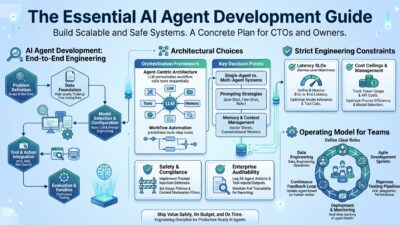
Reference architecture for modern ai agent development (diagram-ready)
Textual diagram (left-to-right flow)
- Clients: web/mobile/CLI; voice via Telephony/SIP (Twilio/Vonage) or WebRTC.
- API Gateway: OIDC/OAuth2, rate limits, request enrichment (tenant ID, RBAC, PII tags).
- Orchestrator: prompt templates; guardrails; planner (ReAct/ToT/Reflexion); tool registry & dispatcher; state machine with durable execution (Temporal/Cadence); retry/backoff; circuit breakers.
- LLM layer: hosted and/or self-hosted behind inference gateway; streaming for partials; model router (cheap→expensive fallback).
- Knowledge & memory: vector DB; ops DB; Redis cache; document store with ingestion/indexing pipeline.
- Tools & integrations: internal services (billing/CRM/ticketing); third-party APIs; secrets in KMS/Vault.
- Safety & governance: PII/PHI scrubbing; content moderation; jailbreak filters; policy engine; audit logging and versioning.
- Observability: OpenTelemetry/LangSmith tracing; metrics (latency, cost, token/tool fail); replay/sandbox.
- Deployment: K8s (HPA), serverless for burst, edge for low-latency, canary/flags/shadow mode.
Trade-offs to call out
- Hosted vs self-hosted LLMs: speed-to-market vs privacy/control/cost at scale.
- One orchestrator vs capability services: simpler governance vs isolated scaling/failure domains.
- Single vs polyglot vector DB: ops simplicity vs domain-optimized recall/latency.
Capability stack and design patterns in the ai agent development guide
Planning strategies
- ReAct: default for tool-heavy flows; interleaves reasoning and action.
- Tree-of-Thought: multi-constraint decisions (e.g., scheduling + pricing).
- Reflexion/self-correction: reflective steps on low confidence; bounded by timeouts/step caps.
Tooling patterns (mission-critical)
- JSON schema-based function calling with strict validation.
- Idempotent tools with requestId and replay-safe semantics.
- Timeouts per tool; exponential backoff with jitter.
- Partial failure handling with graceful degradation and provenance.
- Compensating transactions for multi-step writes.
Memory types and governance
- Short-term: dialog buffer + summarization.
- Long-term semantic: vector store with TTL by tenant; prevent memory bloat.
- Profile memory: preferences with consent and purpose binding.
- Episodic: outcomes and error cases for offline learning under policy.
State management
Durable orchestrations (Temporal/Cadence) with audit trails; event sourcing to correlate tool/LLM actions to durable events.
Data and knowledge grounding: a pragmatic RAG-first strategy
Ingestion pipeline
- Source-of-truth selection (CRM, KB, policy docs, product specs).
- Semantic chunking to balance recall and token cost.
- Metadata tagging (owner, freshness, sensitivity, jurisdiction).
- Indexing cadence: rebuild on schema change; incremental on deltas.
Embeddings and monitoring
- Domain-adapted vs general-purpose embeddings; benchmark .
- Drift checks; re-embed on schema/content drift or model upgrades.
Retrieval strategy
- Hybrid search (BM25 + vector); filters for tenant/recency/role.
- Reranking (MMR) and cite sources in outputs.
Guarding against hallucinations
- Answerability checks; explicit refusal/clarification when grounding is weak.
- Confidence scoring combining retrieval, tool success, and LLM self-estimate.
Offline indexing QA
- Coverage analysis; golden sets; monthly human audits; automated diffs.
Security, privacy, and governance for enterprise-grade ai agent development
Adopt security, privacy, and governance controls from day one.
- Data handling: PII/PHI detection and redaction pre-LLM; field-level encryption; residency controls; retention matrices.
- Access control: role-based prompts/tools; scoped credentials in a secret manager; per-tenant allowlists for high-impact tools.
- Model governance: model/embedding versioning; prompt/policy snapshots; audited exceptions.
- Compliance and safety: SOC 2, ISO 27001, HIPAA/PCI where relevant; red-teaming and anomaly detection; append-only audit logs.
Cost, latency, and reliability engineering
- Latency budgets: text TTFB <700 ms; voice turn-taking <300–500 ms with streaming partials and TTS prefetch.
- Cost controls: prompt compression, retrieval pre-filters, semantic/response caching, adaptive model routing, batch offline jobs.
- Reliability patterns: circuit breakers; retries with jitter; idempotency tokens; DLQs; outbox pattern.
- SLOs and SRE: error budgets per domain; rollback on burn-rate; monthly cost/latency reviews and anomaly alerts.
Observability, evaluation, and continuous improvement
- Tracing and metrics: trace prompts, tool calls, outputs, tokens, latency; metrics for task success, groundedness, hallucination rate, tool error rate, cost/task, and voice CX (AHT, barge-in).
- Offline evaluation: golden datasets per intent; synthetic data with human review; groundedness labeled by citations.
- Online evaluation: A/B prompts/tools/policies; holdouts; replay and sandbox with deterministic stubs; CI/CD regression gates.
Deployment patterns from POC to production
- Milestones: feasibility spike → internal pilot → constrained beta (shadow risky tools) → GA with progressive exposure.
- Release strategies: canary by tenant/region; shadow mode comparisons; staged model rollouts with dual-run.
- Infrastructure: hosted vs self-hosted LLMs; GPU autoscaling; scale-to-zero for episodic workloads; edge inference for VAD/moderation.
- Operational playbooks: incident runbooks (LLM/tool outages, token surges, safety false positives); on-call rotations; blameless post-incident reviews.
How to build an AI voice agent: a production implementation playbook
This is deliberately prescriptive—focused on latency, cost, and safety.
- Channel ingress and call control: SIP (Twilio/Vonage) or WebRTC; VAD for end-of-speech and barge-in; attach tenant/locale/persona/consent to session context.
- ASR: streaming Whisper large-v3 turbo, Deepgram, or Google STT; custom vocab; forward partials early.
- NLU/LLM turn processing: streaming LLM with function calling; maintain dialog + consented profile memory; policy gates for clarifications/escalation.
- Tool integration: CRM lookup, order status, ticket creation, RAG; hard timeouts (e.g., 800 ms reads, 2 s writes); graceful fallbacks; escalate on low confidence.
- TTS: low-latency neural TTS (ElevenLabs, Azure, Amazon Polly); SSML + phoneme dictionaries; chunked streaming to minimize dead air.
- Turn-taking and latency: stream tokens; prefetch likely next phrases; interrupt TTS on barge-in; cache frequent responses as audio.
- Safety and compliance: consent prompts; PII scrubbing; redacted transcripts; HIPAA/PCI-aware flows by vertical.
- KPIs and testing: containment, AHT, CSAT, FCR; red-team adversarial prompts and noisy environments; golden-path success ≥95%.
- Rollout: start with narrow intents (order status, hours, appointments); supervisor whisper; escalate on tool failure/confidence drop.
Pseudocode: streaming voice pipeline (simplified)
function handleCall(session):
  ctx = initContext(session.tenant, session.locale, consent=session.consent)
  vad = startVAD()
  asr = startASR(streaming=True, bias=ctx.domain_vocab)
  tts = startTTS(streaming=True, voice=ctx.brand_voice)

  while session.active:
    user_audio = readAudioChunk()
    if vad.isSpeechEnd(user_audio):
      partialText = asr.partial()  // forward partials to speed planning
      finalText = asr.finalize()
      plan = orchestrator.planAndAct(
        input=finalText,
        context=ctx.dialogState(),
        tools=toolRegistry,
        policy=policyEngine,
        streaming=True
      )
      for token in plan.tokens():
        tts.enqueue(token)
        if userStartsTalking():  // barge-in
          tts.interrupt()
          break
      if plan.requiresEscalation:
        escalateToHuman(plan.summary, transcript=ctx.transcript())
        break

  cleanup(session)
Config snippet: safety policy YAML (excerpt)
policies:
  - id: pii_scrub
    applies_to: [input, output, tools]
    action: redact
    patterns: [SSN, credit_card, DOB, email, phone]
  - id: high_risk_tool
    tools: [refundPayment, changeAddress]
    require_approval: true
    approvers: [team:supervisors]
  - id: escalation
    conditions:
      - confidence < 0.55
      - tool_error_rate > 0.15 over 5m
    action: route_to_human
Config snippet: OpenTelemetry tracing (conceptual)
tracing:
  exporter: otlp
  sampling: parentbased_traceidratio=0.2
  attributes:
    service.name: "voice-agent"
    tenant.id: "${TENANT_ID}"
    session.id: "${SESSION_ID}"
  spans:
    - name: "asr.decode"
    - name: "llm.plan"
    - name: "tool.crm.lookup"
    - name: "tts.synthesize"
Real business case: mid-market retailer voice agent
Context: 500-employee home goods retailer; intents = order status + returns.
Approach: Twilio SIP, Deepgram streaming ASR, GPT-4o-mini with function calling, Pinecone RAG, Azure Neural TTS.
Tooling: OMS read API (800 ms SLA), Zendesk ticket creation (1.5 s), idempotent “initiate_return” with compensating “cancel_return”.
Outcomes (8 weeks): 37% containment (eligible intents); 22% AHT reduction (mixed bot/human queue); $0.41 cost per resolved call (from $1.10); 0 severe incidents; 99.1% tool-call success; 84% barge-in success.
Trade-offs: Slight silence during OMS spikes → mitigated with streaming empathy phrases + prefetching likely next steps.
Build vs buy: a decision framework for CTOs
See build vs buy for diligence criteria. If custom AI agents are a core moat or data residency is strict, build key layers (orchestrator, safety, data). If urgency dominates, start with managed LLMs and off-the-shelf observability; refactor later. Compare TCO and SLAs against staffing and on-call load; validate export paths for prompts, policies, datasets, and logs.
Common failure modes and anti-patterns
- Over-autonomy without guardrails; irreversible actions without approvals.
- No offline evals; GA without golden datasets and regression tests.
- Blind retries without idempotency; duplicate charges or tickets.
- Unbounded context windows; ballooning cost/latency and privacy exposure.
- RAG without governance; stale/uncited/sensitive docs indexed.
- Ignoring PII; sending raw identifiers to third-party models.
Mitigations: policy engine with role-based tools and approvals; stepwise rollouts with shadow mode; idempotency tokens and compensations; systematic retrieval Q citations; PII scanners with pre-LLM redaction and policy-bound retention/erasure.
Implementation checklist: the ai agent development guide condensed
- Design: define use cases and autonomy level; measurable success metrics; risk register.
- Architecture: orchestrator with planner, tool registry, state machine, safety policies; LLM strategy (hosted vs self-hosted) with streaming; memory/RAG with ingestion, embeddings, vector DB, retention, citations.
- Data: sources of truth; semantic chunking; metadata; hybrid retrieval; re-embed cadence.
- Security: RBAC for prompts/tools; PII/PHI handling; encryption; auditability; compliance gates.
- Ops: tracing/metrics; SLOs/error budgets; incident runbooks; CI/CD with regression gates.
- Voice-specific: ASR/TTS choices; latency & barge-in; call flows; consent language; escalation.
- Launch: pilot gating; shadow/canary rollouts; KPI dashboards; HITL feedback loops.
FAQ
What is the difference between ai agent development and building a chatbot?
Chatbots mostly return text; AI agents plan, call tools/APIs with schemas, maintain memory, and operate under policies with observability and SLOs.
How do I choose between hosted and self-hosted LLMs for my ai agent development guide?
Hosted accelerates delivery but raises data residency/control risks; self-hosted demands GPU ops yet can cut unit cost and improve privacy at scale—benchmark latency, cost, and governance needs.
What SLOs should I set before promoting an agent to GA?
Examples: ≥95% golden-path success, severe error rate <1%, text TTFB <700 ms, voice turn-taking <300–500 ms, and cost-per-task budgets with weekly reviews.
How can I prevent hallucinations in production agents?
Use RAG with hybrid search and reranking, enforce answerability checks and explicit refusal policies, and require citations with retrieval confidence thresholds.
What are must-have safety controls for enterprise deployments?
PII/PHI scrubbing, role-based tool access, model/tool allowlists, audit logging with versioned prompts/policies, and red-teaming for jailbreaks and misuse.
How do I build an AI voice agent without blowing latency budgets?
Use streaming ASR and LLM, prefetch TTS, cache common audio, set strict tool timeouts, support barge-in, and trace every step to locate bottlenecks quickly.
Summary
Bottom line: Successful ai agent development blends architecture discipline, rigorous evaluation, and security-by-design with pragmatic cost/latency engineering. Use this ai agent development guide to move from pilot to production, then scale with confidence—starting with narrow, high-impact intents and full observability. When you are ready to operationalize voice, follow the step-by-step plan for how to build an AI voice agent that meets SLOs and proves ROI in weeks, not quarters.