

Estimated Reading Time
17 minutes (CEO-friendly with bolded checkpoints, quick metrics, and a strict FAQ)
Key Takeaways
- AI agent development has moved from hype to operations—fund pilots tied to money-in or money-out workflows.
- Anchor your plan in governance, latency, and task success targets; scale traffic only after >80% task success.
- Start where ROI is provable: support triage/resolution, sales development, after-hours voice, IT/HR desks, and finance back office.
- Adopt a layered architecture with an orchestrator, RAG-first knowledge, typed tools, safety rails, and Human-in-the-Loop (HITL).
- Voice is unforgiving—design for barge-in, <500 ms perceived gaps, and compliant warm transfers with summaries.
- Use a model portfolio; pin versions, evaluate upgrades, and keep vendor redundancy to avoid lock-in.
- 90-day playbook: discovery/guardrails → prototype/RAG → voice/HITL → pilot readiness with SLOs, load tests, and runbooks.
Introduction: Why this AI agent development guide exists for CEOs
AI agent development is past the hype and into operations. If you’re a CEO, this ai agent development guide explains what intelligent agents can and cannot do, where the ROI comes from, and how to go from idea to a reliable pilot in 90 days. Early on, we’ll also show how to build an ai voice agent that customers actually want to talk to—because voice is where latency, safety, and CX collide with the highest stakes.
Executive Brief: What CEOs need to know before funding AI agent development
- Short definition you can use with your team
An “AI agent” is an autonomous or semi-autonomous software entity powered by one or more large language models (LLMs) that can plan, reason, and execute tasks via configured tools/APIs. It operates under explicit policies and guardrails to meet business goals and comply with regulation. - What good looks like (outcomes)
- Faster resolution times: lower AHT, higher FCR.
- 24/7 coverage and peak smoothing without headcount spikes.
- Lower cost-to-serve: containment/deflection in support; automation for back-office triage.
- Consistent compliance with scripts, disclosures, and policy checks.
- Better data capture: structured notes, accurate tags, and CRM hygiene.
- Budget bands for your board slide
- Discovery/POC: $25k–$100k
- Pilot: $75k–$300k
- Production scale: $250k–$1M+
- Latency and UX targets to insist on
- Text: <1.2s p95 response
- Voice turn-taking: <300–500ms perceived gap; smooth barge-in
- Human handoffs: <10s to warm-transfer; include transcript and summary
- Task success rate: >80% before scaling traffic
- Governance must-haves
- Model/data ownership clarity, PII handling/retention, auditability
- HITL fallback with confidence thresholds
- Incident response playbook: detection, containment, legal review, customer comms
- CEO decision: greenlight if
- You can name a money-in or money-out workflow with measurable KPIs
- You accept a 90-day learning curve, not a day-one replacement
- You have an accountable product owner and a clear must-not-do list
From LLMs to Agents: Practical definitions
- LLM vs Agent
LLM: a base or chat model that predicts the next token—the brain.
Agent: an application that wraps the LLM with planning, memory, tools, policies, and orchestration to act on your business systems—the brain with hands, a schedule, and rules. - Agent capabilities glossary
- Planning: ReAct, Tree-of-Thought, or graph planning for reliable subgoals
- Tool use: typed function calls to APIs/CRMs/ticketing; allow-lists enforce least privilege
- Memory: short-term (dialogue state), long-term (vector search), episodic (per-customer)
- Retrieval (RAG): authoritative enterprise context at runtime; better freshness/governance
- Orchestration: flows/state machines, retries, timeouts, compensating actions
- Autonomy: Assistive → Supervised → Fully autonomous (with monitoring)
- Frameworks and platforms to know (no endorsements)
LangChain/LangGraph, OpenAI function/realtime APIs, Microsoft Semantic Kernel, CrewAI, AutoGen
Choosing high-impact use cases
Start where dollars are measurable; prioritize top-right in an Impact × Implementability 2×2.
- Customer support triage and resolution
Objectives: increase deflection, reduce AHT, improve CSAT.
Scope: auth lookups, order status, warranty/returns, policy retrieval, structured follow-ups. - Sales development agent
Objectives: qualify leads, book meetings, enrich CRM, clean handoffs.
Scope: email sequences, chat qualification, scheduling, objections with policy constraints. - AI voice agent for inbound calls (after-hours and peak)
Objectives: maintain SLAs, triage intents, routine requests, graceful escalation.
Scope: auth, account lookups, scheduling, payment arrangements with redaction. - IT helpdesk and HR policy desk
Objectives: cut ticket creation time, deflect how-to queries, policy-consistent answers. - Finance back office
Objectives: faster invoice coding, AP/AR status, onboarding with approvals. - Define success metrics up front
Support: deflection/FCR/AHT/SLA/CSAT and cost-to-serve delta; Sales: conversion/SQL/meetings/pipeline and latency.
A real business case to benchmark against
- Context: Mid-market retailer (800 FTEs) with seasonal spikes
- Use cases: Web chat agent (support) and after-hours voice for order status/returns
- Build: 12 weeks to pilot; HITL escalation to 40 human agents during peak
- Results after 60 days (15% → 30% canary)
- Deflection: 38% of chat contained
- AHT: -24% on agent-assisted chats (prefill + notes)
- Voice: 62% of after-hours calls fully resolved; p95 turn-taking 480ms
- Compliance: 100% disclosures; 0 PII incidents (prompt shields + redaction)
- ROI: Payback month 7 (pilot $180k; $390k annualized savings)
A reference architecture CEOs can hand to their CTO
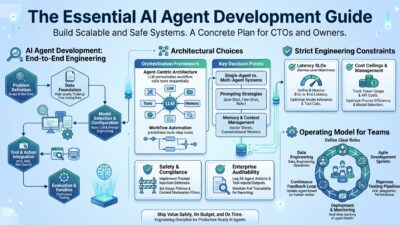
Think in layers; text and voice share the same skeleton. For a deeper walkthrough, see the ai agent development guide.
- Channels: Web chat, SMS, email, voice (PSTN/SIP/WebRTC), app SDKs
- Perception (voice): streaming ASR; natural, low-latency TTS; barge-in, VAD, interruptions
- Orchestrator: dialogue/state machine (LangGraph style), policy checks, planner (ReAct/ToT) with timeouts/retries, turn management with streaming partials/speculative responses
- LLMs: GPT-4o, Claude 3.5 Sonnet, Llama 3.x—router abstracts vendors; version-pin and evaluate
- Tools/skills: CRM, ticketing, order status, payments, scheduling, knowledge APIs—enforce typed schemas, validation, allow-lists, rate limits
- Knowledge layer: RAG with vector DB, chunking (200–400 tokens), recency/authority ranking, citations
- Safety/compliance: policy engine, prompt shields, sensitive-intent filters, PII redaction, jailbreak checks, output scanning
- Observability: per-turn traces, token/cost telemetry, latency histograms, audit logs, replays, offline evals
- HITL: confidence gates, escalation router, side-by-side assist, capture correction signals
- Non-functional SLOs: p95 <1.2s (text), <500ms perceived (voice); 99.9%+ availability; SOC 2 controls and least privilege
Diagram (describe to your team): Channels on the left; ASR/TTS feeding an Orchestrator; LLM router below; Tools/Skills and Knowledge to the right; Safety/Compliance cross-cutting; Observability/HITL spanning all layers. Annotate p95 latency budgets on the voice path.
Implementation playbook: 90 days from concept to pilot
Treat this like disciplined software with CI/CD and evaluation gates. See also the extended 90-day ai agent development guide.
- Day 0–15: Discovery and guardrails
- Map top workflows; pick 1–2 use cases with owners and KPIs
- Collect gold-standard transcripts/emails; define “must-not-do” policies and escalation criteria
- Draft system prompts (persona, tone, constraints, refusal/deferral)
- Write tool schemas with explicit validation and error contracts
- Day 16–45: Prototype and RAG
- Build a minimal orchestrator (states, retries, timeouts)
- Wire 1–3 critical tools (order lookup, ticket create, calendar)
- Implement RAG: 200–400 token chunks; hybrid dense+keyword; recency boosting; authority ranking
- Latency benchmarking; token budgets per turn
- Evaluation harness: task suites + auto-grading (groundedness, tool success, policy compliance) + human spot checks
- Day 46–75: Voice and HITL
- Integrate streaming ASR/TTS; barge-in, VAD, full-duplex where supported
- Orchestrate partials to LLM; speculative decoding; resumable prompts
- Supervisor UI: approvals/overrides, real-time tool visibility, reason logging
- Day 76–90: Pilot readiness
- Security: pen-test; red-team prompt injection; validate PII redaction
- Resilience: load test; chaos test vendor failures/timeouts; fallback models/cached answers
- Ops: runbooks; staff training; rollback conditions; canary + feature flags
- CI/CD and environments: staging with masked data and deterministic evals; versioned prompts/policies; canary releases with automated rollbacks
How to build an AI voice agent customers actually want to talk to
Voice is unforgiving—optimize for latency, turn-taking, and trust.
- End-to-end flow: telephony/WebRTC → ASR partials (80–150ms) → Orchestrator policy/planner → streaming LLM (partial tokens) → TTS speech (interruptible) → Tools → concise summaries
- Turn-taking and barge-in: VAD + “max silence” timers; pause TTS on user speech and resume
- Real-time orchestration: frame-level partials, speculative replies, backpressure during long tool calls
- Latency budget (target perceived <500–700ms): ASR 80–150ms; Orchestration 50–150ms; LLM 150–400ms; TTS 80–150ms
- Voice UX best practices: lexicon boosting, confirmation on risky intents, varied “didn’t catch that,” multilingual handling
- Compliance/privacy: consent and recording notices; PCI redaction; GDPR/LGPD/CCPA alignment; strict retention
- Warm transfers: confidence thresholds; pass transcript, metadata, and a crisp summary
- Post-call automation: structured notes, CRM updates, disposition codes, next-best actions
- Test plan: “mystery shopper” scripts, accent/rate stress tests, noisy environments, device differences, packet loss simulation
Data strategy and model selection you won’t regret
- Retrieval-first: Use RAG for changeable facts; fine-/instruction-tune for stable style and process adherence
- Data readiness: source-of-truth inventory, owners, freshness SLAs, API pathways, redaction, audit trails, retention/deletion workflows
- Synthetic data: expand rare intents/edge cases with human review; measure drift/bias
- Model portfolio design: tier by task (drafting vs retrieval Q&A vs tool-heavy vs guardrail classification); vendor redundancy; version pins; eval gates—see small vs large language models
- Cost control: token budgets, context discipline (summarize/compress/vector-lookup), batch where possible, stream for perceived latency gains
Safety, risk, and compliance for enterprise-grade agents
- Threats and controls: input sanitization, whitelist sources, least-privilege tools, outbound policy checks, retrieval grounding/citations, confidence scoring, refuse-when-uncertain fallbacks
- Regulatory overlays: GDPR/CCPA (consent, retention, subject rights), SOC 2/ISO 27001 (access/logging/change mgmt), HIPAA/PCI where relevant
- Incident response: detection channels, triage, containment, customer comms, legal review, postmortem with corrective actions and regression tests
Measuring performance and ROI: Your board-ready scorecard
- Operational: task success, containment/deflection, FCR, AHT, p95 latency, escalation rate, error budgets
- Quality: groundedness, citation coverage, hallucination rate, policy compliance, human QA pass rate, CSAT/NPS
- Business: cost-per-interaction vs human baseline, incremental conversion/revenue, churn reduction, SLA compliance, net savings/payback
- Analytics stack: tracing/replays, vector/RAG hit analytics, tool outcomes, prompt/version lineage, ablation comparisons
- Experimentation cadence: offline evals, canary traffic, A/B testing for prompts/policies/models, weekly governance review with acceptance gates
Build vs buy: A CEO framework for platforms and agents
Balance time-to-value with long-term leverage—see the full framework: how to choose an AI agent builder.
- When to buy: commoditized channels (telephony/ASR/TTS), mature orchestration/evaluation tooling, tracing/observability—use platforms to accelerate pilots; ref: AI agency ultimate guide
- When to build: proprietary workflows, deep integrations, sensitive data, strategic UX/policy differentiation—consider custom AI agents
- RFP checklist: uptime/SLA, latency guarantees, training opt-out by default, security attestations, data residency, audit logging, rollback/versioning, roadmap transparency, predictable pricing
- Total cost model: platform fees + LLM tokens + ASR/TTS minutes + engineering/ops + QA/HITL
- Exit strategy: portability for prompts/policies/traces/embeddings; export; model/provider abstraction
A 90-day CEO roadmap: From greenlight to real customers
Assign owners and set gates—governance fails without names. For the detailed version, see this CEO roadmap.
- Week 1: approve use case, KPIs, governance doc, budget; staff product owner, architect, ML engineer, conversational designer, QA lead
- Week 2–3: data inventory; RAG POC; initial prompts/policies; vendor shortlist + security review
- Week 4–6: MVP with 1–2 tools; offline/supervised tests; baseline metrics + pass/fail gates
- Week 7–9: voice integration (if in scope); HITL escalation; eval harness automation; observability dashboards
- Week 10–12: limited production pilot (5–20% traffic); canary with rollback; executive readout; go/no-go for scale and budget unlock
FAQ
What exactly is an AI agent and how is it different from a chatbot?
An AI agent wraps an LLM with planning, memory, tools/APIs, policies, and orchestration so it can execute multi-step work, while a basic chatbot mostly answers FAQs without taking actions.
How much should a first pilot for AI agent development cost?
Typical bands: Discovery/POC $25k–$100k, Pilot $75k–$300k, and Production scale $250k–$1M+, depending on channels, safety, and integrations.
What performance and UX targets should we set before scaling traffic?
Insist on p95 <1.2s (text), <300–500ms perceived gap for voice with barge-in, <10s warm transfers with summaries, and >80% task success rate.
How do we keep agents safe and compliant with customer data?
Define data ownership, PII handling/retention, and auditability; enforce least-privilege tools, retrieval grounding, output scanning, confidence-based HITL, and an incident response playbook.
Where should we start to see measurable ROI fastest?
Customer support triage/resolution, sales development, after-hours voice, IT/HR desks, and finance back office—each has clear metrics like deflection, AHT, conversion, or cost-to-serve.
Will AI agents replace jobs or augment our teams?
Agents first augment by removing swivel-chair work and handling routine tasks; plan reskilling and QA-as-supervisor roles for exceptions and oversight.
How do we avoid vendor lock-in as we scale agents?
Use a model router, pin versions, keep evaluation gates for upgrades, negotiate training opt-out, and ensure exportable prompts, policies, traces, and embeddings.
Summary
Bottom line: Tie AI agent development to one money-in or money-out workflow, set hard SLOs and safety gates, and follow a 90-day path to a reliable pilot. Use RAG-first knowledge, typed tools, a graph-based orchestrator, and HITL. For voice, design for latency and barge-in from day one. When ready, review the linked ai agent development guide, explore building an ai voice agent, and hand your CTO the reference architecture to accelerate from idea to pilot with confidence.