

Estimated Reading Time
18–22 minutes (skim-friendly with bolded takeaways, mini-cases, and FAQs)
Key Takeaways
- AI agents are production-ready for well-bounded, tool-using workflows across text, systems, and voice—ship value now with guardrails.
- Anchor your rollout to a cloud-grade foundation: identity, observability, cost governance, policy-as-code, and SLOs.
- Use 6R/7R triage to pick high-ROI, low-risk processes; scale via dual-run, blue/green, and canaries.
- Bring FinOps to LLMOps: model routing, caching, tagging/chargeback, and SLO budgeting tame cost and latency.
- Voice is latency-critical: streaming ASR/TTS, small-model policy checks, and barge-in support are essential.
- Governance wins: cross-functional standards, evaluation gates, and audit trails accelerate safe adoption.
Executive summary: what AI agents can safely automate today
AI agent development is no longer experimental. In 2026, agents reliably execute well-bounded workflows with tool calls, memory, and retries. In this ai agent development guide, we define what an agent is, where it adds value, and what you can safely deploy now.
What is an “AI agent”
Precisely: a software system that uses an LLM or policy model to perceive inputs, plan actions toward a goal, call tools/APIs, and observe outcomes in a closed loop—maintaining state, following constraints, retrying on failures, and logging for auditability. See What are AI agents?
- Goal-directed behavior (e.g., “resolve this support ticket within policy”).
- Tool-use via strongly typed function calls to CRMs, ERPs, RPA, calculators, and custom APIs.
- Memory/state: short-term context and long-term vector/structured records with TTLs and retention controls.
Agent modalities to use now
- Text assistants: triage, email drafting, back-office queues, and chat assistants that contain and resolve high-volume intents.
- Tool-using workflow agents: ERP/CRM updates, reconciliations, enrich/validate, data-quality corrections.
- Voice agents (telephony/IVR): inbound support, reminders, collections/deflection, sales qualification.
Expected outcomes: lower AHT, higher throughput, 24/7 coverage, cleaner data, and new always-on service models.
Scope: An end-to-end ai agent development guide for CTOs: framing, architecture, lifecycle, LLMOps/FinOps, security, governance, evaluation, and how to build an AI voice agent that meets contact-center SLOs.
Why AI agent development belongs on your 12‑month roadmap
Agents map to the same strategic drivers that justified cloud transformations: agility, cost, innovation, and risk reduction. Treat them as a modernization lever—not a side project.
- Agility: ship improvements as prompts/policies and toolflows; iterate business logic fast.
- Cost with discipline: FinOps for LLMOps keeps OPEX predictable (tagging, routing, caching, autoscale).
- Innovation: personalization, proactive outreach, and multi-channel consistency.
- Risk reduction: standardize execution; log tool calls; enforce guardrails for auditability.
Business cases you can borrow
- Frame modernization for the CFO (containment rate, AHT, SLA compliance) as in McKinsey’s cloud lessons.
- Apply Panasonic’s governed-spend mindset to inference infra and model usage.
- Define agents, tools, and policies as code to double feature velocity—Brillio-style.
- Treat legacy manual work as risk; standardize with observable agents.
Sources: McKinsey · Brillio · SoftwareOne (Panasonic) · AlpsAgility · CISIN · Wednesday
Architecture blueprint for enterprise-grade AI agents
Before pilots, define a robust architecture that mirrors cloud-grade standards—clear responsibilities, guardrails, and SLOs.
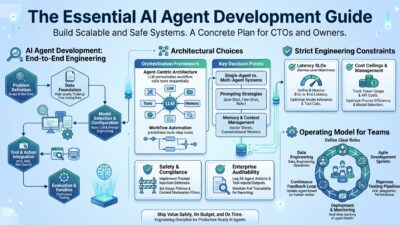
- Policy/reasoning: LLMs/policies with constrained function calling; objectives/constraints/persona; determinism controls.
- Orchestration: plan-and-execute, ReAct, or FSM/DAG; idempotency keys, backoffs, circuit breakers.
- Tooling layer: JSON-schema-typed interfaces; CRM/ERP/webhooks/RPA/search; hybrid RAG retrieval.
- Memory/state: TTL’d sessions; vector + structured records; PII redaction and region-aware retention.
- RAG: chunking, metadata, dedup; hybrid retrieval and grounded citations.
- Safety: content filters, prompt-injection defenses, allow/deny policies, sandboxing, least-privilege.
- Observability: tracing, prompt lineage, correlation IDs, token/latency cost dashboards, drift detection.
- Deployment: containers on K8s or serverless; per-tenant isolation; KMS-backed secrets; audited IAM.
SLOs: text p95 2–5s E2E; voice response start ≤1s with partials in 200–300ms; ≥99.9% availability for customer-facing flows.
Foundations first: land identity, network, monitoring, cost tooling, and policy-as-code before pilots to avoid sprawl and bill shock.
Sources: DigitalFactory24
Implementation lifecycle: from discovery to scaled deployment
Adapt proven cloud migration lifecycles to agents; most failures are planning-related, not model-related. See the ai agent development roadmap.
- Prepare: sponsors, decision rights, skills, compliance alignment.
- Assess: process mapping, dependencies, risk/scopes, escalation paths.
- Foundation: IAM, secrets, network, logging, cost tooling, policy-as-code, IaC; eval harness.
- Pilot: bounded use case, KPIs, rollback; offline evals, red-teaming, SLOs.
- Waves: adjacent intents; dual-run and parity checks before cutover.
- Optimize: routing, caching, prompt tuning; chargeback; scale latency/throughput and manage error budgets.
Warning: Incomplete dependency mapping causes cutover issues—treat it as first-class work.
Sources: Azure CAF · AWS Best Practices · DigitalFactory24 · Digiteum · AlpsAgility · IPSEC Academy
Portfolio triage with the 6Rs/7Rs: pick the right first projects
Use the familiar 6R/7R logic to classify candidate processes for agentization—your ROI gate. Reference the 6R/7R triage guide.
- Retire low-value steps; Repurchase commodity SaaS; Rehost API flows; Replatform vector DB/LLM endpoints; Refactor/Rearchitect into validated tool calls; Retain pending compliance; Replace brittle scripts.
- Screening: volume, exception rate, risk class, deterministic needs, expected ROI, integration complexity.
Case: A healthcare provider applied 6R/7R to scheduling—“repurchased” reminders via HIPAA SaaS, “refactored” exception handling, “retained” high-risk PHI until landing-zone readiness. See the AI agents for healthcare guide.
Sources: CloudForge · SAP LeanIX · YouTube · CISIN
Enterprise security, compliance, and governance for AI agents
- Identity and access: least-privilege per tool/env/tenant; MFA; break-glass; audit trails.
- Data protection: classify data; encrypt in transit/at rest; redact PII; retention and residency.
- Shared responsibility: document model provider vs cloud vs you (keys, logs, prompts, datasets).
- Attack surface: secure hybrid APIs; CSPM; pen-tests; rate limiting/DDoS defense.
- Backup/DR: snapshot embeddings/prompts/policies; tested restores; rollback gates; dual-run during stabilization.
Sources: VAST IT · Infosec Institute · Cloud.nl
LLMOps and FinOps: controlling cost, latency, and reliability at scale
- FinOps patterns: decouple compute/storage; autoscale workers; warm pools for voice/chat; tagging/chargeback per agent/tool/intent.
- Model routing/caching: use small/fast models for intent/policy checks; escalate complex turns; cache frequent intents; cap tokens with grounded prompts.
- Reliability: SLOs per intent; error budgets; circuit breakers; shadow deployments.
- Cost modeling: ASR/TTS $/min; tokens/turn; turns/session; containment; p95 targets; peak concurrency.
Sources: AlpsAgility · DigitalFactory24 · IPSEC Academy · SoftwareOne (Panasonic)
How to build an AI voice agent that meets contact-center SLOs
Voice is unforgiving. Your voice pipeline must be streaming-optimized end-to-end.
- Telephony ingress: PSTN/SIP or WebRTC; IVR integration; DTMF fallback; geo-routing; correlation IDs.
- ASR: streaming with partials in 150–300ms; noise suppression; diarization; PII/profanity masking.
- NLU/Policy: intent/entity, state tracking, escalation criteria, compliance prompts.
- Tools: CRM lookup/update, scheduling, payments; strict validation and reconciliation.
- LLM planning: short-turn reasoning; persona; policy checks; barge-in support.
- TTS: neural voices; first-byte ≤150–250ms; SSML; cached common utterances.
- Handoff: real-time transcript + state to agent desktop; fast transfer SLOs.
Latency budget (p95): ASR partials 150–300ms; NLU/LLM 200–400ms (with caching/short prompts); TTS first-byte 150–250ms; response start ≤1s.
Sources: Cloud.nl
Tooling, automation, and IaC for reliable agent platforms
- IaC & policy-as-code: Terraform modules for services, gateways, vector stores, observability; guardrails/redaction/versioned alongside prompts.
- CI/CD: prompt/policy versioning; schema migrations; pre-prod evals; gated promotions; instant rollback.
- Observability: OpenTelemetry/Langfuse; structured logs for tool I/O; latency/error dashboards; replay harnesses; cost correlation.
- Security in pipeline: CSPM, secret scanning, SAST/DAST, signed artifacts, drift detection.
Sources: Brillio · VAST IT · Infosec Institute
Zero‑downtime rollouts, hybrid coexistence, and data consistency
- Deployment: blue/green and canary; per-intent canaries; feature flags; auto-rollback on KPI regression.
- Dual-run: run legacy in parallel; parity checks and stabilization windows before cutover.
- Data consistency: dual-writes to legacy and lakehouse; Kafka as event spine; CDC + schema gates; parity tests.
Sources: Cloud.nl · AlpsAgility · TCS (Avis)
Governance and operating model for ai agent development
- Agent Modernization Center (AMC): product, ops, security, legal, finance, data—own standards for prompts/guardrails/evals/rollouts; ROI tracking.
- Sponsorship: IT + business; KPI ownership; faster decisions.
- Roles: LLM engineers, platform SREs, conversation designers, evaluators/red-teamers, FinOps, compliance.
- Process: quarterly 6R/7R reviews; change advisory for prompt/policy updates; KPI-based graduation to prod.
Sources: Deloitte · AWS Best Practices
Metrics and evaluation framework CTOs should demand
- Business: containment, AHT, FCR, CSAT/NPS, revenue lift, SLA adherence.
- Technical: task success, groundedness/citation, hallucination, p95/p99, tool error rate, escalation quality, safety violations/1k interactions.
- Cost: cost per resolution, model mix, cache hit rate, infra utilization.
- Security/Compliance: PII redaction success, audit coverage, failed auths, DR test pass rate.
- Lifecycle: deployment frequency, MTTR, drift detection time, rollback frequency.
Cadence: weekly scorecards in pilots; monthly governance reviews; continuous post-migration optimization.
Sources: Digiteum · DigitalFactory24
Lessons from large-scale cloud transformations that apply now
- Avoid big-bang rewrites; evolve with pilots/waves.
- Don’t “lift-and-spend”—govern cost from day zero.
- Strong landing zones and governance prevent sprawl.
Real cases: Brillio (IaC velocity), Avis (CDC + Kafka parity), Panasonic (disciplined ops), Deloitte AMC (global scaling), McKinsey (CFO-ready framing).
Sources: CISIN · Wednesday · IPSEC Academy · DigitalFactory24 · Brillio · TCS (Avis) · SoftwareOne (Panasonic) · Deloitte · McKinsey
Common pitfalls in ai agent development and how to avoid them
- Shallow planning: cure with rigorous discovery and dependency inventories.
- Lift-and-spend: cure with tagging, autoscaling, routing, caching, and SLO budgets.
- Weak IAM: enforce MFA, least privilege, CSPM, pen-tests.
- Big-bang rewrites: apply 6R/7R; phase by risk/ROI; dual-run with parity targets.
- No rollback/monitoring: blue/green/canary, stabilization windows, full-stack observability, drift detection.
Sources: IPSEC Academy · DigitalFactory24 · AlpsAgility · Infosec Institute · VAST IT · CISIN · CloudForge · Cloud.nl
Step-by-step 90‑day starter plan for CTOs
- Weeks 1–2 (Governance/goals): sponsors; 2–3 KPIs (containment, AHT, p95); security baseline; landing-zone backlog.
- Weeks 3–4 (Discovery/triage): map dependencies; data classification; 6R/7R; select one pilot with rollback.
- Weeks 5–6 (Foundation): IaC-managed platform (orchestration, vector DB, tracing, cost tags, secrets vault); policy-as-code; eval harness.
- Weeks 7–9 (Build pilot): MVP with validated tool calls; offline evals + red-teaming; define SLOs and go/no-go; synthetic + shadow tests.
- Weeks 10–12 (Canary/expand): canary 5–10%; parity checks; iterate; prep Wave 1; enable model routing and caching.
Sources: Azure CAF
Appendix: vendor and component selection checklist
Use this buyer’s frame alongside the how to choose an AI agent builder guide.
-
- Models/endpoints: quality/latency/cost, data-use policy, regional availability, enterprise SLAs, eval tooling.
<li
ASR/TTS
- : accuracy across accents, streaming latency, cost/min, SSML, barge-in, PCI scope options.
- Vector DB: low-latency QPS, hybrid search, filters, backup/DR, tenancy/isolation, SOC2/ISO.
- Orchestration: graph/FSM, retries, type-safe tool schemas, managed vs local, language/runtime fit.
- Observability: prompt lineage, trace correlation, PII-safe logs, cost export APIs, alerting.
- Security/compliance: ISO 27001, SOC 2, HIPAA as needed; DPA, KMS/HSM, key rotation, usage auditability.
Sources: VAST IT
Conclusion: build agents like you built your cloud—incremental, governed, secure, ROI‑driven
Success in ai agent development mirrors cloud-era discipline: clear outcomes, strong foundations, incremental rollouts, and relentless measurement. Start with a landing zone, select high-ROI pilots via 6R/7R, scale through dual-run and canaries, and bring FinOps to LLMOps so your costs, latency, and reliability stay within SLOs—especially for how to build an AI voice agent that must hit sub-second response starts. When you modernize your operations with agents like you modernized infrastructure with cloud—incrementally, governed, secure, and ROI-driven—you de-risk adoption and accelerate value.
Extended reading: CloudForge: 6Rs · DigitalFactory24 · McKinsey. Build agents with cloud-grade discipline to win 2026 and beyond.
FAQ
What can AI agents safely automate in 2026 without risking customer harm or compliance breaches?
Well-bounded, policy-constrained workflows with strong tool validation—ticket triage, CRM updates, reconciliations, text/voice FAQs, and appointment flows—provided you enforce least-privilege IAM, PII redaction, output validators, and audited tool calls.
How do I pick the first use case for ai agent development?
Use 6R/7R triage: favor high-volume, low-exception, low-risk processes with measurable KPIs (containment, AHT) and clear rollback. Defer high-risk PHI/PCI flows until your landing zone and data residency controls are ready.
What architecture choices most affect reliability and latency?
A graph/FSM controller with typed tool schemas, hybrid RAG, small-model policy checks before larger planners, caching, and circuit breakers. For voice, streaming ASR/TTS and barge-in support keep p95 under one second.
How do I control LLM costs as traffic scales?
Adopt FinOps for LLMOps: tag/chargeback by agent/intent, route easy turns to small models, cache frequent answers, cap tokens with grounded prompts, and autoscale inference workers. Track cost per resolved task and cache hit rate.
What governance model speeds delivery without sacrificing safety?
A cross-functional “Agent Modernization Center” owning standards for prompts, guardrails, evaluations, and rollouts, with KPI-based stage gates, shadow tests, and instant rollback paths baked into CI/CD.
How do I de-risk cutovers to production?
Blue/green or canary by intent/region, dual-run with parity targets, automated rollback on KPI regression, and dual-write event streams to maintain data consistency and audit trails.
What makes voice agents production-grade versus demos?
Streaming pipeline end-to-end, partial ASR in 150–300ms, persona + policy checks, validated tool outputs before TTS, barge-in, PCI segmentation for payments, and rigorous evaluation across accents and overlap speech.
Summary
Bottom line: AI agents are ready for prime time if you apply cloud-era discipline. Stand up a governed landing zone, choose the right first workflow via 6R/7R, and ship a measured pilot with dual-run and canaries. Control spend and latency with FinOps-for-LLMs, and meet voice SLOs with streaming-first design. For deeper context and patterns, see the ai agent development guide, the roadmap, and voice blueprint at AI Voice.
Next steps
– Appoint IT + business sponsors and pick 2–3 KPIs.
– Establish identity, observability, and policy-as-code.
– Build a 90‑day pilot with rollback and parity gates; then scale by intent waves.