

Estimated Reading Time
18 minutes (executive-grade, skim-friendly with bolded metrics, sidebars, and a 90‑day action plan)
Key Takeaways
- Fund an operation, not a chatbot. You’re investing in a capability to plan, call tools/APIs, and act with measurable SLAs and ROI—not just replies.
- Speed and guardrails win. Ship one high‑value use case with ≤3–6 month payback, then scale. Track success rate, p95 latency, cost per resolution, and escalation rate weekly.
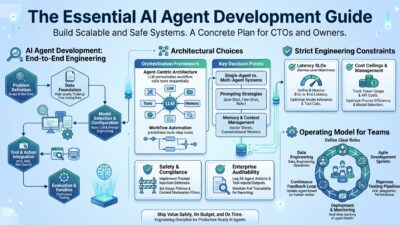
- Minimum viable architecture includes: policy/LLM core, state manager, strict tool contracts, RAG, safety/compliance, observability, and HITL—anything less won’t survive production.
- Voice adds growth capacity. Meet callers with real‑time ASR/TTS, duplex turn‑taking, and p95 ≤600ms first audio to delight instead of frustrate.
- Board‑ready governance. Audit trails, PII controls, regional hosting, DPAs, and incident drills are non‑negotiables for executives.
30‑second executive summary — ai agent development guide
This ai agent development guide shows CEOs how to move from concept to production with ROI guardrails, budget discipline, and embedded compliance. Expect faster response times, lower cost‑to‑serve, 24/7 sales/service capacity, and richer data capture for continuous improvement. Preview the 90‑day plan below, then greenlight one use case with a 3–6 month payback—because speed plus guardrails wins the first inning.
Track these 5 KPIs from day one:
- Task success rate (by intent and channel)
- p95 latency (chat ≤1.5s, voice turn ≤1.2s)
- Cost per resolution (tokens + ASR/TTS + tools)
- Escalation/transfer rate to human agents
- CSAT/NPS by interaction type
What CEOs need to know before funding ai agent development
You’re not buying a chatbot. You’re funding an operational capability. An AI agent is an autonomous or semi‑autonomous software entity powered by an LLM or policy model that can perceive inputs, reason with goals and constraints, call tools/APIs, and act in your environment. A static chatbot only replies; it cannot reliably plan, check tools, or change system state. Set expectations—and budgets—accordingly.
Common business use cases (prioritize one high‑value intent to start):
- Customer service triage and deflection to self‑serve
- Appointment setting and rescheduling
- Internal IT helpdesk and HR FAQs
- Lead qualification and routing to AEs
- Collections reminders and promise‑to‑pay capture
- Invoice and billing queries (disputes, copies, payment links)
- Post‑purchase onboarding and activation nudges
- Sales discovery call prep and follow‑up drafting
When not to build (yet): Highly regulated decisions without human oversight (credit determinations, clinical diagnosis)—see this AI for healthcare overview. Also defer if success criteria are unclear, tool/data access is insufficient, or local laws restrict outreach/recording.
Greenlight criteria CEOs should insist on: ≤3–6 month payback; idempotent APIs and RBAC; explicit guardrails (allow/deny lists, HITL); evaluation plan tied to pipeline lift, cost‑to‑serve reduction, or cycle time compression.
The minimum viable AI agent architecture CEOs should expect — ai agent development
Insist on this set—anything less won’t survive production.
- Policy/LLM core (reasoning and planning) — Model capable of tool use and structured outputs.
- Conversation and state manager — Tracks goals, memory, tool outcomes, guardrail flags.
- Tooling/action space — Strict JSON schemas, idempotent APIs, RBAC credentials, request budgets.
- Knowledge layer (RAG) — Domain facts, policies, SKUs, price books, SOPs.
- Safety and compliance — PII handling, moderation, redaction, audit trails.
- Observability and cost telemetry — Tracing, token accounting, p50/p95/p99, retries/timeouts/errors.
- Human‑in‑the‑loop — Escalation paths, circuit breakers, kill switches, human takeover.
Golden path data flow with SLAs
- Input → Pre‑processing (PII masking, language detection, intent hinting; ≤60ms)
- Policy model (plan/decide tools; ≤400–700ms/turn for chat)
- Tool calls (validated, retries/timeouts; ≤150–300ms each, total ≤600ms)
- Post‑processing (grounded answer assembly, SSML; ≤80ms)
- Response logging (redacted transcripts, tool traces, cost tags)
- Metrics store (success/failure, escalation, unit economics)
Sequence targets: User → Gateway (10–20ms) → State Manager (20–40ms) → Policy/LLM (400–700ms) → Tool(s) (≤600ms total) → Post‑processor (60–80ms) → Channel (chat ≤100ms; voice ≤600ms first audio). Telemetry overhead ≤20ms/turn.
SLAs to publish internally
- Chat: p95 ≤1.5s; p99 ≤2.5s
- Voice: first audio p95 ≤600ms; full turn p95 ≤1.2s
- Availability: ≥99.9% monthly (excluding carrier outages)
- Error budget: ≤1% failed turns; escalations logged 100%
Picking models and runtimes: cost, latency, privacy, and control — ai agent development
Model selection checklist: See Small vs large language models — why SLMs matter.
- Latency budget — Chat p95 ≤1.5s; voice ≤300–600ms incremental turn‑taking.
- Cost ceiling — Model $/1K tokens × avg turns × concurrency; include tool latency costs; TCO with 2–3x headroom.
- Safety — Function calling, JSON adherence, tunable refusals.
- Data handling — No‑training by default, data residency, HIPAA/GDPR/CCPA options.
- Task evals — Run on your intents; measure structured accuracy and tool success.
Runtimes
- Managed APIs (OpenAI, Anthropic, Google): best safety/latency, turnkey scale; trade‑offs: lock‑in, opaque changelogs, residency constraints.
- Self‑hosted OSS (Llama, Mistral, Granite, Mixtral): control, privacy, cost leverage; trade‑offs: ops burden, SRE/MLOps talent, tuning cadence.
Vendor risk management: SLAs/SLOs, rate‑limit headroom, model pinning, export paths (prompts/memories/embeddings/traces), regional failover, incident comms, DPA terms.
Building a trustworthy knowledge layer (RAG) your board will accept — ai agent development guide
Define RAG clearly: Retrieval‑augmented generation grounds answers with vetted content via embeddings + vector search, reducing hallucinations and enabling citations.
- Data prep — Semantic/structure‑aware chunking (200–800 tokens, 10–20% overlap); metadata (version, locale, policy dates, confidentiality); PII scan/redact before embedding.
- Embeddings and indexes — Fit dimensionality to domain; normalize; HNSW for recall, IVF‑Flat for scale; per‑corpus indexes with ownership and retention labels.
- Retrieval strategies — Hybrid (BM25 + vector), multi‑query expansion, reranking; domain filters via metadata.
- Grounding contracts — Require citations (doc_id/page/anchor); abstain on low confidence; ask clarifying questions; log evidence and confidence.
- Caching — Request‑level (short TTL) + answer‑level (FAQ hits); webhook cache invalidation.
- Governance — Freshness SLAs (critical policies <24h; product docs <7d); named owner per corpus; quarterly audits and change logs.
Orchestration and reasoning patterns that improve reliability — ai agent development
Determinism beats vibes in production. For deeper patterns, see this ai agent development guide.
- Function calling — Strict JSON schemas; validate I/O; repair/retry with backoff; cap attempts.
- Reasoning — ReAct for multi‑step tasks; Toolformer for known API patterns; self‑reflection/voting for high stakes; plan‑summarize‑commit for auditable turns.
- Deterministic control — State machines/routers for regulated branches (KYC/AML/HIPAA); avoid pure‑LLM routing on sensitive intents.
- Guardrails — Allow/deny lists, injection defenses, safety filters, jailbreak detection, rate‑limit spikes, anomaly alerts with auto‑escalation.
Designing a production‑grade voice agent: how to build an ai voice agent that delights callers — how to build an ai voice agent, ai agent development
Here’s how to build an ai voice agent that meets enterprise expectations while advancing your ai agent development roadmap.
- ASR — Streaming with VAD and partial hypotheses; word‑level timestamps; domain vocabulary; accent/noise robustness; optional diarization.
- TTS — Neural voices with prosody control; SSML for emphasis/pauses; streaming; barge‑in; brand‑aligned persona.
- Duplex — Handle partial ASR; incremental synthesis; silence/interrupt logic; smart “please go ahead.”
- Latency — ≤600ms first audio p95; ≤1.2s turn p95; locally cache greetings/disclosures to save 150–300ms.
- Telephony — SIP/Twilio; WebRTC softphone; DTMF fallback; transfer/whisper; consent capture; TCPA alignment.
- Safety — Profanity filters; crisis detection; harassment handling; termination heuristics.
- Evaluation — Task completion, AHT, transfer, FCR; QA sampling; red‑team accents/noise/topics; weekly calibration.
- Deployment — Stateless media servers; region affinity; jitter/loss observability; MOS scoring; carrier alarms.
Security, safety, and compliance by design (non‑negotiables) — ai agent development
Assume breach; constrain blast radius.
- Threats — Prompt injection, tool‑based exfiltration, poisoning, PII leakage, system prompt disclosure.
- Controls — CSP on tool outputs; sandboxed runtimes; output validation at boundaries; allowlisted domains/APIs; secrets vault; short‑lived RBAC tokens.
- Data protection — Field‑level encryption; reversible tokenization where necessary; redacted logs; strict retention/deletion; secure transcript storage.
- Compliance — GDPR/CCPA DSR flows; HIPAA/SOC 2 readiness; DPAs; regional hosting/residency; third‑party audits; pen tests; tabletop drills.
- Incident response — Behavior/cost anomaly detection; kill switches; signed/immutable/time‑synced logs.
Testing, evaluation, and continuous improvement — ai agent development, ai agent development guide
Operational excellence is a loop, not a launch.
- Offline eval — Golden test sets; synthetic variants; rubric‑based scoring (correctness/helpfulness/safety); hallucination and refusal scores; tool success and schema adherence.
- Online eval — A/B and shadow; intercept CSAT/NPS; SLA monitors (p50/p95/p99); cost per successful action and per resolved task.
- CI/CD — Version prompts; diff/review; canary; auto‑rollback on KPI breach; suppress verbose chain‑of‑thought in prod outputs.
- Human review — Weekly QA; red‑team drills; postmortems with corrective actions; scorecards by intent; drift trend analysis.
- CEO monthly pack — Success by intent; deflection/transfer; unit economics; drift alerts; failure modes; latency/cost trends.
Deployment architecture and SRE patterns that keep agents up — ai agent development
- Infra — Serverless for bursty spikes; containers for steady load; pick GPU/CPU/speculative decoding for voice token throughput.
- Resilience — Retries with jitter; timeouts; circuit breakers; fail‑open vs fail‑closed by use case; retrieval‑only fallback on tool failure.
- Multi‑model — Route by intent/risk; hot‑standby models; feature flags; version‑pinned prompts.
- Observability — OpenTelemetry tracing; LLM‑native tracing (Langfuse/Arize); RED/USE dashboards; token/$ budgets with alerts.
- Cost controls — Max tokens/turn; caching tiers; pre‑approval for high‑cost tools; anomaly budgets throttle spend.
Governance, risk, and ethics for executive oversight — ai agent development
- Structures — AI risk committee with RACI; quarterly vendor/model risk renewals; policies for model updates, prompt change control, retention/classification, accessibility.
- Brand/legal — Tone guardrails; disclaimers; mandated human handoff for regulated topics; inclusion/accessibility; crisis escalation.
- Board reporting — KPI deck (success/latency/cost); audit trails and incident logs; ROI summary; roadmap risks and mitigations.
Implementation roadmap and budget guardrails (0–90 days) — ai agent development, ai agent development guide
0–30 days
- Opportunity sizing; pick use case with success criteria.
- Vendor shortlist; run a PoC (see how to choose ai agent builder); start risk register.
- Data/tool access audit; decide managed vs OSS models.
31–60 days
- Build MVP (chat first); add RAG; implement observability + HITL.
- Offline/online evals; canary rollouts; staff QA program.
61–90 days
- Production hardening; SRE patterns; SOC 2 control alignment.
- Pilot launch; analytics + KPI baselines; voice pilot for 1 use case.
Budget (ex‑FTEs; indicative) — PoC: $25–75k; MVP→pilot: $100–300k; first production workload: $300–800k; recurring: tokens, vector DB, ASR/TTS minutes, telephony, tracing/observability.
Day‑zero roles — Product owner, LLM engineer, data engineer, QA/eval lead, SRE/platform, compliance counsel.
Case snapshot: appointment‑setting agent for a healthcare network — ai agent development
Scenario — A regional healthcare network (AI agents for healthcare guide) launched an appointment‑setting agent across voice and chat (AI chatbots for healthcare) to reduce hold times and increase booking conversion.
Stack — Streaming ASR+TTS (domain lexicon); HIPAA‑aligned LLM via private endpoint; RAG over policy docs and provider calendars; EHR scheduling tools with idempotent booking; HITL escalation.
90‑day outcomes — 38% lower cost‑to‑serve/appointment; 22% faster scheduling cycle time; transfer ≤12% (week 6); p95 voice turn 550ms; zero PII incidents (field‑level encryption; redacted transcripts).
Why it worked — Clear success criteria; tight tool contracts; robust RAG citations; strong HITL/QA; rapid prompt versioning.
Why this is long‑form, data‑backed, and executive‑ready — ai agent development guide
Executives prefer deep, actionable, evidence‑based content for complex decisions such as ai agent development and platform selection. Hence this long‑form, referenceable ai agent development guide you can circulate to your COO/CIO/GC.
Evidence: Senior executives’ content preferences · NetLine B2B Content Report · Longer‑form content preference · Where decision‑makers get information
Our publication strategy: 60% SEO‑driven docs + 40% thought‑leadership narratives around ai agent development—because findability + authority wins.
Executive checklist and operating cadence — ai agent development, ai agent development guide
12‑point go/no‑go before you fund:
- Business case with ≤3–6 month payback
- Clear success criteria and KPIs
- Data availability and content owners
- Action space with idempotent APIs and RBAC
- Model selection for latency/cost/privacy fit
- Evaluation plan (offline + online)
- Privacy and PII redaction/logging
- Compliance posture (GDPR/CCPA/HIPAA) and DPA
- SRE plan with SLAs/SLOs and error budgets
- Budget guardrails and cost controls
- Roles staffed (PO, LLM eng, data, QA, SRE, counsel)
- Vendor SLAs and exit plan; incident comms plan
Post‑launch weekly — Triage new failure modes; review latency/cost; adjust prompts/version pins; update roadmap.
Quarterly governance — Vendor/model updates; security review; KPI vs plan; intake next use case.
Sidebars and callouts — ai agent development, ai agent development guide, how to build an ai voice agent
Cost math (replicable)
Tokens: 1.2K in + 1.6K out/turn; ~6 turns → ~16.8K tokens/conversation.
If $3/1K input and $15/1K output blended → ≈ $0.21–$0.28/conv.
ASR ≈ $0.006/min; TTS ≈ $0.015/min; 4‑min call ≈ $0.08.
Telephony ≈ $0.007–$0.015/min; 4‑min call ≈ $0.04–$0.06.
Add vector DB + tracing pennies; many resolved calls land < $0.50 at scale.
SLA targets
Chat p50 ≤700ms; p95 ≤1.5s; p99 ≤2.5s
Voice first audio ≤600ms p95; full turn ≤1.2s p95
Availability ≥99.9%; error budget ≤1% failed turns
Risk box: top 5 red flags
No HITL path · No audit logs for tools · Unpinned prompts · No PII controls · Single‑vendor lock‑in without exit plan
Conclusion: lead indicators to watch and the next investment — ai agent development
Your mandate is clear: invest in reliable ai agent development, start with one use case, harden operations, then expand to voice. Watch task success rate, p95 latency, cost per resolution, and transfer rate weekly. When metrics hold under targets, fund a 90‑day expansion with board‑ready KPIs. Next: add multi‑intent routing and compliant proactive outreach.
Real business case bar: 38% cost‑to‑serve reduction, 22% faster scheduling, ≤12% transfers, 550ms p95 voice turn, zero PII incidents in 90 days—enabled by tight tool contracts, governed RAG, and ruthless observability.
FAQ
What’s the fastest path to ROI?
Pick one intent with measurable payback (e.g., appointment setting). Ship chat first with RAG and 3–5 tools, hold voice until day 45–60, and track success rate, cost per resolution, and escalations weekly—then expand from a proven nucleus.
How do we prevent brand‑damaging mistakes?
Combine allow/deny lists, HITL escalation, circuit breakers, strict tool schemas, boundary validation, abstain‑on‑low‑confidence with citations, and a weekly QA/red‑team ceremony to catch drift and new failure modes.
How do we build an AI voice agent for our call center?
Use streaming ASR (domain lexicon) + neural TTS with SSML, duplex turn‑taking, and a p95 latency budget of ≤600ms to first audio and ≤1.2s per turn; add DTMF fallback, transfer/whisper, consent capture, TCPA alignment, and instrument AHT/FCR/transfer.
Build vs buy vs hybrid?
Build if you need maximum control/privacy and have LLM/SRE talent; buy managed runtime for speed and safety; hybrid (managed LLM + your RAG + your tools) is usually best early—evaluate vendors with this how to choose ai agent builder guide.
How do we measure “good” in the first 90 days?
Benchmarks: success rate ≥70% on scoped intents; transfer ≤15%; chat p95 ≤1.5s; voice first audio ≤600ms; cost per resolution 25–40% below the human baseline with stable quality and compliance logs.
What KPIs should a CEO track from day one?
Task success rate, p95 latency (chat and voice), cost per resolution (tokens + ASR/TTS + tools), escalation/transfer rate, and CSAT/NPS by interaction type—paired with weekly cost and error‑budget reviews.
Summary
Bottom line: Treat ai agent development as an executive capability—governed, observable, and ROI‑tuned. Start narrow, ship fast with guardrails, prove unit economics, and scale deliberately (voice next). Anchor the program on SLAs (chat p95 ≤1.5s; voice ≤600ms first audio), strict tool contracts, governed RAG, and HITL. When the foundations are solid, scale is mostly orchestration and compliance—not heroics.