

Estimated Reading Time
17 minutes (executive-friendly: crisp bullets, practical checklists, mini-cases, and a strict FAQ)
Key Takeaways
- Fund for outcomes, not demos. Start with one high-frequency, high-value workflow and ship a vertical slice in 90 days.
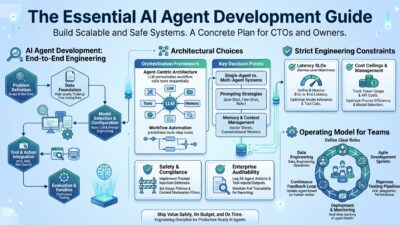
- Architecture-first wins: orchestrator, RAG with citations, typed tools, memory policy, guardrails, observability, and staged rollout.
- Mitigate risk via retrieval-first answers, confidence thresholds, scoped tool rights, HITL for sensitive actions, and immutable audit logs.
- Balance cost/quality with a multi-model strategy; route tasks by complexity and latency budgets (voice needs sub-second loops).
- Voice adds telecom and latency constraints—this guide shows how to build an ai voice agent that handles real calls.
- Measure like a product: golden sets → offline evals → canary → weekly steering; tie metrics to P&L from day one.
AI Agent Development: A CEO’s End‑to‑End Guide from Use Case to Deployment
Introduction: why this guide exists
Most CEOs are now asked to “ship an AI agent this quarter.” Consider this your ai agent development guide: a pragmatic, architecture‑first playbook to go from the right use case to a compliant production rollout—without betting the company on a science project. We will define AI agent development precisely, give you a reference architecture you can describe to your CIO, lay out a 90‑day delivery plan, a governance and ROI model, and show exactly how to build an AI voice agent that handles real calls.
What is an AI agent, precisely? For executives, an AI agent is a software system that uses a large language model (LLM) to perceive inputs (text/voice), plan actions, call tools/APIs, maintain memory/state, act autonomously within guardrails, and learn from feedback. Unlike a static “chatbot” that answers FAQs, an agent can reason across steps (multi‑step intelligent behavior), take actions in your systems (with scoped credentials), and escalate to humans when confidence is low. See: What are AI agents?
Preview: If voice is on your roadmap, we’ll detail how to build an ai voice agent that can qualify leads, triage support, and schedule follow‑ups—safely and within a tight latency budget.
What CEOs Need to Know Before Funding AI Agent Development
Business framing that de‑risks investment
- Pick a workflow that is frequent, high‑value, and has clear, repetitive logic or retrieval (support triage, sales qualification, invoice exceptions, knowledge service desk).
- Ensure data/tools exist: knowledge bases, CRM/ERP/ticketing APIs, and policy docs you can ground with RAG.
- Layer human‑in‑the‑loop (HITL) for safety and learning.
Executive constraints and risks to manage up front
- Hallucinations/false confidence → retrieval‑augmented generation (RAG), citations, confidence thresholds, HITL for irreversible actions.
- Prompt injection/tool abuse → strict JSON schemas, input/output sanitization, allow/deny lists.
- Data leakage/privacy → minimization, PII masking, regionalization for GDPR/CCPA/PCI/PHI.
- Latency and user patience → chat targets <1.5s round‑trip; voice targets <300ms phoneme latency.
- Vendor lock‑in/cost volatility → abstract model/runtime choices; monitor token usage and price curves.
- Operating model change → QA/evals roles, prompt/retrieval engineers, incident response for AI behaviors.
Acceptance criteria rubric you can sign
- Accuracy: task thresholds (e.g., >95% routing; >90% extraction on known forms).
- Coverage: % of intents handled (e.g., 60% pilot; 80% scale).
- Latency: chat <1.5s average; voice <300ms phoneme, <1.0s think time.
- Containment: % resolved without human takeover (50–70% pilot; 70–85% scale).
- Cost per resolution: 30–60% below human baseline while maintaining CSAT/NPS.
- Customer outcomes: CSAT/NPS deltas; first‑contact resolution improvements.
- Compliance: immutable logs; DPIA complete; SOC2‑aligned controls in place.
Checklist (funding gate)
- We have a clear, high‑value workflow with repetitive logic and accessible data/APIs.
- We’ve documented accuracy, coverage, latency, containment, cost, CSAT, and compliance targets for ai agent development.
- We staffed HITL escalation and QA; we have an incident response plan for AI behaviors.
- We agree on a 90‑day plan with “go/no‑go” decision points for this ai agent development guide.
Choose the Right First Use Case: Outcome‑Backed Prioritization for CEOs
How to prioritize with an executive evaluation matrix
- Impact: hours saved, cost‑to‑serve reduction, revenue uplift (size per ticket/lead/call).
- Feasibility: data availability, API/tool access, knowledge quality, model suitability.
- Risk: regulatory exposure, brand risk, actionability risk.
- Time‑to‑value: can you prove value in 90 days with a thin slice?
Output to insist on: one‑page decision brief per candidate use case
- Business owner, stakeholders, baselines (volumes, AHT, FCR, CSAT, cost per resolution).
- Target deltas (e.g., 40% containment, 25% AHT reduction, +5 CSAT) and 90‑day feasibility.
- Data/Tool readiness, security/privacy notes, regulatory considerations.
- Risks, mitigations, and HITL design.
- Acceptance criteria and a go/no‑go checkpoint.
Real business case (prioritization in action)
Decision: Start with a sales voice agent to capture revenue, then fund invoice exceptions in Phase 2 using the same RAG foundation.
Checklist (use case down‑select)
- We scored top candidates across impact, feasibility, risk, and time‑to‑value.
- We documented a one‑page decision brief with baselines and target deltas for ai agent development.
- We validated stakeholder questions/intents using real sales/support notes.
The Executive Reference Architecture for AI Agent Development
See the full breakdown in the ai agent development guide.
Picture a central “Agent Platform” (orchestrator) with a Perceive → Plan → Act → Observe loop across inputs (web/chat/Slack/Teams/IVR), reasoning and tool selection, typed function calls, and state updates with human feedback.
Modular components and business value
- Orchestrator/Agent runtime: LangGraph/LangChain, Semantic Kernel, DSPy. Value: faster iteration, reproducibility, safer tools, observability.
- Foundation models: GPT‑4o/4.1, Claude 3.5, Llama 3.1. Value: match capability, context, privacy/SLAs, and cost.
- RAG: Pinecone/Weaviate/pgvector/FAISS; hybrid (dense + BM25). Value: reduced hallucinations, policy‑grounded responses, auditable citations.
- Tools/skills layer: thin, typed function interfaces (CRM, ERP, ticketing). Value: scoped rights and lower blast radius.
- Memory/state: session + long‑term with TTL. Value: personalization and continuity.
- Guardrails/safety: filters, prompt hardening, PII redaction, allow/deny lists, rate limits, kill switch. Value: risk reduction and compliance.
- Observability/evals: structured logs, traces, versioning, offline/online evals, LLM‑as‑judge. Value: faster debugging, regression control, governance reporting.
- Deployment surfaces: API, web, Slack/Teams, IVR/telephony; blue/green + feature flags. Value: staged rollout and safe experimentation.
CIO‑level integration considerations
Identity (SSO/OAuth), data residency and minimization, private endpoints/VPC peering, field‑level encryption (KMS), and procurement diligence (SOC2/ISO, DPAs, SLAs, DR).
Patterns vs. anti‑patterns
- Patterns: retrieval‑first with citations; strict JSON function calling; multi‑model routing; offline evals before online rollout.
- Anti‑patterns: monolithic prompts; early write‑access before eval targets; single‑vendor lock‑in; “ship and forget” with no eval harness/logs/versioning.
Checklist (reference architecture readiness)
- Orchestrator, RAG, tools, memory, guardrails, and observability identified with owners.
- Tool contracts (JSON) have scopes, rate limits, and audit logging enabled.
- Identity, data residency, encryption, networking controls defined and tested.
- Blue/green deployment and feature flags are available for ai agent development.
Implementation Blueprint: How to Ship a Production Agent in 90 Days
Phase 0 — Alignment (Week 0–1)
- Define success metrics and acceptance criteria.
- Legal/privacy review: DPIA kickoff, DPAs, data‑flow diagrams.
- Data inventory/access approvals; redaction/minimization rules.
- Shortlist vendors for models/vector store/runtime; prototype contracts in parallel.
Phase 1 — Prove (Week 1–4)
- Thin vertical slice: 3–5 intents, RAG over limited corpus, HITL escalation.
- Golden test set from real tickets/calls; label ground truth.
- Offline evals: accuracy, coverage, latency; build the cost model at forecast volumes.
- Observability/structured logs day 1; archive traces for audit.
Phase 2 — Hardening (Week 5–8)
- Guardrails: policy classifiers, PII detection/masking, prompt hardening.
- Expand tools: CRM lookups, ticket creation, scheduling, calculators (typed functions).
- Improve retrieval: tuned chunking, hybrid dense+BM25, mandatory citations.
- Red team prompts; security sign‑off; regression suites on any change.
Phase 3 — Rollout (Week 9–12)
- Canary to 10–20%; measure containment, cost, CSAT; iterate weekly.
- Operations training: runbooks, escalation trees, incident response, on‑call rotation.
- Blue/green or flag‑controlled ramp to 100%; one‑click rollback ready.
Governance cadences
Weekly steering on acceptance metrics; monthly model/version board; retire or roll back underperformers.
Why 90 days works: treat the program as a compounding asset; content coverage widens, evals improve, outcomes rise over months, not days.
Checklist (90‑day ship)
- Vertical slice live behind flags by Week 4; production rollout begins by Week 9.
- Offline evals and cost models gate any action rights.
- Guardrails, observability, runbooks in place before canary.
- Steering cadences are calendar‑committed for ai agent development.
How to Build an AI Voice Agent That Actually Handles Real Calls
Definition and scope: A voice agent is a telephony‑integrated AI agent that performs real‑time ASR, reasoning, tool use, and TTS with barge‑in, natural turn‑taking, low latency, and compliance controls. If you’ve been asked how to build an ai voice agent that qualifies leads or triages support, use this blueprint.
Voice architecture specifics
- Telephony: Twilio/Vonage/SIP trunk → media streams via WebRTC/SIPREC to your voice gateway.
- ASR: Whisper‑large v3, Deepgram, or Azure; evaluate WER, diarization, language coverage, streaming latency.
- VAD and barge‑in: detect onset/offset; immediate TTS interruption for human feel.
- NLU/LLM loop: keep “think time” <1.0s; tool calls for CRM lookups, KB grounding, scheduling, payments (with confirmations).
- TTS: ElevenLabs/PlayHT/Azure Neural; target 200–300ms; pre‑cache frequent utterances.
- Safety/compliance: consent language, call recording policy, PII redaction, regional routing (GDPR), TCPA on outbound.
Latency budget
~200–300ms ASR + 300–500ms LLM + 150–250ms TTS. Parallelize retrieval and prefetch likely intents; cache static prompts and common tool responses.
Knowledge grounding
Domain lexicons; RAG snippets with citations; deny claims without evidence; HITL or transfer for medical/financial actions.
Evaluation for voice quality
Call‑level: FCR, containment, AHT, CSAT. Utterance‑level: WER, interruption rate, confidence‑weighted correctness. QA sampling with LLM‑as‑judge calibrated to human reviewers.
Rollout steps that work
Pilot internally → small customer cohort; staff a “swarm” for daily transcript reviews 2–4 weeks; train humans on barge‑in etiquette and escalation codes.
Patterns vs. anti‑patterns
- Patterns: interruptible TTS with VAD; confirmations for irreversible actions; KB/tool prefetch after each turn; explicit SMS/email fallback.
- Anti‑patterns: multi‑second thinking pauses; overly chatty personas; tool calls without guardrails; ignoring TCPA/consent.
Mini‑case (voice): 60k monthly inbound minutes → after 10 weeks: 74% Tier‑1 containment; missed calls cut to 7%; speed‑to‑lead <60s; CSAT 4.4/5; unit cost $1.18 vs. $3.20 baseline.
Governance, Risk, and Compliance: Guardrails CEOs Must Demand
Threat model for agentic systems
Prompt injection/data exfiltration; tool abuse; jailbreaking/model exploits; over‑delegation of actions.
Controls to require
- Data: minimization, PII masking, field‑level encryption, regionalization by default.
- Policy: allow/deny lists; scoped credentials; rate limits; human approval for irreversible actions.
- Testing: red teaming, adversarial prompt suites, retrieval/model regression tests pre‑release.
- Auditability: immutable logs for prompts, tool calls, outputs, and approvals; retention per policy.
Vendor diligence
SOC2/ISO; model privacy (no training on your data); DPAs/subprocessor transparency; DR posture with RTO/RPO commitments.
Checklist (GRC go‑live)
- DPIA complete; consent language and data maps signed.
- Kill switch in place with one‑click rollback.
- Red‑team and regression suites run; results logged.
- Immutable audit logs enabled and reviewed by security.
Measuring ROI from AI Agent Development: From Pilot Metrics to Board‑Level Outcomes
See the board framing in this CEO guide.
Financial model components
- Cost per task: LLM tokens (prompt/completion/RAG), vector storage/queries, hosting/inference, observability, telephony (for voice).
- Benefit drivers: hours saved, throughput, conversion lift, churn reduction, AHT reduction—translate to per ticket/lead/call.
- Sensitivity analysis: volume growth, model swaps, corpus/tool expansion.
KPIs by stage
Sandbox: accuracy, coverage, latency, cost per successful action. Pilot: containment, FCR, CSAT/NPS, cost‑to‑serve deltas. Scale: SLA adherence, latency/cost variance, retrain cadence, incident rates. Enterprise: risk incidents, audit scores, compliance findings.
Board model example
Baseline: 120k tickets/year; $6.50 cost‑to‑serve; CSAT 4.2/5. Target after 2 quarters: 65% containment; $3.25 cost‑to‑serve; CSAT ≥4.3; P95 latency ≤1.2s; two minor incidents, zero major. Investment: $480k (12 months). Savings/uplift: $390k–$680k + $1.5M ARR from voice‑qualified leads.
Checklist (ROI discipline)
- Track unit economics per task vs. human baselines.
- Stage KPIs by maturity; roll up for the board.
- Document a 3–6 month horizon; communicate compounding effects.
Team, Budget, and Vendor Strategy for CEOs
Skills matrix
Product (AI), agent/ML engineer, prompt/retrieval engineer, data engineer, platform/DevOps, QA/evals lead, security/privacy, analyst.
Build vs. buy trade‑offs
Buy: managed runtimes speed time‑to‑value but risk lock‑in—negotiate portability. See: how to choose an AI agent builder.
Build: open‑source/custom agents reduce lock‑in; higher initial platform cost and staffing.
Budget ranges (indicative)
90‑day pilot: $150k–$400k. 12‑month scale: $500k–$1.5M. Sensitivities: telephony and tokens drive OPEX; eval automation reduces QA over time.
Procurement checklist
SOC2/ISO, DPAs, SLAs (uptime/latency), model/version guarantees, private endpoints/VPC peering, pricing transparency with rate‑limit controls.
Checklist (organizational readiness)
- Clear RACI across product, engineering, operations, security.
- Budget covers evaluation, observability, governance—not just LLM calls.
- Exit paths defined for models, embeddings, and vector stores.
Best Practices Checklist CEOs Should Enforce on Every Agent Project
Policy and platform guardrails
- Always‑on governance: model/version registry; one‑click rollback; kill switch.
- Retrieval first: no critical claims without citations and source tracking.
- Evaluate like a product: golden datasets; offline+online evals; shadow runs before action rights.
- Operational excellence: structured logs; dashboards (accuracy/latency/cost); weekly postmortems.
- Human control: explicit escalation policy; HITL for high‑risk intents until metrics mature.
- Documentation and comms mapped to stakeholder “intent.”
Acceptance criteria (project‑level)
No production rollout without a passing regression suite; P95 latency and cost budgets enforced with alerts; CSAT/NPS and containment tracked weekly; audit logs reviewed monthly. Keywords: ai agent development guide.
Putting It All Together: An Actionable, CEO‑Level Acceptance Checklist
- Use case: decision brief with baseline/targets; 90‑day value feasibility; stakeholders mapped.
- Architecture: orchestrator, RAG with citations, typed tools, memory policy, guardrails, observability; private endpoints configured.
- Evals: golden set >95% routing (or task metric); latency budget met; cost per resolution modeled at target volumes.
- Governance: DPIA complete; immutable logs; model/version registry; kill switch; red‑team results reviewed.
- Rollout: canary to 10–20%; weekly steering; daily transcript QA (voice); one‑click rollback.
- ROI: unit economics dashboard live; pilot → breakeven plan with 3–6 month horizon.
Mental model:
“If it’s not observable, it’s not governable. If it’s not grounded, it’s not safe. If it’s not measured, it’s not moving the P&L. If it’s not staged, it’s not shippable.”
Real‑World Mini‑Case Study: From Idea to Impact in 12 Weeks
Context: A regional healthtech provider (HIPAA‑bound guide) handled 18k monthly support contacts across billing, portal access, and benefits. Leaders asked for an AI agent to cut backlog without hurting CSAT.
Approach: Use case: support triage prioritized for repetitive logic and high volume (healthcare chatbots). Architecture: LangGraph orchestrator; Claude 3.5 for reasoning; pgvector‑backed RAG with strict citations; tools for account lookup and password resets; profile memory disabled by default; PII redaction at ingest. Governance: DPIA; SOC2‑aligned controls; tool allowlist; human approvals for refunds; immutable logs.
90‑day outcomes: Week 4: vertical slice live to 10%; 3 intents; HITL escalation. Week 8: 8 intents; red‑team complete; citations mandatory. Week 12: 68% containment; AHT −22%; CSAT +0.2; $2.05 per resolved ticket vs. $4.10 baseline; zero major incidents; one minor rollback via kill switch.
Financial impact: ~$260k annualized savings; payback in two quarters; roadmap approved for a voice appointment‑reminder agent with consent and opt‑outs.
FAQ
What is the fastest way to get executive‑grade value from ai agent development in 90 days?
Ship a thin vertical slice with 3–5 intents, retrieval‑first answers with citations, strict tool scopes, offline evals gating any action rights, and a canary rollout with weekly steering reviews.
How do we prevent hallucinations in production agents?
Use RAG with source citations, deny ungrounded answers, set confidence thresholds and fallback prompts, and require human approval for irreversible or sensitive actions.
Will agents replace staff or augment them?
They primarily reallocate work—agents handle repetitive, rules‑based tasks while humans focus on exceptions, QA/evals, and higher‑value interactions; net capacity rises with quality maintained.
How can we avoid vendor lock‑in for models and runtimes?
Abstract model/routing in the orchestrator, use exportable embeddings/vector stores, keep prompts/tool contracts versioned, and negotiate portability and private endpoints in DPAs.
What’s different about how to build an ai voice agent versus chat?
Voice adds streaming ASR/TTS, barge‑in, telecom consent/TCPA, and a tight latency budget; you must parallelize ASR/LLM/TTS and prefetch retrieval to enable natural turn‑taking.
How soon can we see ROI and what metrics matter?
Breakeven often arrives in 1–3 quarters depending on volumes; track containment, FCR, CSAT/NPS, AHT, and cost per resolution versus baseline, with sensitivity to token and telephony costs.
Summary
Bottom line for CEOs: You were asked to “ship an AI agent this quarter.” Now you have the architecture, a 90‑day blueprint, governance and ROI levers, and a clear path to how to build an ai voice agent that actually works. Fund the right use case, demand retrieval‑first safety and observability, stage rollout with measurable acceptance criteria, and manage the operating model from day one. Treat ai agent development as a compounding asset—disciplined engineering and governance will improve margins, accelerate growth, and reduce operational risk.