

Estimated Reading Time
17 minutes
Key Takeaways
- AI agent development is about outcomes: cost-to-serve down, conversion up, 24/7 coverage, faster SLAs, and provable pipeline lift.
- This ai agent development guide gives you a vendor-neutral stack, 8-sprint blueprint, guardrails, and MLOps—so you can move from concept to production.
- Invest early in RAG quality, tool schemas, safety, and evaluation; then ship fast with canaries, feature flags, and rollback plans.
- Voice is special: tight latency budgets, streaming ASR/TTS, barge-in, sentiment, and escalation are non-negotiable.
- Governance-by-design wins security reviews: PII controls, RBAC, DPAs, audit trails, incident runbooks, and kill switches.
- Anti-lock-in patterns let you route across models and vendors while keeping prompts, evals, and schemas in your repo.
Introduction: outcomes, definitions, and why now
AI agent development is the process of designing, building, evaluating, securing, and operating autonomous or semi-autonomous AI systems that use LLMs and tools to complete business tasks. As a CEO, the outcomes matter more than the buzzwords: reduced operating costs, higher conversion rates, 24/7 coverage, faster response times, and measurable pipeline lift. Therefore, this ai agent development guide delivers a practical implementation playbook from concept to production, plus a step-by-step blueprint on how to build an AI voice agent that customers actually prefer.
Key definitions CEOs can use with their teams
- AI agent: an LLM-driven software entity that perceives context, reasons, and acts via tools/APIs under explicit business constraints.
- Agent modalities you will fund:
- Text agents: chat or workflow assistants embedded in web, mobile, or internal tools.
- Voice agents: telephony or voice UI that handles calls with barge-in and real-time turn-taking.
- Multi-agent systems: specialized roles (researcher, planner, executor) collaborating on a task.
- Tool-using agents: function-calling to CRM, ERP, ticketing, billing, schedulers, search, and more.
- RAG agents: grounded in proprietary knowledge via retrieval pipelines.
Use this playbook to de-risk scope, compress timelines, and enforce measurable success across your first 3–5 months.
AI Agent Development Guide: What This Playbook Delivers and Why It Matters
What you will get
- A CEO-grade roadmap from use-case selection and PRD to guardrails, evaluation, and deployment.
- A reference architecture that is vendor-neutral and built to avoid lock-in.
- An 8-sprint implementation plan with testable acceptance criteria.
- A hands-on tutorial on how to build an AI voice agent with a strict latency budget.
- Governance-by-design patterns to pass security reviews and audits.
- An MLOps loop to observe, evaluate, and iterate agents in production.
- Team, budget, and timeline guidance aligned to a 3–5 month pilot path.
- A content/SEO activation plan so your market discovers, trusts, and adopts your agent.
Why it matters to CEOs right now
- Labor-constrained functions (support, IT, finance ops) are urgent candidates for automation—without sacrificing CX.
- Agents shift cost structures from headcount to elastic compute, improving cost-to-serve and margins.
- Agents produce structured “data exhaust” (intents, failure modes, unmet needs) that informs product and GTM.
What CEOs Need to Know Before Funding AI Agent Development
Prioritize use-cases with near-term ROI. Then mandate explicit success metrics and risk controls.
Top 5 enterprise use-cases (with quick ROI notes)
- Sales qualification and routing
- Automate inbound lead triage against ICP rules, schedule meetings, and enrich CRM.
- ROI: higher speed-to-lead, better SLA adherence, incremental pipeline lift.
- Customer support triage and resolution
- Contain repetitive issues with RAG-grounded answers, tool calls for status/returns, and smart handoff.
- ROI: containment rate up, average handle time down, 24/7 coverage at low marginal cost.
- IT helpdesk workflows
- Password resets, access requests, knowledge lookup, and ticket updates via tool-using agents.
- ROI: reduced backlog, better first contact resolution, improved employee satisfaction.
- Finance/AP automation
- Invoice matching, PO lookups, vendor Q&A, payment status via ERP connectors.
- ROI: faster cycle times, fewer errors, lower cost per transaction.
- HR onboarding Q&A
- Policy guidance, checklist reminders, benefits FAQs, and scheduler integration.
- ROI: lower HR ticket volume, consistent policy compliance, improved new-hire NPS.
Business-model impacts to track: cost-to-serve reduction and containment rate; lead handling SLAs, abandonment reduction, and latency P95; upsell/cross-sell prompts; after-hours coverage; and data exhaust insights.
Risk/fit checklist (go/no-go): data readiness and governance; tolerance for probabilistic outputs with HITL; regulatory scope; integration complexity.
Success metrics to mandate: task success, containment, FCR, AHT, tool-call success, hallucination/guardrail violations per 1k, latency P95/P99, cost per interaction, CSAT/NPS, incremental pipeline/revenue.
Reference Architecture for AI Agent Development: The Modern Stack Executives Can Trust
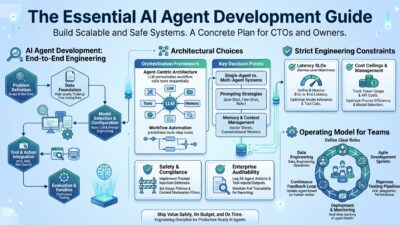
Build on a layered, swappable stack to avoid lock-in, manage cost/latency, and satisfy infosec.
- Interface: chat UI, IVR/telephony, in-product widgets; streaming for voice; accessible design; analytics hooks; feature flags.
- Reasoning: LLMs (GPT-4o/4.1, Claude 3.5, Llama 3.x); planning via ReAct, function-calling planners; robust system/safety prompting.
- Orchestration: LangChain, LlamaIndex, Semantic Kernel; Temporal or AWS Step Functions for long-running workflows; session state.
- Knowledge (RAG): doc cleanup, chunking, embeddings, vector DB (Pinecone, Weaviate, pgvector); metadata filters; freshness SLAs; governance.
- Tools: CRM, ticketing, ERP, billing, schedulers, email/SMS; parameterized DB I/O with strict RBAC and query guards.
- Memory: short-term buffers; long-term profile memory with PII controls, encryption, TTLs, consent flags.
- Guardrails: schema validation; policy evaluators; PII scrubbing; jailbreak and prompt-injection detectors; topic denylists.
- Evaluation + observability: OTel traces; dashboards for cost/latency/errors; model-graded evals; golden test sets; CI regressions.
- Deployment: container/serverless; real-time voice streaming and barge-in; canaries, staged cohorts, instant rollback.
- Anti-lock-in: abstraction interfaces for models/embeddings/vector stores/tools; capability routing; keep prompts/evals/schemas in-repo.
Implementation Blueprint for AI Agent Development: 8 Sprints From Prototype to Production
Run these sprints with acceptance criteria to compress time-to-value and reduce rework.
Sprint 0 — Strategy and PRD
Deliverables: problem statement, prioritized use-cases, NFRs, privacy model, KPIs, thresholds, go/no-go gates.
Acceptance: executive-approved PRD; data access approvals; sandbox credentials.
Sprint 1 — Data + RAG Foundations
Actions: source-of-truth inventory; cleanup; chunking; embeddings; vector store; retrieval eval set.
Acceptance: ≥90% doc coverage; retriever top-3 accuracy ≥80%.
Sprint 2 — Baseline Agent with Tooling
Actions: system prompt; tool schemas; function-calling; planner; error handling; rate limits/retries.
Acceptance: task success ≥50% on golden tasks; tool-call success ≥90%.
Sprint 3 — Guardrails and Safety
Actions: content filters, PII scrub, jailbreak tests; red-team; escalation rules.
Acceptance: unsafe output rate ≤1% on red-team; PII masked at egress.
Sprint 4 — Evaluation Harness and Telemetry
Actions: golden datasets; LLM-as-judge; human rubric; end-to-end tracing; cost/latency dashboards.
Acceptance: eval pipeline in CI; regression alerts to Slack/PagerDuty.
Sprint 5 — UX and HITL
Actions: conversation UX; confidence scoring; graceful handoff; feedback capture stored with trace IDs.
Acceptance: handoff median <= 20s; feedback loop queryable.
Sprint 6 — Pilot and Canary
Actions: cohort rollout; feature flags; A/B prompts/models; fallbacks; incident runbooks.
Acceptance: pilot KPIs within 10% of PRD; zero Sev-1 incidents in 2 weeks.
Sprint 7 — Scale and Optimize
Actions: caching; hybrid retrieval; cost controls; prompt compression; targeted fine-tuning.
Acceptance: P95 latency targets met; cost/interaction reduced ≥30% vs baseline.
Primary keywords: ai agent development, ai agent development guide
How to Build an AI Voice Agent Customers Actually Prefer
Voice has unique user expectations—treat it as a first-class product and aim for P95 turn-time of 1.2–1.5s.
- Channel choices: Telephony (PSTN/VoIP), in-app voice, smart speakers (only if real usage exists).
- Core pipeline + latency budget:
- VAD for quick start/stop; streaming ASR (Whisper v3, Deepgram, Azure).
- Real-time LLM with tools; plan partial responses.
- Streaming TTS (Azure Neural, ElevenLabs) with barge-in.
- Budget: ASR 250–350ms; LLM/tools 400–700ms; TTS 250–400ms; network 100–200ms.
- Dialog management: intent/slot extraction; confirmations on low confidence; mixed-initiative; personalization; interruption handling.
- Tooling examples: CRM lookup; order status/returns; scheduling; secure payment links; ticket creation with transcript.
- Production must-haves: noise robustness; abuse handling; accents/multilingual; sentiment; human escalation with full context transfer.
- Testing and evaluation: synthetic calls; LLM-as-judge; MOS for TTS; weekly error audits (ASR mis-hears, tool fails, escalations).
- Compliance in telephony: recording disclosures; PII redaction; retention/deletion by region.
Primary keywords: how to build an ai voice agent, ai agent development
Governance, Security, and Compliance by Design in AI Agent Development
Bake governance into day zero—or you’ll stall at security review.
- Data handling: minimization; field-level encryption/tokenization; RBAC/least privilege; region pinning; DPAs and subprocessor disclosures.
- Model safety: prompt compartmentalization; injection defenses; toxic content classifiers; policy evaluators I/O.
- Regulatory patterns: GDPR/CCPA rights flows; SOC 2 controls; HIPAA/PCI segmentation and tokenization.
- Operational safeguards: rate limiting; anomaly detection; circuit breakers; kill switches; version pinning; incident runbooks and chaos drills.
Primary keyword: ai agent development
Deploy, Observe, and Iterate: The MLOps Loop for AI Agent Development
- CI/CD for prompts and agents: prompts-as-code; tool/retriever tests; eval gates on PR; staged rollouts with feature flags.
- Observability: OTel spans for retrieval/model/tools; cost/latency by cohort; drift detection on embeddings and retrievers.
- Evaluation program: golden sets; LLM-as-judge plus human audits; target cards; periodic re-grounding and freshness policies.
- Optimization levers: model routing; context window management; tool schema refinement; hybrid search; fine-tuning vs prompt engineering based on ROI.
Primary keywords: ai agent development, ai agent development guide
Team, Budget, and Timeline CEOs Should Approve for AI Agent Development
Staff lean but cross-functional; fund to a real pilot (not a demo).
- Core roles: product owner; LLM/ML engineer; backend engineer; data engineer; prompt/conversation designer; QA/analyst; security/compliance; DevOps; CX lead.
- Pilot budget (3–4 months): talent $250k–$600k; infra/LLM $10k–$50k; eval/observability $5k–$25k; telephony usage-based.
- Timeline: 8 sprints → pilot in 8–12 weeks; production scale in 16–20 weeks.
- Vendor due diligence: SLAs, retention/residency, privacy terms; cost/burst ceilings; validated fallbacks. See how to choose an AI agent builder.
Templates, Checklists, and Acceptance Criteria for AI Agent Development
PRD template
- Business outcomes and use-cases; KPIs and thresholds; latency/availability targets; data sources/ownership; privacy/PII model; constraints/assumptions; governance/audit; go/no-go gates and mitigations.
Readiness checklist (before pilot)
- Data inventory complete; model/provider DPA; PII tokenization/encryption; retriever top-3 ≥80%; guardrails ≤1% unsafe; runbooks approved; HITL staffed.
Go-live gates
- Task success ≥ PRD; unsafe ≤ threshold; cost/interaction within budget; incident/rollback rehearsed; HITL coverage for peak/after-hours.
Post-launch cadence
- Weekly KPI/error review; monthly red-team/policy refresh; quarterly prompt/model refresh and doc re-grounding; quarterly vendor risk review.
Primary keyword: ai agent development
AI Agent Development Case Example: 35% Cost Reduction in 90 Days
Context and goals
65 FTE support team; Zendesk + Salesforce; after-hours backlog. Target: 50% containment of repetitive tickets; faster speed-to-lead; CSAT ≥ 4.5/5.
Solution overview
Deployed a RAG-grounded text agent + a Twilio-based voice agent with CRM personalization and order-status tooling.
Stack highlights
GPT-4o + Claude 3.5 with confidence routing; pgvector RAG on Postgres; tools to Zendesk/Salesforce/OMS; LangChain + Temporal; PII scrubbing and policy gates; OTel traces and evals.
Timeline and results
- Weeks 1–2: PRD + retrieval eval; top-3 accuracy 83%.
- Weeks 3–4: Baseline agent; tool-call success 94% (staging).
- Weeks 5–6: Guardrails + eval harness; unsafe 0.6%.
- Weeks 7–8: UX/HITL pilot; median handoff 14s; thumbs-up 72%.
- Weeks 9–12: 62% containment; AHT -28%; after-hours backlog cleared; voice P95 1.38s; barge-in 91%; cost/interaction -35%; speed-to-lead 46m → 7m; +12% conversion to meeting; CSAT 4.6/5.
Governance and ops
GDPR-consented recording; PII tokenized; kill switch tested; scheduled prompt refresh; 30-day doc freshness on returns rules.
CEO takeaway: Start with one high-volume, lower-risk domain; invest in retrieval, guardrails, evals; route models by confidence; maintain a standing HITL.
Primary keyword: ai agent development
Conclusion: Compound ROI With a Disciplined AI Agent Development Guide
Start narrow with a high-ROI use-case, follow the 8-sprint path, embed governance from day zero, and stand up evaluation and observability that improve outcomes weekly. Pair delivery with a content/SEO plan so your market can find, trust, and adopt what you ship.
Call to action
– Request an executive workshop to prioritize use-cases and define Sprint 0 PRD.
– Kick off a 10-week pilot with shared success thresholds.
– Download PRD/readiness checklists to accelerate alignment.
Primary keywords: ai agent development, ai agent development guide
Appendix: Executive Implementation Notes (Quick Reference)
- Primary KPIs: containment, tool-call success, P95 latency, CSAT, cost/interaction, incremental pipeline.
- Latency targets: chat ≤ 2.0s P95; voice 1.2–1.5s P95 per turn.
- Cost guardrails: budget ceilings per 1k interactions; automatic model downgrades on low-confidence after-hours tasks.
- Security: RBAC, tokenization, region pinning, DPAs, audit trails, incident runbooks.
- MLOps: prompts-as-code, golden sets, CI eval gates, feature flags, staged canaries, OTel traces, quarterly doc refresh.
FAQ
What is AI agent development in practical business terms?
It’s the end-to-end process of designing, building, securing, evaluating, and operating LLM-powered agents that plan and act via tools/APIs—measured against KPIs like containment, AHT, latency, and cost per interaction.
How do I choose the right LLM and avoid vendor lock-in?
Evaluate models on your golden tasks, latency SLAs, and unit economics; implement abstraction layers for models/embeddings/vector stores/tools; keep prompts, evals, and schemas in your own repo to enable fast swaps.
When should we fine-tune instead of relying on prompt engineering?
Start with strong prompts and RAG; fine-tune only when tasks are stable, error costs are clear, and volume is high enough that accuracy gains beat token costs—pilot LoRA or small supervised runs first.
What’s a realistic timeline to production?
Pilot in 8–12 weeks and scale in 16–20 weeks using the 8-sprint plan—see the AI agent development roadmap for milestones and gates.
What data do we need for a useful RAG agent?
Start with 50–200 high-value documents with clean metadata (version, product, locale) and freshness rules; measure retriever precision/recall and iterate chunking/filters before scaling.
How do we measure and reduce hallucination in production?
Track model-graded factuality on golden sets, human spot-checks, and guardrail violations per 1,000 turns; tie them to escalation and CSAT, and improve via better retrieval, schema validation, and policy gates.
How do we build a voice agent customers actually prefer?
Engineer for 1.2–1.5s P95 turn-time with streaming ASR/LLM/TTS and barge-in; add sentiment and confident escalation; follow the steps in “How to Build an AI Voice Agent Customers Actually Prefer.”
Summary
Bottom line: Fund a focused use-case, execute the 8-sprint blueprint, enforce governance from day zero, and run a tight MLOps loop. Ship small, observe deeply, and iterate weekly. The payoff: durable cost reductions, faster cycle times, higher conversion, and 24/7 customer coverage—without lock-in.